One good thing about the Dominican Republic is, that it has much more things to offer than just beaches and seasides. Especially waterfalls are scattered across the whole country. But what makes these waterfalls in the Dominican Republic especially interesting is that they are rather neglected from the local population. They prefer to spend their free time at the beaches than in the mountains where waterfalls can be found. Both attention and references on- and offline about them are rather low. It’s not easy to obtain information about these places. Best thing is to discover themself. And that’s what I did. I visited Salto de Yanigua – A rather secret waterfall in the Hato Mayor province.
I usually show maps of the location to show where to find my visited destination. This one is rather difficult to map – Because there are two ‘Salto de Yanigua’ on Google Maps.
So which one to chose? I checked the metadata from my taken photos to locate the GPS position. There’s nothing more reliable than that in terms of finding out where you are or were. Also Google Maps entries can be wrong – As you saw in this example with the double entry. So whom to trust?
Literally inside of the waterfall!
I recorded this video literally from the inside of the waterfall. You can’t be any closer than that. You can find Salto de Yanigua with the following GPS coordinates:
Latitude: 18° 58′ 18.864″ N
Longitude: 69° 26′ 29.568″ W
Did you know, that you can also search in Google Maps after GPS coordinates? If I use the ones from above, I’ll end up here:
The good news is, that the red dot on the map is with the coordinates 100% exact. The bad news is, that both entries from before are therefore wrong. Even the closer one in the middle with grey color is approximately 100 meters away from Salto de Yanigua.
Montaña Redonda is one of the most sold excursions in the Dominican Republic. With about 1.5 hours distance and a close proximity to Punta Cana, many full tourist buses arrive there and transport a lot of visitors to the top of the mountain.
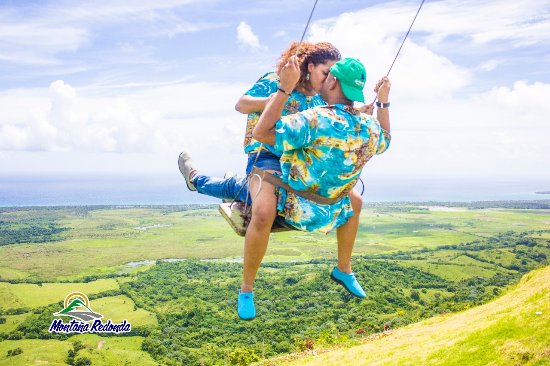
The name describes nothing more than a ’round mountain’. And it’s true! From there, you have a stunning 360° view to the adjacent valleys and can enjoy nature at it’s best. Thanks to the perfect sights, there are some funny and beautiful motives for photographers possible:
Definitely worth a visit, huh!? I thought the same and wanted to do the same excursion. But of course on my own initiative and not as part of an overpriced tourist bus from Punta Cana.
I visited this place on the same day directly after my trip to Laguna Redonda:
If you are familiar with tourism in the Dominican Republic and like to travel, you probably have heard already of Montaña Redonda. This is a famous tourism excursion on the top of a hilly area where you have a stunning 360 degrees with to the adjacent valleys. But have you ever heard about the little…
First thing to say is, that you definitely need a SUV or Jeep. Something really powerful, because the way to the top of the mountain is in extreme bad condition and very narrow.
This was after passing the entrance. And the surface got much worse than that!
The admission is with 200 Peso (4 USD) quite cheap. Guided tours from Punta Cana start at Trip Advisor from 70 USD. Wow!
I would recommend to go of course off-season (MAR – DEC) and avoid if possible the high season (JAN + FEB and Easter/Christmas holidays). You’ll have definitely a better experience alone without a ton of strangers. next to that, also the way is a bit safer. If a car or bus is coming down while you plan to drive up or vice versa, it can be extremely challenging to pass each other. Highly advanced driving skills are more than necessary and welcome!
Bad weather conditions at Montaña Redonda
During climbing up the round mountain with the jeep, the weather conditions got really bad. It started to rain and dense cloud band came from the Atlantic side to the island. Unfortunately, my experiences were a little bit different, when I arrived on top of the mountain:
We parked not at the parking space, but directly on top of the mountain. At least no one complained about that 🙂
Well…As you can see, there wasn’t any 360° view possible. I had literally a 0° view, because the clouds were all over the place. No idea, where the meteorological difference between a cloud and fog is. But it felt, that I had both of it.
I’m pretty sure, that it’s actually a nice place, ignoring the weather conditions.
The only shelter a visitor can find on top of the mountain is a little shack in the middle of the plateau.
No real shelter possible: The only shack on top of the mountain has, of course, no walls. Rain and wind entered from all sites and made me wet anyways.
It didn’t really matter anymore to look for cover or not. At the end, I was completely soaked of water anyway.
Let’s make the best out of Montaña Redonda!
So why not making the best of it and at least pretending having a good time? 🙂
Easier said than done, but I tried to have the same amount of fun and happiness as people during a clear day. For example with…
The hammock at Montaña Redonda
Could’ve been a wonderful photo without the water drop on the lens AND with a clear view!
How it actually looks like!
The broom at Montaña Redonda
Also this optical illusion didn’t really work out for me!
How it actually looks like!
The swing at Montaña Redonda
What a beautiful view…
How it actually looks!
Let’s make the best out of it and swing!
Never give up mentality!
Advertisements
Montaña Redonda is a beautiful tourism destination, I suppose…?!
Needless to say, that you barely can make the way back, because you don’t like it there anymore. So my girlfriend and me waited for two hours, hoping for a better view. And we got ALMOST rewarded for that patience. The sky brightened up for a little bit and offered a little view through the dense cloudscape…
There was a little hope for a few minutes – But I was waiting in vain for a better view
Please give me at least a bit of a clear view…
…but that was nothing more than just 5 short minutes. Well, at least we tried it! I think, that Montaña Redonda can be a really beautiful tourism destination with a little bit of luck!
Enough space and possibilities to enjoy the view!
A memorable experience at Montaña Redonda (the round mountain) in the Dominican Republic.
It was definitely an adventure to get up. But in the late afternoon and with the bad vision, rain and muddy surface it was a challenge to get down as well. I’m very glad, that nothing bad happened during the way down and that we arrived safe and secure. But there is one announcement I want to bring up to Montaña Redonda:
Santo Domingo Pop es un festival sobre … Bueno, la cultura pop, supongo. Para jóvenes, familias, con muchos colores, varias oportunidades para comer rico y muchos artistas dominicanos locales de literatura, música, teatro, danza y trabajo artesanal. La edición 2020 participó en el jardín botánico de Santo Domingo y fue el mejor festival de la ciudad que he visitado hasta ahora.
En un artículo anterior en mi blog describí que hay una falta en Santo Domingo con respecto al entretenimiento. Estos “problemas de entretenimiento” hacen que la vida en la capital de la República Dominicana no sea tan interesante como en muchas otras ciudades latinoamericanas.
La Poesía de la vida – Lema del festival Santo Domingo Pop 2020
Pero el festival Santo Domingo Pop es una gran excepción de esa regla. He visitado antes algunos otros festivales en la capital. Este fue, por mucho, el festival más hermoso, mejor organizado y agradable que he visitado en Santo Domingo.
Creo que puedes tener una buena impresión de todo el festival si miras la película posterior que creé:
¿Dónde está el festival Santo Domingo Pop?
En una zona bonita, el jardín botánico nacional. Donde hay suficiente espacio para descubrir cosas coloridas y extrañas durante todo el día.
El festival fue el sábado y domingo, 1 y 2 de febrero. Comenzó a las 3pm y la pasé muy bien allí.
Entrada del festival Santo Domingo Pop
Elegí ir allí el domingo por la tarde para evitar los tapones más grandes. Santo Domingo es una ciudad, donde siempre hay tránsito. Eso hace que sea bastante difícil de ir de A a B.Un taxi en UBER no cuesta más de 230 Pesos (4 USD) desde la zona colonial.
Pensé que con la admisión también tendría entrada al jardín botánico. Visité el jardín botánico antes y realmente me gustó el esfuerzo y la dedicación que pusieron en esta área. Es un lugar tranquilo y pacífico, tal vez debería escribir otro artículo sobre el jardin botanico algún día.
De todos modos: el festival se celebró en un área limitada muy cerca de la entrada principal. Solo desde mi perspectiva personal, debo decir que un poco de espiritu y libertad se perdieron cuando me di cuenta de que estaba atrapado entre vallas.
Advertisements
¿Cuánto cuesta Santo Domingo Pop?
Uff, no es muy barato. Llamémoslo así. Pero estos altos costos justifican y garantizan un buen festival. Haz clic y mira las imágenes a continuación para ver las diferentes entradas para Santo Domingo Pop:
Costos para la admisión al festival Santo Domingo Pop:
Adultos: 700 DOP (13 USD)
Niños: 300 DOP (5,50 USD)
Combo 1 – Dos adultos y un niño: 1.545 DOP (28.70 USD)
Combo 2 – Dos adultos y dos niños: 1.818 DOP (33.75 USD)
Combo 3 – Dos adultos y tres niños: 2.091 DOP (38.80 USD)
Combo 4 – Un adulto y tres niños: 1.455 DOP (27 USD)
Combo 5 – Cuatro adultos: 2.545 DOP (47.20 USD)
¿Qué comer en Santo Domingo Pop?
Como un viajero feliz con su comida especial, debo decir que había mucha variedad para el visitante. Por supuesto, no pude probarlo todo. Mi presupuesto financiero y calórico del día no me permitieron probar toda la excelente comida, snacks y postres. Pero aquí hay algunos de los mejores bocadillos que pude encontrar:
Empanadas de ‘La Empanadaria’ @ Santo Domingo Pop 2020 festival
Queso con empanada @ Santo Domingo Pop 2020
Wallys Burgers
¡Mi heladería favorita de la República Dominicana ‘Valentino’ se expandió y ahora también ofrece batidos!
Un sorbete sabroso y afrutado de Valentino @ Santo Domingo Pop 2020
Las resoluciones de mi año nuevo todavía están en progreso 🙂
Afortunadamente, puedo informar que definitivamente como menos carne que el año pasado. Por lo tanto, también probé la comida vegetariana que pude encontrar en Santo Domingo Pop.
Que hacer en el festival Santo Domingo Pop?
Como se puede imaginar, había muchísimas familias con niños. Por lo tanto, la mayoría de las actividades que podía realizar durante el festival se adaptaron a los intereses de la generación más joven.
Pero especialmente las áreas de picnic y relax estaban bellamente decoradas. Se dio suficiente espacio para que todos pudieran encontrar una mesa o una alfombra de picnic. Y afortunadamente, había suficiente somb. Habían 30 grados durante un domingo bastante caluroso.
Area bonita para hacer picnic @ Santo Domingo Pop 2020
Lo que realmente me gustó del festival Santo Domingo Pop 2020
Bien, ya no soy un niño. Tal vez algunas veces. Pero estas actividades para niños no eran lo que me interesaba.
Todo lo que tenía el toque artesanal y especial despertó mi interés. Pero lo que realmente me gustó del festival pop de Santo Domingo fue un stand innovador.
En mi opinion eso estaba el stand mejor: Atabey con sus guitarras recicladas
Estas personas de Atabey reciclan cosas y fabrican guitarras. No solo, que estas guitarras realmente funcionan, también tocaron algunas canciones con ellas. ¡Y no sonó para nada mal!
No estoy seguro, si estas guitarras también estaban a la venta, ¿pero supongo? Sin embargo, me hicieron pensar en estos vaqueros y hillbillies que tocan canciones country en sus banjos creados por ellos mismos. ¡La imaginación melancólica de la infancia se hizo realidad!
Advertisements
Lo que no me gustó del festival Santo Domingo Pop 2020
Lo que personalmente no me gustó fue la oportunidad perdida de salir del área del festival y volver a entrar. Desafortunadamente, no has tenido la oportunidad de volver a entrar una vez que dejaste el jardín botánico. Eso es algo raro, porque la mayoría de los festivales que he visitado te permiten volver a entrar.
Otra cosa que realmente no entendí fue la exposición del zoológico local. El “Parque Zoológico Nacional” de Santo Domingo vino a presentarse y despertar el interés de los visitantes. Por supuesto, un zoológico solo puede ser interesante y convincente, si muestran algunos animales. Y realmente hicieron eso, pero no de una manera agradable:
El zoológico de Santo Domingo también exhibió sus animales en el festival Santo Domingo Pop
Parque Zoológico Nacional
Erizo de tierra @ Santo Domingo Pop festival
Una culebra @ Santo Domingo Pop 2020
Un poco contradictorio: educar a los niños sobre la libertad de los animales y exponerlos en jaulas. Realmente no encajaba con el espíritu libre del festival.
Personalmente, no vi realmente el ajuste de toda esta colaboración. Primero, tu como visitante no puedes traer tus propias mascotas al festival. ¡Política estricta!
Pero, por otro lado, algunos animales salvajes se exhiben en jaulas, cajas o compuestos demasiado pequeños. Independientemente de decir, que estos animales salvajes se mantienen en el zoológico para simular su hábitat. Si bien esto es de todos modos un manejo inapropiado, se toman de su biosfera artificial con la que se familiarizaron durante años para mostrarse en un entorno mucho más pequeño.
El contacto más cercano con el visitante, los ruidos más fuertes, el impacto directo del sol y todo el transporte de los animales deben haberlos estresado. Todo esto realmente no encajaba con el mantra de los festivales de ser un festival de artes libres al aire libre, si los animales son capturados en jaulas.
¿Vale la pena ir al festival Santo Domingo Pop?
En mi opinión, definitivamente sí. El festival combina muchas actividades interesantes y se dirige a varios grupos objetivo. Ya sea que vengas con tus hijos para que se diviertan en la amplia área o quieras disfrutar bailando con amigos música electrónica durante uno de los muchos espectáculos, definitivamente vale la pena visitar Santo Pop Pop. La admisión parece un poco caro, pero calidad tiene su precio y se le prometerá al visitante un festival realmente bien organizado.
Santo Domingo Pop 2020 festival
Un gran gracias a Karol Medina Díaz de Tres Media que me ayudaba con la admisión al festival!
Santo Domingo Pop is a festival about…Well, the pop culture I suppose. Young, for families, colorful, lots of opportunities to have a bite and many local Dominican artists of literature, music, theater, dance and artesian work. The 2020 edition took part in the botanic garden of Santo Domingo and was by far the best festival of the city I attended so far.
La Poesía de la vida – Lema del festival Santo Domingo Pop 2020
In a former article on my blog I described, that there is a lack in Santo Domingo regarding entertainment. These so called ‘entertainment problems’ make the life in the capital of the Dominican Republic not as interesting as in many other Latin-American cities.
The official newspaper from the Santo Domingo Pop 2020 festival came on recycling paper – Good idea!
But the Santo Domingo Pop festival is a great exception. I’ve visited before some other festivals. This was by far the most beautiful, best organized and pleasant festival I’ve been in Santo Domingo.
Where is the Santo Domingo Pop festival?
In a beautiful area – the national botanic garden – there is enough space to discover the colorful and odd things throughout the whole day.
The festival was held Saturday and Sunday, February 1 and 2. It started at 3pm and I had a really great time there.
Selfie time!
I chose to go there on the Sunday afternoon to avoid the biggest traffic jams. Santo Domingo is a city, where there is always traffic. That makes it quite difficult to get from A to B. A taxi by UBER cost not more than 230 Pesos (4 USD)
First I thought, that I would have with the admission as well entrance to the botanic garden. I visited the botanic garden and really liked the effort and dedication they put into this area. It’s a quiet and peaceful place, maybe I should write another article about it one day.
I think, that you can get a good impression of the whole festival, if you watch the after movie which I created:
Anyway: The festival was held in a fenced area very close to the main entrance. Just from my personal perspective, I need to say, that a little flair and freedom got lost when you realized that you are captured between fences.
Building a fence behind a fence? Good idea!
Too many fences and borders at the festival
Advertisements
How much does Santo Domingo Pop costs?
Uff, it’s not too cheap. Let’s call it like that. But these high costs justify a good festival. Click and check the images below to see the different tickets for Santo Domingo Pop:
Adults – 700 Pesos
(Santo Domingo Pop tickets)
Children – 300 Pesos
(Santo Domingo Pop tickets)
Family Combo 3 – 1.545 Pesos
(Santo Domingo Pop tickets)
Family Combo 2 – 1.818 Pesos
(Santo Domingo Pop tickets)
Family Combo 3 – 2.091 Pesos
(Santo Domingo Pop tickets)
Combo 1 – 1.455 Pesos
(Santo Domingo Pop tickets)
Combo 2 – 2.545 Pesos
(Santo Domingo Pop tickets)
Costs for the admission to the Santo Domingo Pop festival:
Adults: 700 DOP (13 USD)
Children: 300 DOP (5,50 USD)
Combo 1 – Two adults and one child: 1.545 DOP (28.70 USD)
Combo 2 – Two adults and two children: 1.818 DOP (33.75 USD)
Combo 3 – Two adults and three children: 2.091 DOP (38.80 USD)
Combo 4 – One adult and three children: 1.455 DOP (27 USD)
Combo 5 – Four adults: 2.545 DOP (47.20 USD)
What to eat at Santo Domingo Pop?
As a happy food traveler, I must say that there was a lot of variety for the visitor. Of course I couldn’t try it all. My financial and caloric budget per day didn’t allow me to taste all of the great food, snacks and desert. But here are a few of the best munchies I could find:
Empanadas from ‘La Empanadaria’ @ Santo Domingo Pop 2020 festival
A cheesy empanada @ Santo Domingo Pop 2020
Wallys Burgers
My favorite Dominican ice cream dealer ‘Valentino’ expanded and now offers also Shakes!
A tasty and fruity sorbet from Valentino @ Santo Domingo Pop 2020
My new years resolutions are still in progress 🙂 Luckily I can report that I eat definitely less meat than last year. Hence I also tried the vegetarian food I could find at Santo Domingo Pop.
What to do at the Santo Domingo Pop festival
As you can imagine, there were a loooooot of families with children. Hence, the most of the activities you could do during the festival was adapted to the interests of the youngest generation.
Kids Zone at the Santo Domingo Pop festival 2020
Pumping up some clown baloons @ Santo Domingo Pop 2020
Santo Domingo Pop 2020, Chill Area
But especially the picnic and chill areas were beautifully decorated. Enough space was given for everyone to find a table or picnic rug. And luckily, there was enough shade to find. It was with 30 degrees Celsius quite a hot Sunday.
Beautiful arranged picknick area @ Santo Domingo Pop 2020
What I really liked about the Santo Domingo Pop 2020 festival
Okay, I’m not a child anymore. Maybe sometimes. But these activities for children were not what I was deeply interested in.
Everything that had the artesian and handcrafted touch gathered my interest. But what I really liked about the Santo Domingo Pop festival was especially one booth.
One of my favorite exhibitions: Recycled guitars
These people from Atabey recycle things and fabricate guitars. Not only, that these guitars actually work, they also played some songs with them. And it sounded not too bad!
Not sure, if these guitars were also for sale, but I suppose?! Nevertheless, they made me think about these cowboys and hillbillies who play country songs on their self created banjos. Melancholic childhood imaginations came true!
What I didn’t like about the Santo Domingo Pop2020 festival
Advertisements
What I personally didn’t really like was the missing opportunity to exit the festival area and get back in. Unfortunately, you haven’t had any chance to reenter, once you left the botanic garden. That’s something unusual, because the majority of festivals I’ve visited allow you to reenter again.
Another thing I really didn’t comprehend was the exhibition of the local zoo. The ‘Parque Zoologico Nacional’ of Santo Domingo came to present themselves and gather some interest from the visitors. Of course a zoo can only be interesting and convincing, if they show some animals. And they really did that, but not in a pleasant manner:
The local zoo of Santo Domingo also exhibited their animals at the Santo Domingo Pop festival
Parque Zoológico Nacional (The national zoo) hat a booth at Santo Domingo Pop as well and brought some animals
Erizo de tierra @ Santo Domingo Pop festival
A snake @ Santo Domingo Pop 2020 from the local zoo
A little contradictory: Education children about the freedom of the animals and exhibiting them in cages. Didn’t really fit the free spirit of the festival.
I personally didn’t really see the fit of this whole collaboration. First, you as a visitor are not allowed to bring your own pets to the festival. Strict guideline policy!
But on the other hand, some wild animals are exhibited in far too little cages, boxes or compounds. Regardless to say, that these wild animals are held in the zoo to simulate their habitat. While this is anyway an inappropriate handling, they are taken from their artificial biosphere they got familiar with over years to be shown in a far smaller environment.
Closer contact to the visitor, louder noises, direct impact of the sun and the whole transportation of the animals must’ve stressed them out. This all didn’t really fit to the festivals mantra to be a festival of free arts at the fresh air, if animals are captured in cages.
Is it worth visiting Santo Domingo Pop 2020?
In my opinion, definitely yes. The festival combines a lot of interesting activities and addresses several target groups. Whether you come with your children to let them have fun in the ample area or want to enjoy dancing with friends electronic music during one of the many show acts – Santo Domingo Pop is definitely worth a visit. A little pricy, but a really well-organized festival will be promised the visitor.
Die Dominikanische Republik ist ein bezauberndes Urlaubsziel in der Karibik. Viele Urlaube beginnen in der Dominikanischen Hauptstadt Santo Domingo. Die berühmte koloniale Altstadt heißt mit einem historischen Flair ihre Besucher willkommen. Wie ist es, dort zu wohnen? Geht das überhaupt? Ja klar – In Santo Domingo zu leben ist wahrlich eine prägende Erfahrung. Und es gibt darüber hinaus auch 5 gute Gründe nach Santo Domingo auszuwandern.
Kann man als Ausländer in der Hauptstadt der Dominikanischen Republik gut leben?
Welche Gründe gibt es, in Santo Domingo zu wohnen?
Warum sollte man vielleicht doch eher andere Städte in Lateinamerika bevorzugen?
Wie ist das Leben in Santo Domingo, wenn man auswandert?
Lies in diesem Artikel, was das tägliche Leben in der ältesten Stadt auf dem amerikanischen Kontinent wirklich für einen Expat bedeutet. Und ob es für Dich ebenfalls in Frage kommen kann. Oder Du vielleicht eine andere Stadt bevorzugen solltest. Ich beantworte alle diese Fragen.
Ungefähre Lesezeit: 20 Minuten
Would you like to read this article in another language?
Ich glaube, dass es der richtige Moment ist, um Santo Domingo als würdigen Lebensmittelpunkt für Auswanderer und Interessenten zu prüfen. Falls Du nach Vorteilen über das Leben in Santo Domingo nachforschst, wirst Du in diesem Artikel die Antworten dazu finden.
Insgesamt wohnte ich knapp 2 Jahre in Santo Domingo. Und ich denke, dass ich ein paar wertvolle Eindrücke über das tägliche Leben in der Dominikanischen Hauptstadt aus der Perspektive eines Auswanderers gewinnen konnte. Und ich freue mich, wenn ich mit Dir diese Eindrücke teilen kann!
Das ist nun schon bereits das dritte Kapitel in dieser Kategorie. Ich habe bereits zuvor in Quito (Equador) und Lima (Peru) gelebt und ähnliche authentische Erfahrungsberichte über das Leben als Auswanderer in den lateinamerikanischen Hauptstädten verfasst. Falls Dich diese Quervergleiche auch interessieren, schau Dir meine Artikel (in englischer Sprache) an.
Das gleiche Konzept möchte ich nun über Santo Domingo realisieren und einen ähnlichen Ratgeber verfassen. Diesmal sogar noch ausführlicher.
Meine Informationen sind weder von anderen Seiten inspiriert, noch kopiert worden. Alle von mir genannten Argumente basieren – so sie denn nicht gesondert gekennzeichnet wurden – aus meiner eigenen Erfahrung und die Photos und Videos sind mein eigenes Copyright. Du wirst den Inhalt dieses Erfahrungsberichtes auf keiner anderen Seite finden können. Ich habe diesen Artikel aus meinen eigenen Beobachtungen und Erlebnissen niedergeschrieben.
Ich war sogar sehr überrascht, dass sich bisher kein anderer Blogger dieses Thema rund um den Ratgeber für Auswanderer in Santo Domingo gründlich behandelt hat. Santo Domingo ist eine große und internationale Stadt, in der sehr viele Auswanderer wohnen.
Plaza Maria de Toledo in der historischen Altstadt von Santo Domingo
Aber ich konnte keine vergleichbaren Artikel über diese Informationen finden aus der Sicht eines Auswanderers finden. Daher möchte ich gerne diese kleine Marktlücke mit einem qualitativ hochwertigen Beitrag schließen. Hoffentlich findest Du in diesem Artikel, was Du gesucht hast und kannst Dir Deine Meinung bilden, ob sich Santo Domingo in der Dominikanischen Republik als Ort zum Auswandern eignet oder nicht.
The Dominican Republic is a magnificent tourism destination in the Caribbean. Many holidays begin in the capital of Santo Domingo and its Colonial Zone to welcome the visitor with a historical flair. But what about life in Santo Domingo? What are good reasons to move and live there? How is life in Santo Domingo for an expat? I lived an expat life in the biggest city in the Caribbean for 1.5 years and would like to help you with 5 good reasons to live in Santo Domingo. I’m sure that you’ll find all the answers you’re looking for.
Approximate reading time: 20 minutes
Read in this article, what life in the oldest city on the American continent really means for a foreigner. And if you should consider to move to Santo Domingo or to rather look for a different city.
Would you like to read this article in another language?
I think, that it’s a good moment to analyze Santo Domingo as a valuable residence destination for expats and foreigners. Whether you are looking for good reasons to live in Santo Domingo, you will find them in this article. I could obtain some valuable insider knowledge from the perspective of an expat, because I lived there as well. And I am gladly sharing them with you!
Some years ago. I lived in Lima, Quito and Asunción. All these experiences in other Latin American capital cities helped me to analyze and assess Santo Domingo.
The 5 good reasons to live in Santo Domingo don’t come from researching other websites. I am creating the content of my own experiences and all photos I share are my own copyright. You won’t find this content elsewhere, if it was not linked or copied from. It’s nothing less than made by own observations and opinions about what’s good and bad about Santo Domingo.
I was quite surprised, that so far no other expat blogger treated this topic on whether living or not living in Santo Domingo in a thorough manner. It’s a quite big and international city and many expats lived here.
Plaza Maria de Toledo in the Colonial Zone
But I couldn’t find any comparable article by giving this information from the inside to interested readers who look for this kind of expat information. I hope, that I’ll fulfill your purpose and deliver some valuable insights from the life in the capital of the DR.
Alright then, hope you enjoy my article and will find what you were (re)searching for!
If you are familiar with tourism in the Dominican Republic and like to travel, you probably have heard already of Montaña Redonda. This is a famous tourism excursion on the top of a hilly area where you have a stunning 360 degrees with to the adjacent valleys. But have you ever heard about the little neighbor Laguna Redonda?
Where is Laguna Redonda?
Laguna Redonda can be found in the northeast of the Dominican Republic. It’s part of the district El Seibo and in a rather scarce populated area of the country.
As you can see on Google Maps, it is quite close to Montaña Redonda and shares even the same name. Both are ‘redonda’ which means ’round’ in Spanish. Okay, if I see it on Google Maps, it might not be perfectly round but I think that you get the idea what I mean.
Laguna Redonda filmed from the top of the hill.
Advertisements
What is Laguna Redonda?
Laguna Redonda is one of the many aquatic and hidden places in the Dominican Republic. The country is rich of lagoons that create habitat for both flora and fauna. Laguna Redonda has an extension of 1.93 mi² (5 km2) and consists of salt water. It’s connected with the near sea through Caño Celedonio.
View from the shoreside
Laguna Redonda has been a livelihood for hundreds of poor families who fish with rustic instruments to survive in this place of just a few opportunities. Some species of fauna that can be observed in the lagoon are: crabs, tilapia, bass, shrimp and guabinas.
Fisher boats at Laguna Redonda
Nice scenery for taking pictures
These fisher boat give the landscape a beautiful touch
Lagoons in the Dominican Republic are a pure paradise for bird watchers. The birdlife around Laguna Redonda is also rich and is represented by Pied-billed grebe (Podilymbus podiceps), the common moorhen (Gallinula chloropus), great egret(Ardea alba), black-crowned night heron (Nycticorax nycticorax), roseate spoonbill (Platalea ajaja), northern pintail (Anas acuta).
This sign welcomes you with additional information about Laguna Redonda
Unfortunately I haven’t had sufficient time and boats to discover the whole lagoon. But what I saw from the shore was kind of beautiful already.
Advertisements
How to reach Laguna Redonda?
Laguna Redonda is not touristically developed and accessed. Meaning, that you need to invest a high effort to reach it. But it’s worth it if you want to have an individual and exclusive feeling.
Usually, tourism destinations and excursions in the Dominican Republic are completely overrun. This one’s not. I had the luck to be there on my own. If we zoom a bit out at Google Maps, we can see, that there is only one single pathway to reach Laguna Redonda:
Only one pathway from the south leads to Laguna Redonda
The Atlantic is in the the north and there are no connections both from east and west towards the lagoon. This makes it a bit more difficult to reach.
Here is how you get there: On the highway 104 (RD-104 Carretera Bávaro) you see a quite an unremarkable green traffic sign with ‘Laguna Redonda’ on it. It’s probably around 1.5 miles (2,5 km) away from the entrance to Montaña Redonda. Just continue driving for about 10 – 12 minutes and you’ll reach Laguna Redonda.
That’s the official part you would guess by planning it from the outside. But I was beneath the surface and can tell you, that you should park the car approximately where you can see the little white square on the screenshot. Why?
Advertisements
Is it easy to access Laguna Redonda?
It’s better to walk the rest of the route to the lagoon. Shouldn’t be more than 1/2 or a 3/4 mile from the marked checkpoint. You should see a gate:
Takes probably 5 -7 minutes walking time from here until you reach Laguna Redonda.
The road conditions are not stable enough and look the following:
Muddy conditions on the way to Laguna Redonda
You better not wear sandals, flip flops, etc. and rely on sturdy shoes. That’s what I can recommend, because I wore flip flops and looked more than dirty after reaching the lagoon 🙂
But on dry days without rain it won’t be easier either. Here is how the path looks like:
Beautiful landscape around Laguna Redonda
To be 100% sure to reach Laguna Redonda safe and to not get stuck in the muddy terrain, you should only access it with a jeep or a SUV. Everything that has a 4×4 engine is the only secure car to go there.
Of course you could as well motorbikes, quads, etc. These vehicles would be even more suitable to enter the difficult terrain. But once you reached Laguna Redonda, it’ll be more than worth it!
Laguna Redonda is a saltwater lagoon in the northeast of the Dominican Republic.
Advertisements
Why is the water at Laguna Redonda green?
That’s a good question, isn’t it? If you took a closer look to the videos and photos above, you’ll see a green shimmer at the water surface.
Green water at Laguna Redonda in the Dominican Republic
The reason for the green water are the mangroves and the rotten leaves from the surrounding trees. In combination with the very salty water, this rare effect of green water is produced. It corrodes at the bottom of the water surface. There are no rocks or stones that could wash the water and make it a little more clear.
That’s why the water at Laguna Redonda shimmers in a light green hue.
I have seen a lot of green water places like stagnant ponds, natural pools or puddles. Mostly, because they are not moving waters. But this was the first time, that I saw a moving water with this green hue.
The water at Laguna Redonda is surprisingly green.
I decided to not swim there, rather enjoy a few silent minutes at the shore and observed the little fisher boat before I continued the trip to Montaña Redonda.
Laguna Redonda is one of these many hidden destinations in the Dominican Republic that are barely known and communicated. Few information are available of it and you have to search for places like that. But once you discovered one of these places, you can be sure to be the only person there.
Are you looking for some real inspiration for your next big travel adventure? A tropical paradise in a coconut shell? Never considered traveling to the most beautiful and diverse destination of the Caribbean? Maybe the Dominican Republic? I would love to inspire with 10 insider facts of the Dominican Republic for individual travelers.
If you answer at least one of these questions with a “Yes”, you are eligible to become an individual traveler in the Dominican Republic. As you can imagine, I wouldn’t write this article, if I couldn’t present some reasons to emphasize, that the biggest country in the Caribbean has at the same time plenty of opportunities and hidden gems to visit as an individual tourist.
During Canyoning – An offroad excursion at “Cola de Pato”
The Dominican Republic is the most visited destination in the Caribbean. Yet it has much more to offer than the usual and expectable things. Naming a few…
Big holiday resorts
All-Inclusive-vacations in Punta Cana
Palms along endless beaches
These are standardized imaginations. Probably these are the imaginations most people expect when it comes to this country.
The Dominican Republic is a paradise for individual tourism
What most people don’t know is the versatility of the Dominican Republic. And that it can satisfy the needs of every ambitious traveler type.
Well, let’s say almost every travel type. Winter sports might be a little difficult to realize because of warm and sunny conditions for all year round. For this reason, the climate of the Dominican Republic is also known as an “endless summer.”
But an endless summer in the Caribbean is probably what you already expected. Rather let us focus on some thrilling and unique features of the Dominican Republic which inspire you to travel instantly.
Did you know, that the Dominican Republic…
was discovered during Columbus first expedition?
is also home of the oldest (capital) city of the entire American continent?
has the highest mountain (10,164 feet – 3.098 m) of the Caribbean?
These are only a few of the triggering facts to create curiosity. Yet, the Dominican Republic has much more to offer.
Read in this article 10 characteristics about the Dominican Republic that might surprise you to create wanderlust and see it with your own eyes.
Advertisements
1
Columbus landed here in 1492
Christopher Columbus landed during his first voyage first on the Bahamas and later on Hispaniola Island on December 5, 1492. In 1493, the colony of La Isabela was built on the northeast coast on Columbus’ second trip. Even though the Republic itself was founded as a sovereign state much later, Columbus landed on today’s Dominican territory.
Columbus’ Landing in the Dominican Republic
La Isabela was depopulated by 1500 due to a hurricane. Furthermore, the discovery of gold one year earlier in 1499 in the interior of the country made people flee to follow the gold rush. But the footsteps of Christopher Columbus are still present. And even 525 years later, the site of La Isabela can be visited. There are still some relics of the very first European settlement in the Americas.
On the first glance the ruins of Isabella might appear a little disappointing to the visitor. Before 1986, almost no one was taking care of that place. Unfortunately, a lot of construction material was cleared up by bulldozers in 1952 because of presidential order of the dictator Trujillo. Only the foundation grounds and the reconstructed House of Christopher Columbus are nowadays visible at the excavations of La Isabela.
At second appearance, you can find with a little bit more patience and an informative tour guide a lot of interesting information about the place. Very impressive are the excavations of La Isabela and the items the people from back then were using. They can be seen in the museum. Even recollections from the old Taino people could be found during the excavations. This first European colony was on a very developed state-of-the-art back then, Spanish style.
La Isabela is perfect for a half day trip. And for everyone who would like to follow Columbus’ path seeing the oldest buildings of the first European settlers. Travelers who love to see historical facts with their own eyes will love the colony of La Isabela.
Columbus’ house in La Isabela
Columus’ Landing in La Isabela
Monument and flag of the Dominican Republic in La Isabela
Cemetery in La Isabela (Dominican Republic)
⏳ How much time should I spend here? Not more than 2 – 3 hours
📅 Recommended visit: All year season (Better in the morning hours before it starts to get hot – There is no shade)
💰 Costs: Affordable
Admission per person 200 Pesos <-> 3.50 – 4 USD.
Spanish speaking local tour guide not more than 500 Pesos <-> 8 – 9 USD)
✅ Suitable for: History lovers, archaeologists
Advertisements
2
Santo Domingo is the first capital city on the American continent
The colony of Santo Domingo became the first permanent European settlement in the Americas. Consecutive upon that, Santo Domingo is the oldest city in the new world. Also at the same time, it is the first capital city, the first place of a Catholic cathedral out of Europe, and has the first university and hospital in Latin America. You can breathe in centuries-old history in the Dominican Republic.
Die koloniale Altstadt von Santo Domingo
Iglesia de Nuestra Señora del Carmen
Santo Domingo is the oldest city on the American continent.
Some of the original buildings have been restored and can be visited in the charming Colonial City of Santo Domingo. For this reason, a visit to the Dominican Republic should always include a few days Santo Domingo and the Colonial Zone with its picturesque and dainty flair which is worth to discover. Additionally, it attracts yearly thousands of visitors for its festivals. Check out the festival schedule – Maybe you can join the local Carnival, Barbarella and Merengue festivals.
Don’t worry too much about not being safe in the Colonial Zone. This neighborhood is one of the most protected areas in Santo Domingo. Next to that, this part of the city is one of the cleanest – Although it might not seem as it is from the perspective of a visitor from a first world country. But compared to many other neighborhoods, the Colonial Zone is in a quite good and clean condition.
To round up your experience in the oldest city of the American continent, I would like to recommend you to visit two more places which are easy to reach from the Colonial Zone. You’ll need a vehicle though, but would be able to get to the destinations in less than 20 minutes driving time.
Columbus Lighthouse (‘Faro El Colon’) – A mausoleum monument, that contains the remains of Christoph Columbus.
The three Eyes (‘Parque Los Tres Ojos’) – An open-air limestone cave with three lagoons. Check also this dedicated article.
Columbus’ Lighthouse
Parque Los Tres Ojos
Santo Domingo is perfect to start your vacation as an individual traveler in the Dominican Republic. Urban lifestyle and city travelers will love the metropolitan part of the country.
⏳ How much time should I spend here? Not more than 2 nights
📅 Recommended visit: All year season
💰Costs: Affordable
Discovering the Colonial Zone is of course free. But with a local tour guide much more informative and worth it. Should be available between 25 – 35 USD.
Admission for Columbus’ Lighthouse is 200 Pesos <-> 3.50 – 4 USD
Entrance for “The three eyes” is 250 Pesos <-> 4.50 – 5 USD
✅ Suitable for: Urban travelers, history lovers
Advertisements
3
The highest peak of the Caribbean
Contrary to sandy and pristine beaches, the Dominican Republic has the highest mountain of all Caribbean islands. ‘Pico Duarte’ is 10,164 feet (3.098 m) high and was named in appreciation of Juan Pablo Duarte, one of the Dominican Republics’ founding fathers.
The mountainous area offers challenging ascents for hikers. Its peak welcomes yearly approximately 3,000 climbers who like to experience its incredible beauty. That’s less than 10 people every day! As a result of this a real insider tip for everyone who likes to discover nature and be all alone on top of a mountain. And who can claim to have made it to the highest point of a geographic area? If you consider visiting the Dominican Republic, you hopefully have now an additional motivation to hike to Pico Duarte and be on top of the Caribbean!
There are several routes with varying difficulty levels from Jarabacoa that lead to Pico Duarte. Depending on your physical condition, you know which routes and which difficult level are best for you. Only experienced ascensionists should consider to do it alone without a tour guide. It’s recommended to climb up the mountain accompanied by pack animals and tour guides with a good knowledge of the area.
Another little recommendation to maximize your individual experience would be to visit it off the high season. You know now, that approximately 3,000 travelers approach Pico Duarte yearly. But almost the half does it only in January and during the Easter holidays! Try to avoid these peak times and reach the peak of the mountain for the rest of the year.
Pico Duarte is the ideal assignment for mountaineers, adventurers and everyone who seeks for an individual challenge.
⏳ How much time should I spend here? You should expect 4 days for the standard route. Starting ideally from Jarabacoa in the mountains.
📅 Recommended visit: NOT during January and Easter. Evade the peak times and go in low season
Conversely to everything that was written before about the highest peak of the Caribbean, the Dominican Republic possesses the exact geographic opposite.
Located in the southwestern region of the country, Lake Enriquillo is the largest lake and the lowest elevation in the whole Caribbean. It covers an area of 145 square miles and the lake level is approximately 140 feet below sea level. Although it can appear seasonable as hypersaline, Enriquillo Lake offers habitat conditions to the largest population of American crocodiles (Crocodylus acutus) in the Caribbean.
Lago Enriquillo in the southwestern part of the Dominican Republic
Very unusual as well as the flooding trend: Since 2004 the lake has grown by almost 130% due to increased rainfall and reduced evaporation caused by milder temperatures. This, on the other hand, helps some endangered species who are living in the lake to keep their habitat protected.
Have you ever seen wild flamingos in their natural habitat? At Lake Enriquillo, you’ll have the chance to! You’re a bird watching expert and need some elaborated challenges? As a hint, you should remain patient and wait for the reason number 8 for individual tourism in the Dominican Republic.
If you’re not interested in birds at all, you can also find an endemic iguana species at Lago Enriquillo. The Rhinoceros Iguana (Cyclura cornuta) has its habitat there and welcomes you with its majestic appearance. Insiders’ tip: Bring some fresh fruits and feed them, they love cherries!
Lake Enriquillo is a very suitable destination for wildlife watching and nature exploration. And everyone who wants to see pink flamingos needs to see Lago Enriquillo.
Now to a very magic characteristic of the Dominican Republic that became over the last years more and more a viral trend. Close to Barahona in the southwestern part of the country, a tiny town called Polo can be found. Here you have one of the few opportunities in the world to trick scientific laws and challenge gravity at the Magnetic Pole (El Polo Magnético).
If you are going to stop your car in neutral gear in the downhill section, your car will roll up! You don’t believe it? Please drive to Polo and check out the gravity hill. Your car rolling up is caused by an optical illusion due to the condition of the road and the landscape itself. Still, a nice and unique experience. Don’t forget to take enough convincing photos or even illusory videos as a memory. Most importantly: No entrance fees are charged and you can discover it for free! For this purpose, it might be a good idea to include the magnetic pole into your road trip.
Apart from that, there is not much to see and do in Polo. But you can use this stop in your road trip as a nice stopover to continue to the unknown southwest of the country.
The Polo Magnético is ideal for everyone who wants a self-drive tour across the Dominican Republic. And for those who want to trick laws of nature.
⏳ How much time should I spend here? 30 minutes
📅 Recommended time: All year season
💰Costs: Free of charge
✅ Suitable for: Nerds, You-Tubers
Advertisements
6
You will be able to play presidential Golf at ‘Teeth of a dog’
Did you know, that even former US-presidents are coming to the island to play golf? Furthermore, the Dominican Republic ranks with more than 30 beautiful golf courses among the best golf destinations in Latin America. Swing and no miss in the Dominican Republic! Most were designed by famous designers like Jack Nicklaus, Robert Trent, Bobby Jones, Nick Faldo and Peter Dye.
The ‘Teeth of the Dog’ course is the most prestigious Golf course in the Dominican Republic. Feel welcome to spend unforgettable golf holidays in the Caribbean. Nine of the Dominican golf courses are mentioned amongst the “Top 50” in the listing of the magazine Golfweek. Many sports champions, enthusiasts and celebrities from around the world came to the Dominican Republic to play Golf. To emphasize some of them: Former U.S. Presidents Bill Clinton and George H.W. Bush came to play at the Dominican designer golf courses.
Teeth of the Dog golf course is for everyone who would like to bring his or her own pair of clubs. And for those who prefer having a luxury holiday in a Caribbean destination.
⏳ How much time should I spend here? Depends on your budget
📅 Recommended visit: All year season
💰Costs: Expensive
✅ Suitable for: Golfers
Advertisements
7
Merengue has its cultural origin in the Dominican Republic
Sugar, coffee, and tobacco are the most important economic export products of the Dominican Republic. But it’s the typical Merengue music and dances who made the country internationally popular and famous in cultural aspects.
Fast-paced rhythmic music from hand-made instruments in combination with close and graceful dancing moves – nowhere else can the Dominican lifestyle be better observed as during the evenings when the Merengue music is played. The good thing is, that you will find it everywhere in the whole country. Merengue is not only the music and not only the dance, it is a cultural Dominican expression!
In July and August there are several Merengue festivals in Santo Domingo that wait to be discovered from you. They take place around the Malecón and the music beats keep pumping all night. A very special insiders’ tip is the visit of the restaurant ‘El Conuco’. It is one of the most typical Dominican restaurants of the city with traditional decoration, staff in folkloric clothing and typical Dominican dishes. I haven’t seen before anyone dancing as wild but controlled as these two people ON a bottle of rum. Yes, ON a bottle, not with a bottle!
‘Festival de Merengue’ is for cultural explorers, active dancers and such who want to move their hips to Caribbean music.
⏳ How much time should I spend here? One day
📅 Recommended visit: Takes place usually late July – early August
💰Costs: Free of charge
✅ Suitable for: Cultural interested people, dancers
Advertisements
8
Most bird species of the Caribbean have their habitat in the Dominican Republic
You remember the little hint I gave the bird watching experts in chapter 4? Now your time has come to discover why!
Bird watchers have been considered lately with a decent interest from travel destinations. Hence, the Dominican Republic is a pure paradise for bird watchers. Especially Los Haitises National Park, Sierra de Bahoruco and Cordillera Septentrional offer stunning opportunities to observe the winging Dominican wildlife. Amongst tropical trees and many other animals, some threatened, endangered and even endemic species can be seen. Under those circumstances, the Dominican Republic is a pure paradise for ornithologists.
Bird watching in the Dominican Republic
Flamingos at Laguna Oviedo
The diversity of bird species in the Dominican Republic is a consequence of Hispaniola’s complex geologic history with various microclimatic zones. In the Caribbean, the island is geographically the most diverse and enables the habitat conditions. As a result, it offers a habitat for 320 birds whereof 32 are endemic bird species.
And the Dominican birds are worth to glass. You should observe them with your own eyes – or your own field glasses. The unknown southwest offers many opportunities for bird watchers and such who want to become it.
📅 Recommended visit: All year season
💰Costs: Expensive
✅ Suitable for: Nature lovers, bird watchers
Advertisements
9
Neither 99% of the local population nor Trip Advisor know the highest waterfall of the Caribbean
Whenever it comes to really secret insider tips, the following Dominican destination shouldn’t be missed in any anecdotes. Totally disregarded by all guide books and excursions in the country, there is one of these secret insider tips. A waterfall with a single-drop of 390 feet (119 m) can be found in the middle of a green area.
We’re talking about the waterfall ‘Salto de La Jalda’. Truly a travel destination, which is unknown to most of the locals and not even listed on Trip Advisor. A trip to this secret waterfall will take you about 4.5 hours by foot or 2.5 hours on horseback. Don’t forget to pack your swimsuit before you go. Chilled water will refresh your mind once you arrive there.
As it can be still considered as an absolute hidden gem, you shouldn’t hesitate too long to go there. See it with your own eyes, before standardized package tour operators will bring thousands of tourists here. Furthermore, this stunning beauty is beside its long hike easy to reach. In detail, it’s just 1.5 hours distance away from Punta Cana and 2 hours from Santo Domingo. For this reason, it would be the ideal destination for an adventurous day trip.
The top-secret waterfall Salto de La Jalda is perfect for explorers, nature lovers and adventurous travel pioneers.
⏳ How much time should I spend here? 1 full day
📅 Recommended visit: All year season
💰 Costs: Moderate
✅ Suitable for: Nature lovers, hikers
Advertisements
10
Giant humpback whales are born in the Dominican Republic
Especially nature lovers who want to enjoy the diversity of animals will get one’s money’s worth in the Dominican Republic. Each year, approximately 2,000 – 3,000 giant humpback whales arrive in the bay of the peninsula Samaná.
They are migrating seasonally from the Northern Atlantic to the milder Dominican waters for calving and breeding. Their newborns don’t have enough fat reserves to be able to survive the cold winter waters in the northern waters, that’s why they come here to the Dominican Republic. In late March, they are returning to North America, Greenland, and Iceland to their feeding sites to prepare for the next season.
Whale watching in the Dominican Republic
In a wider sense, giant humpback whales are native Dominicans who live abroad for the summer and come back home for winter. Of course, they visit their homeland (or better: “homewater”) every year. How cool is that?
The Samaná Peninsula is ideal for whale watchers, animal lovers and everyone who wants to see whales with their own eyes.
⏳ How much time should I spend here? 1 full day
📅 Recommended visit: From January till mid of March
💰 Costs: Moderate
✅ Suitable for: Nature lovers, hikers
Advertisements
Did you like these 10 thrilling and unique features about the Dominican Republic? Do you feel inspired to plan your next dream holidays there?
As described before, the Dominican Republic has many interesting characteristics that every individual traveler would cherish. If you need more recommendations for your Caribbean dream holiday and some more insiders’ tips, be forearmed for other articles on this blog. You’ll read about some destinations that are hard to find and possibly not even communicated elsewhere in the internet.
If you were happy reading this article, I would be very happy if you are happy to subscribe to my blog to never miss an update. Let’s both be happy together!
Did you like this article?
Subscribe to my blog and never miss an update!
I can promise you, that many other articles are currently under construction and just wait for you to be read.
Come back regularly and check out many more interesting stories about the
I can’t say, that I’m a lucky guy, but this day I was very lucky to have had the opportunity to see something very special at ‘El Conuco’ in Santo Domingo. It was November 26, 2019 and I had dinner in a restaurant in the Dominican capital city. Luckily, it was one of the most typical Dominican restaurants of the city with traditional decoration, staff in folkloric clothing and typical Dominican dishes. But the best thing about all this was this specific day itself. Later I found out, that the November 26 is the ‘National Merengue Day’ and that it’s even an ‘Intangible Cultural Heritage of Humanity‘.
To honor this specific day with its traditional music and dances, the employees of the restaurant wore traditional Dominican clothes and showed some Merengue dances. Not the normal dances you’d expect, but on a bottle. Yes, ON a bottle, not with a bottle!
I remember, that I danced myself already very often WITH a bottle, but never ON a bottle. Most of the times, these bottles I danced with contained alcoholic beverages, that let me dance more than usual. But that specific dance the couple demonstrated was something I didn’t expect to see that evening. Almost as good as dancing on a bottle was the finisher of another dance with several pirouettes for the poor lady:
Dominicans call this dance ‘Perico Ripiao’. I haven’t seen before anyone dancing as wild but controlled as these two people. Thank you, dear coincidence, that I was at the time on the right place and could see it with my own eyes!
La cultura dominicana no esta a flor de piel y para muchos extranjeros no es tan fácil experimentarla. Si hablamos en comparación con otros países latinoamericanos, República Dominicana tiene menos de las que esperarías. Aunque la mayoría se perciben como personas estrictamente católicas, esto cambia a la hora de celebrar festividades como el Carnaval. La celebración de la independencia que es el 27 de febrero apenas se reconoce con una festividad. Sera que los Dominicanos prefieren estar en la playa en vez de celebrarlas a lo grande como en otros países?
Tuve la alegría de ver una excepción a esta regla en San Cristóbal. Anualmente el último domingo de noviembre se celebra la ‘Fiesta de Palos’ cerca de la ciudad capital de la República Dominicana. ¡Afortunadamente, pude unirme a esta mezcla de sonidos y me sorprendió como los dominicanos celebraron su cultura un domingo por la tarde en San Cristóbal!
A unas 20 millas de Santo Domingo, se puede encontrar en la mapa a un pueblo llamado “San Cristóbal”. Ni mi novia dominicana ni sus padres con los que viajaba sabían que nos esperaba esta tarde.
Estábamos visitando a algunos familiares de ese pueblo que organizaban en su calle una vez al año la “Fiesta de Palos”. Aunque viven bastante cerca de la capital de la República Dominicana en San Cristóbal, este tipo de festividades no se celebran en los distritos urbanos de Santo Domingo. Lo que significa que ellos también aprendieron algo nuevo sobre su propio país, la cultura Dominicana y sus co-ciudadanos.
Para mí, como Super-Gringo, todo era absolutamente nuevo y sorprendente. Sin tener una buena conexión con la familia de mi novia, nunca hubiera tenido acceso a una comunidad como esa. Por lo tanto, estoy muy agradecido de haber obtenido esta oportunidad para ver de la cultura dominicana, que generalmente está oculta para los extranjeros. Comparablemente con mi experiencia de sentirse como Eminem en Guallupe, Ecuador en diciembre de 2017, nuevamente fui el único extraño blanco y extranjero en una comunidad. Y nuevamente, me recibieron con los brazos muy abiertos y con un espíritu sincero que me complació mucho.
Tomé mi GoPro y hice muchos videos, pero desafortunadamente no muchas fotos. Para explicar un poco mejor estas festividades, podría ser útil leer las siguientes preguntas:
¿Qué es la “Fiesta de Palos”?
La “Fiesta de Palos” es una festividad cultural en la República Dominicana para honrar a los santos católicos o aniversarios de los fallecidos. Suele tener lugar en zonas rurales.
Advertisements
¿Dónde tiene su origen la “Fiesta de Palos”?
La “Fiesta de Palos” tiene sus raíces en el Congo, África Central. Junto con sus instrumentos africanos folklóricos, se caracteriza por sus ritmos rápidos, cantos fuertes y bailes juguetones.
¿Cuáles instrumentos se tocan en “Fiesta de Palos”?
Por lo general, se utilizan tres tambores largos diferentes con una altura de hasta 3 a 4 pies. Los dominicanos llaman a estos tres tambores El Mayor, El Menor y El Alcahuete. Y no, esa palabra no es una traducción incorrecta ni una broma. Realmente llaman a este tambor ‘pimp’.
Junto a la batería larga, los idiófonos acompañan el sonido para completar los ruidos fuertes.
¿Dónde se celebra la “Fiesta de Palos”?
Posiblemente en todas partes en la República Dominicana, pero más en el campo y en barrios con muchos habitantes de ascendencia afroamericana. Fiesta the Palos no es una fiesta urbana y no se puede encontrar en las zonas turísticas de Punta Cana. Necesitas profundizar un poco más antes de encontrar las verdaderas raíces dominicanas con su cultura y música.
¿Con qué frecuencia se celebra la “Fiesta de Palos”?
De manera muy irregular. La “Fiesta de Palos” está asociada con las celebraciones de vírgenes y santos. Cada vez que hay un fuerte vínculo entre una aldea y una figura católica sagrada, se trata de que los aldeanos los honren anualmente con esta festividad. Dependiendo de qué virgen o santo sea apreciado o adorado, las fechas de la fiesta también varían. No existe ninguna regla consistente o periódica para toda la República Dominicana. Todo depende de los favores de los aldeanos a los santos, o viceversa, como quieras.
Este tipo de actividades culturales de pequeño tamaño no se comunican ni publican transregionalmente y siguen siendo conocimiento interno. Es muy difícil encontrarlos, aún más difícil para los extranjeros.
¿Qué es especial de la Fiesta de Palos?
Una de las cosas más sorprendentes fue para mí, que los músicos no recibieron ningún aplauso. Si observas cuidadosamente los videos hasta el final de sus canciones, notará que nadie de la audiencia aplaude a la banda. Fue la primera vez en mi vida que observé a una audiencia que no valora la presentación con aplausos, aunque la apoya con fuerza y bailes. Las pregunté a algunas personas por qué no aplauden la música. Ellos respondieron: “No es parte de esta cultura y nunca hacemos eso cuando alguien toca canciones como esa”.
Otra cosa interesante es que cada uno de estos tambores largos es tan único como su creador. Todos se producen a mano y nunca en fabricación por lotes. Por lo general, estos tambores están hechos de árboles ahuecados y cubiertos con pieles de cabra o vaca para la cabeza. Cada tambor hace un sonido diferente.
Advertisements
Fiesta de Palos es una gran reunión con gente bebiendo, bailando, charlando todo el día. No muy diferente a un Colmado dominicano habitual en la noche. Pero con el deseo de mantener la cultura afroamericana en la República Dominicana. Como puedes imaginar, estas tradiciones rurales con su música y bailes se extinguen, debido a la falta de comunicación y grabaciones digitales. Espero poder contribuir al menos un poco para conservar una pequeña parte de la tradición dominicana con la publicación de este artículo.
Ni siquiera podía decir qué santo católico específico fue honrado ese día. La mesita con las velas en los videos mostraba los devocionales. Pero durante todo el tiempo que estuve allí, no se comunicó a quién honrar ese día. Tampoco entendí realmente de qué estaban cantando, sus palabras eran muy fuertes, rápidas y argot. Pero fue un día muy especial para mí ver la Fiesta de Palos en la República Dominicana y entendí un poquito mas de la cultura Dominicana.
The Dominican culture is hard to find and for foreigners sometimes even harder to detect. In comparison to many other Latin American countries, they spare out some festivities you would expect from a country like the Dominican Republic. Although they perceive themselves as strictly catholic people, they don’t express it with religious festivities during Carnival and with Easter progressions in a collective and colorful way. The national holiday on February 27 is as well barely recognized with organized and widespread festivities or ceremonies. I had the joy to saw a great exception of that rule in San Cristobal. They celebrate annually on the last Sunday in November a ceremony called ‘Fiesta de Palos’ (Translated: Stick party) close to the capital city of the Dominican Republic. Luckily, I could join this racket and was surprised how Dominicans celebrate their culture on a Sunday afternoon in San Cristobal!
Some 20 miles away from Santo Domingo, a village called ‘San Cristobal’ can be found on the map. Neither my Dominican girlfriend nor her parents I was traveling with knew what to expect from this afternoon.
We were visiting some relatives of that village who organize on their street once in a year the ‘Fiesta de Palos’. Although they are living quite close to the capital of the Dominican Republic in San Cristobal, these types of festivities aren’t celebrated in the urban districts of Santo Domingo. Which means, that also they learned and something new about their own country and fellow citizens.
For me as a Super-Gringo, everything was absolutely new and astonishing. Without having a good connection to the family of my girlfriend, I would never have access to a community like them. Thus, I am quite thankful to have obtained this insight to the Dominican culture, which usually is hidden to foreigners. Comparably to my Eminem-experience in Guallupe in Ecuador in December 2017, I was again the only white and foreign stranger in a black community. And again, they welcomed me with very open arms and with a candid spirit that pleased me very much.
I took my GoPro and took a lot of videos, but unfortunately not many photos. To explain these festivities a little bit better, it could help to read the following questions:
What is ‘Fiesta de Palos’?
‘Fiesta de Palos’ is a cultural festivity in the Dominican Republic to honor Catholic saints or anniversaries of the deceased. It usually takes places in rural areas.
Advertisements
Where does ‘Fiesta de Palos’ has its origin?
‘Fiesta de Palos’ has its roots in Congo, Central Africa. Along with its folkloric African instruments, it’s characterized by its up-tempo rhythms, loud chants, and playful dances.
What instruments are played at ‘Fiesta de Palos’?
Usually, three different long drums are used with a height of up to 3 – 4 feet. The Dominicans call these three drums El Mayor, El Menor and El Alcahuete à The oldest, the youngest and the pimp. And no, that translation is neither wrong translated, nor a joke. They really call this drum a pimp.
Next to the long drums, idiophones accompany the sound to complete the loud noises.
Where is ‘Fiesta de Palos’ celebrated?
Possibly everywhere in the Dominican Republic, but more likely on the countryside and in villages with many inhabitants of Afro-American descent. Fiesta the Palos is not an urban festivity and can’t be found in the touristy areas around Punta Cana. You need to dig a little deeper before finding the true Dominican roots with its culture and music.
How often is ‘Fiesta de Palos’ celebrated?
On a very irregularly basis. ‘Fiesta de Palos’ is associated with the celebrations of virgins and saints. Whenever there is a strong bond between a village and a holy catholic figure, it’s about the villagers to honor them on a yearly basis with this festivity. Depending on which virgin or saint is cherished or adored, the festivity dates also varies. There isn’t any consistent or periodical rule for the entire Dominican Republic. All depends on the favors of the villagers to the saints – Or vice versa as you like.
These types of micro-sized cultural activities aren’t communicated or published transregionally and remain cultural insider knowledge. It’s very hard to find them, even more difficult for foreigners.
What is special about Fiesta de Palos?
One of the most surprising things was for me, that the musicians did not receive any applause. If you carefully watch the videos until the end of their songs, you will notice, that no one of the audience gives applause for the band. It was the first time in my life, that I observed an audience that doesn’t value the performance with clapping their hands although supporting it strongly. I asked a few people, why they don’t applaud to the music. They answered: “It’s not part of this culture and we never do that when someone plays songs like that.”
Another interesting thing is, that each of these long drums is as unique as its creator making it. They are all produced hand-made and never in batch fabrication. Usually, these drums are made from trees hollowed out and covered with goat or cow skins for the head. Each drum makes a different sound.
Fiesta de Palos is a big get together with people drinking, dancing, chattering all day. Not very different to a usual Dominican Colmado at night. But with the desire to maintain the Afro-American culture in the Dominican Republic. As you can imagine, these rural traditions with its music and dances die out, because of the lack of communication and recordings. I hope, that I could contribute at least a little bit to conservate a little piece of the Dominican tradition and publication of this article.
Advertisements
I couldn’t even tell, which specific Catholic saint was honored that day. The little table with the candles in the videos showed the devotionals. But the whole time I was there, it was not communicated, whom to honor that day. Neither did I really understand what they were singing about, their words were very loud and fast and slang. But it was a very special day for me to see Fiesta de Palos in the Dominican Republic.
This is the second article I am dedicating to this festival. I was writing earlier this year an article about the Zoneo Fest 2019. A festival in Santo Domingo about the…with…where you can do…
Well, to be honest, there is a lot to do for many different audiences. Whether you come with family and kids, discover gastronomic specialties, have an ice-cold coffee, want to walk over the street market and look for handcrafted goods or just listening to live music you can do that. And you can bring your dog. Thus, there is a lot to do and everybody is welcome to spend two days at Fortaleza Ozama, right in the Colonial Zone in Santo Domingo.
If you’re interested in the first article, you should click here.
Peru Street Food
Contrary to my first visit at the end of June 2019, I didn’t focus this time on all the offered food variations from the trucks. The reason for that was the lack of time. At the respective weekend, I had only time for a few hours on one of the two days. And on Sunday afternoon under the burning Caribbean sun, I wasn’t that hungry to try them all.
Nevertheless as always where you would expect tasty food freshly prepared, it was Daniel from Peru Street Food who served his specialties from the Andean kitchen.
If you are interested in the Peruvian kitchen and why it is the best kitchen in the world, you should read the following article about my 10 favorite Peruvian dishes I tried during my time in Peru. If you rather want to see a crash course on how to prepare the most famous and internationally known dish called Ceviche, take a look at the following video:
Advertisements
Street vendors
A lot of artesian work was offered by many vendors. Here you could find valuable alternatives to the whole Made-in-China industry from the supermarkets. Most of them offered products and packaging material from sustainable sources and most of the things were themed to the upcoming Christmas time.
Unfortunately, I couldn’t spend this time more hours there. I am looking forward to the next Zoneo fest in 2020!
After the mysterious deaths of several US-American citizens within a short period of time in 2019, many vacationers highly doubt that the Dominican Republic is still a safe country to go on holiday. Is their perception correct or is it maybe only collective hysteria created by the powerful US-American media manipulation? What are the causes? Even more interesting: What are the effects of all the incidents? I encourage you to read this article if you are curious about the opinion of a regular guy like me and how I can contribute to this topic with a little research and without being part of the mass media.
First things first, let me please introduce myself, and explain why I want to write this article. My name is Phil and I have lived for 6 months in Santo Domingo, the oldest capital on the American continent and at the same time the most heavily populated city in the Caribbean and the Dominican Republic. Although I live in the same country where all these incidents happened, I can’t claim that I have insider information. The only thing I can do is analyze the given information and compare them with the regular tourism statistics. I can’t do magic or unravel the deaths of the US-American citizens. That’s not my goal, neither my task to play Sherlock Philmes here. It should be actually the job of every journalist to reveal all the information to create an objective article with high quality. But the media nowadays…
Let’s forget about this. I might be neutral enough to write about it. Neither am I Dominican, nor a US-American. That gives me a little distance from the hot topic. But I am not unconcerned either. I work for a Dominican DMC (destination management company) and the company suffers as well from several cancellations from US-Americans. Major fears are: “I don’t feel safe anymore” and “What if that also could happen to me?”.
This is a general risk which no one can take away from another person. Nearly every day, tragic accidents can happen to you. Most accidents happen at home, some on the way to work, several when you exercise and go to the gym and even during your working time you’re not spared from them. But if you visit a county that you didn’t know before, surely everyone has his/her concerns. Same with me – And I came to the Dominican Republic to stay for longer, not only for a ten-day all-inclusive vacation in a hermetically sealed resort. I need to live in this country and with all the circumstances of Santo Domingo (e.g. cleanliness, order, medical care, etc.) are even worse than in paradisiac appearing Punta Cana where international visitors encounter a highly modern and neat looking area.
US-Americans are far more likely to be killed in the US than in the Dominican Republic
To directly counteract against the negative news propaganda, it would be worth it to watch a powerful video with interesting content:
The odds of a US visitor dying unnaturally in the Dominican Republic in 2017 was about 0.82 per 100,000. Those odds dropped even further last year to 0.58 unnatural deaths per 100,000 American visitors.
Source: CNN
Advertisements
If you take a closer look at the death statistics…
In this video, you will hear the Dominican minister of health speaking about the deaths. The US embassy in Santo Domingo says, that they have no proof that these deaths are related.
Sure…That’s what a minister of health has to say to defend his country in this situation, aight? But what, if he and the US-embassy in Santo Domingo would be right? What, if the death US-tourists are not related?
I found a very interesting article on the American Council on Science and health. They basically tried to answer the two questions I asked before: “Is It Safe to Go To The Dominican Republic?“ All data about US citizens who died out of the United States can be found publicly here:
Non-natural US-American deaths in the Dominican Republic: from 2018 – 2018
What are non-natural deaths? According to its definition, non-natural causes of death include motor vehicle accidents, falls, suicides, homicides, drowning, poisoning, complications from medical or surgical treatments, and exposure to smoke and fire. These deaths are in total responsible for less than 10% of total all-cause mortality.
Source: American Council on Science and health
From these numbers of 2017, you can make a comparison between the Top-5 tourism destinations for US-American citizens.
Keeping in mind the caveats that (1) the non-natural death data includes not only tourists but business travelers and expatriates; (2) the non-natural death data includes accidents and suicides; and (3) the calculated mortality “rate” is just a rough estimate since Americans don’t generally spend an entire year in a foreign country. The numbers are pretty clear. Among the top five most popular tourist destinations for Americans, Mexico is by far the most dangerous (in 2017, anyway).
Source: American Council on Science and health
Well, 6.12 deaths per 1 million US-visitors – Is that now a good or a bad statistical result?
Advertisements
The coherence of African killer bees, shark attacks and the Dominican Republic
For me, this information is very interesting to see and shows – of course – the general failure of the US-American media. Whenever something produces interest to be able to create supreme hysteria to the US-American population, the effects on that related topic is drastic. Whether speaking about the African killer bees from the ’90s or – as mentioned in the video – Summer of the sharks from the early ’00, the US-American media created a class enemy, a major scare and anxiety because they were bored to death during their silly season in the summer. Nothing to report about? Let’s create something!
Unfortunately, this media frenzy continued for a long time and solidified in the perception of the US-American civilization. It took several years before US-journalists lost their interest and looked out to terrify the population with other topics. Instead of reporting in a dedicated and critical manner about these incidents, journalists speculate and try to force an opinion. Still, nowadays, sharks are seen as a major threat. Although we know the urban legend, that coconuts are more dangerous than sharks.
I hope, that the US-media doesn’t try the same with the Dominican Republic, what they before succeeded with bees, sharks and other topics. Bees and sharks can nothing do than continuing living their feral lives. Dominicans can’t. They are dependent on tourism as one of their major GDP sources.
Heavy losses for the Dominican economy due to US-cancellations
The following statistics made by CREES are from 2015, I couldn’t find a more recent comparison. Although these statistics aren’t up to date, they show significant data about the dependency of tourism for the Dominican Republic. We can be of course sure, that these figures raised until 2018.
This statistic shows the total Income of tourism in Latin AmericaThis statistic shows the tourism income per capita in Latin America.
Both income per capita and the total amount shows the dependence of tourism for the economy of the Dominican Republic. Tourism itself exceeds 20% of the country’s GDP. Approximately 12% of the whole Dominican GDP is coming from US-American tourists.
The United States are the masters of marketing, the media circus, and mass manipulation. These three ‘Magic M’s’ are responsible for a jab into the Dominican economy. I’m curious about the final statistics for 2019 and which impact it all had on the economy.
The Dominican Republic announced a 6.2 percent increase in 2018 for overall tourism to the country, welcoming a total of 6.5 million tourists. This growth exceeds the world average growth of 6 percent and solidifies the Dominican Republic as the top destination in the Caribbean, representing 20 percent of all travel to the area in 2018.
Source: Global News Wire
Followed by these good statistics from 2018, the first two months in 2019 looked appealing as well:
In the first two months of 2019, Dominican Republic welcomed 604,977 tourists, an increase of 8 percent compared to this time last year. In that timeframe, 65 percent of those tourist arrivals came from North America, specifically the United States which continues to be a key market for the Dominican Republic.
Source: Global News Wire
But then, the slump started to affect the statistics due to the US-American casualties. With only having data from the first six months of the year, it is too early to inference whether or not 2019 is going to be an overall bad year for the Dominican Republic. According to ForwardKeys, a good reliable source for references to tourism trends, the cancellations from US-citizens exceeded 70% in June compared to the same months in 2018:
Source: ForwardKeys
Even more distinct and obvious are the statistics of the cancellation without comparing them to the prior year. Taking a look at the cancellations since April 2019 shows the real impact and power of the US-American media hysteria:
Source: ForwardKeys
Not only mass media has worsened the situation with the cancellations to the Dominican Republic. Now, air carriers like Delta Airlines aggravate this situation and hysteria and inspire US-citizens to cancel their trips to the Dominican Republic for free.
Can other Caribbean countries produce the same tourism quality like the Dominican Republic?
What we learned earlier from CNN was that Americans are far more likely to be killed in the US than in the Dominican Republic. Consequently, US-American citizens still want to spend their vacations in a country with sunshine, palms, rhythmic music, and fruity cocktails. Hence the people shift to other Caribbean destinations which might provide comparable holidays:
Source: ForwardKeys
One remaining question is if these destinations can fulfill the customers’ expectations regarding quality and excellence experiences. Due to statistics, the Dominican Republic offers the highest quality for travelers in the Caribbean. As a result of eight sub-rankings (culture, entertainment, sightseeing, sports and adventure, culinary, lodging, safety and connectivity), the Dominican Republic ranks number one here. 21 out of 25 of the region’s highest-rated hotels are in the Dominican Republic.
This heat map shows the crime index of the Caribbean in 2017. Source: numbeo.comThe Dominican Republic has the lowest crime index and the highest safety index of the Caribbean
But…What if I get killed in the Dominican Republic?!
Another statistic shows the Top 25 countries by Americans killed per capita. These statistics exclude any country that received fewer than 100,000 American visitors between 2009 and 2016.
Source: data.world
The chance to get killed for a US-American is highest in Pakistan. But where is the Dominican Republic?
Other Latin American countries (e.g. Nicaragua, Costa Rica, Colombia, Mexico, etc.) and such from the Caribbean (e.g. Jamaica, Haiti, Grenada, Barbados) could be seen here as direct competitors for a tourism destination. Even they are likely to represent a higher danger for US-American citizens. The Dominican Republic doesn’t come off badly in this ranking, particularly if you consider the mass of people who are traveling to that country.
Advertisements
Is the Dominican Republic still safe to visit?
Soooo, what did you learn from this article? You learned about the coherence amongst killer bees, killer sharks and killer Dominicans thanks to the US-American media hysteria. You learned about the importance of tourism for the Caribbean island. And you learned that the Dominican Republic produces the highest tourism quality in the geographic region.
Is the Dominican Republic still safe to visit? The best answer should be: That depends on your own perspective and what you do during your vacations. It’s safer for US-American tourists to visit Mexico than the Dominican Republic, but more unsafe than visiting France. Does this help? Of course not. But it replaces ‘panic thinking’ with ‘rational thinking if you consider soberly the statistics and keep emotions far away from decision making.
A beach is a beach. No matter if it’s in the Dominican Republic, Mexico, Brazil, Dubai, Thailand or Australia. And people die everywhere in the world during their vacations, regardless of their nationality. Not only US-Americans.
You can still visit the Dominican Republic and have a good time, fun and what is most important: a safe feeling. Even if you are a US-American. But please don’t binge-drink at an All-Inclusive resort all day in the sun at 100°F if you suffer from heart failure and are currently on meds. I don’t want to see yourself included either into these or in Jamaican, Cuban or Barbados statistics. Have a long, successful and healthy life!
OOPS! One of these typos again. I wrote “How Du you Du?” – But actually, wanted to ask my audience “How do you do?” What an unforgivable mistake and what a weird headline! Dancing with dogs at Laguna Dudu? Who for Heaven’s sake had the idea to name a lagoon Dudu? And is it really possible to dance with dogs? You don’t believe my words? Read this article and Du not hesitate to comment and like this article!
Where is Dudú?
During the last site inspection, I was duing (okay, enough of that platitude for now) for my job I stopped 25 km to the northeast of Nagua to see a tourism destination.
For me and my job, it’s very important to obtain practical knowledge about the national tourism resources of the Dominican Republic. This beautiful place called ‘Laguna Dudú’ is one of the famous spots where adventurous tourists go.
Why Dudú?
That’s of course the most important question. Why do tourists like to go to Laguna Dudú? There are many other lagoons, lakes, ponds and fluvial tourism destinations, where tourists can go and spend some nice time. What makes Laguna Dudú special?
Costs $1 – Makes fun!
The only thing I heard before visiting the place, was the possibility of doing zip-lining over the lagoon. Contrary to the usual zip-lining activities where you go from platform to platform, you can splash here into the water. Which was definitely one of the main reasons for me to try it out.
A security guard told me, that it is 13 meter (42.5ft.) high, which is doubtful. A few months before I was doing the ‘Magic Mushroom experience’ where I jumped down from 15 meter (50ft.). This one here seemed to be less high. Especially, if an obese participant pulls down the zip-line. Hence, the distance to the water surface decreases progressively during the ride because of the participants’ overweight by the factor of two. If you were not good at Physics and Geometry in school, watch the following two videos of my second attempt:
It’s never ever 13 meters (42.5ft.) high. Maybe, if you span it straight and taut. But as soon as I was pulling the line down with my weight, it was max. 10 meters (32.8ft.) high.
Advertisements
What else can you do at Dudú?
Laguna Dudú is only a part of a national park. Hence, you pay for more and can go and see more than just the lagoon itself. It has for example as well a beautiful garden area, which would invite you to do a pick-nick…
…or exploring another cave…
…or even dancing with a dog!
Doggo seemed to live in the national park. He didn’t wear a dog collar, but wanted to play and dance all the time with me. Poor thing didn’t seem to receive enough attention. Thus, he was very happy, that someone helped him to spend a good and interesting day at Laguna Dudú. He was also very interested to observe the fishes in the water.
A dog observes the Dudú lagoon
How much costs Dudú?
Don’t take my words for granted. Price consistency and informational reliability are alien concepts in the Dominican Republic and are actually non-existent. I paid 200 DOP (=Dominican Pesos) for the entrance to the national park. That’s about $4 and I think, that it is quite much. But prices for these type of attractions and entrances usually fluctuates significantly in the country. It could be, that a new tourism minister, director or responsible person decides to raise the prices for a bit before it will decrease again. Price policy in the Dominican Republic is like a roller coaster without a seat belt. And I am not talking about the thrilling attraction itself, but the metaphor to showcase the inconsistency.
A very good spot to take a picture
All in all, I would say that it’s quite pricy and a lot for a national park of this limited area. Of course, it depends on what you want to do and how much time you are willing to spend there. If you really want to swim at both lagoons, make a pick-nick on the grass and enjoy the area for a walk to discover every corner you get your money’s worth. Unfortunately, we didn’t have sufficient time to do that and spend maybe 60-80 minutes there.
Oh, before I forget: Using the zip-line costs extra 🙁
You need to pay 50 DOP (about 1$) per ride to be allowed to splash into the water. Very exploitative, these Dominicans!
What makes Dudú unique?
Another interesting fact is that…
Laguna Dudú is the only place in the world where it is possible for speleologists to dive from one natural lake to another one.
I have no idea, what a speleologist does for a living. But it always seems very attractive, if you can sell and advertise something with a pure USP and if you are ‘the only X in the world’. And speleologists appreciate it very much! Except them, no one else seems to be elected to dive from one natural lake to another one. Quite elitist people, these speleologists! Too bad, that I found out about this additional activity too late. I would have loved to become a speleologist before I visited Dudu Lagoon and go diving in these caves. According to the further description, it seems to be tremendous:
This place has two lagoons connected to each other and to the sea (the connection with the sea is more indirect). Dudú Lagoon is 32 meters deep, and it is surrounded by a thick forest that occupies the surrounding cliffs.
In the surroundings of Dudú Lagoon, it is possible to find some caves, there are some stalactites and stalagmites that were formed little by little. But the best place to admire pre-Columbian art is the Taíno cave: its 30 metre-high walls are decorated by this kind of art.
Apart from speleology, the refreshing baths, the funny experience of jumping over the rocks or the interesting cave exploring, this place has charming restaurants and hotels.
A not complete snapshot from the bird perspective of Laguna Dudú
Goddamn! In my next life, I definitely want to become a speleologist. If I will have the chance to come back here again, I will bring my diving goggles and discover the subterranean area of the lagoon. Promised!
Would I recommend Dudú?
Advertisements
I definitely would recommend to visit Dudú lagoon. Even if you are not a speleologist (which is a by the way the scientific name for potholer/cave explorer), if you don’t like to dance Merengue with dogs and if you are afraid of heights and would never ever do the water zip-lining, you would have a good time at Laguna Dudú. But make sure, that you’d bring enough of it with. If you come at the right day and the right time, you can spend some quiet hours here.
Dudú you like my article about the lagoon?
If you do (!) like my article, I would be very happy about your appreciation. Please help with a like, a share or a comment. I would be very happy like the dancing dog!
This fluvial tourism excursion was part of the canyoning experience I had during the Easter weekend 2019 at Tubagua Eco Lodge. I already wrote an article before about the time I spent there. It was the perfect half-day excursion and a great combination of hiking, climbing and jumping inside of natural sweet water pools. Comparable to the adventure I had in Cabarete, but this time with better photos and videos. Nothing too crazy, moderate difficulty level, high fun attitude. Stay tuned and read further, if you are looking for a fun outdoor activity off the beaten track in the proximity of Puerto Plata. A canyoning trip to Charcos de los Militares and god’s swimming pool in Tubagua.
The ‘Charcos de los Militares’ in Tubagua might be a great alternative for nature and action lovers.
Approximate reading time: 6 minutes
(Last update: April 11, 2021)
Advertisements
Why does this place have two different names?
‘Charco de los Militares’ comes undeniably from the soldiery vocabulary. But why do the Dominicans call this place ‘military puddle’ (Charco de los Militares)?
According to the community, the name of puddles is because at the time of the dictatorship of Rafael Leónidas Trujillo, a group of soldiers took the difficult and sensitive decision of dropping out, leaving their uniforms pulled into the crystalline waters of these pools, and from this event were baptized with the name of : The puddles of the military.
Some sources name this trail also God’s swimming pool. Well, although I did this trip during the Easter holidays – what would be a good catholic explanation – I didn’t feel either resurrected, nor reborn or baptized. But very refreshed. In any event: A divine swimming pool sounds a bit more peaceful than the military connotation about the military puddle.
Anyway: This excursion is supposed to be held exclusively through the Tubagua Eco Lodge with a guide who accompanies you during the whole trip. Don’t even think about trying to hike there on your own, you will never make it without local help.
I would have never found the way to the water, neither the way back to the lodge. That’s why I was thankful for the good guidance. Although this guy walked as fast as 100m runner, we never lost track during the way. And I was always the last of the group because I took photos and videos on the way what the other members of the group didn’t do.
Where is Charcos de los Militarios in the Dominican Republic?
You can find it on the map:
The GPS coordinates from Charco de Los Militares:
Latitude: 19.6743856
Longitude: -70.5978251
But again: Without an experienced tour guide who has local knowledge, you’ll never find it on your own. That’s why you need the Tubagua Eco Lodge and their guides to access Charco de los Militares.
The hiking trail to Charcos de los Militares is a green paradise
Advertisements
Every nature lover would be happy to do this excursion and walk to the ‘Charcos de los Militares’. What nature offers you is a stunning view and green paradise:
Our guide must’ve felt that our group was in a rush and we hiked, unfortunately, with a high velocity. Consequently, there wasn’t enough time to enjoy the green landscape. Only a few little videos and photos were possible. It would have been for me also okay to spend some more minutes to breathe in the pure air and enjoy the view.
But after approximately one hour of crossing abundant vegetation through ups and downhill areas, the group arrived at the military puddle or God’s swimming pool. The landscape changed now to a rugged and mountainous zone, but still with the same vegetation.
Advertisements
What you can see behind this chubby guy who blocks the view, is one of the three pools you can jump into and take a swim. Clear and cold water coming from the mountains and then accumulating to three different little or big ponds. The quantity of the pools of course depends according to rainfall and drought periods. Our guide told us, that there was at the time we arrived at a low water level.
Jumping into Gods swimming pool in Tubagua
You can climb up the rocks and jump into two of the three pools – If you dare to:
The water is crystal clear and refreshing and looks as following:
Individual tourism is quite rare in comparison to mass tourism in the Dominican Republic. The majority of tourism concentrates on Punta Cana. Hence you have in the country many opportunities to do an excursion that fly under the touristic radar. These excursions are hard to find for foreigners, but promise some unique moments you’d never experience in All-Inclusive trips.
I was warned before, that during the Easter holidays a 1/3 of the Dominican population would travel through the country as well. It was supposed to become difficult collecting unique experiences. But at Tubagua, it was surprisingly quiet on the highway, in the accommodation and during the whole excursion. No one was actually ‘in the way’ during the walk to the military puddle. We spend at least 1.5 good hours there. Until the moment, when we were about to leave at maybe 12:30am and a horde of Dominicans entered the area with music and fire for BBQ.
That was the perfect moment to leave the scenery and hike back one hour to the eco lodge. This time uphill – Very exhausting!
What you should definitely bring to Charcos de los Militares:
Comfortable tramping boots to hike to the pools. A pair you might want to jump into the water with.
Sun blocker (water resistant)
Head covering
Sunglasses to look cool on photos
Swimsuit
Towel
Water – Although there is enough water to see, you should bring bottled water to drink
Advertisements
An insect repellent was recommended to bring with as well. I didn’t apply it to my skin and was lucky to not have been bitten by insects there. Better bring insect repellent just in case.
Another top secret recommendation from me is to bring and wear water shoes or old well-worn but comfortable tennis shoes which can get wet. Putting of your tramping boots, go for a quick swim, putting them on again, walk to the next pond and repeat it several times is annoying. But walking the surface without any shoes make you look like a fool.
Better would be during the walks of the ‘Charco de los Militaros’ to put on water shoes which have a flexible sole and can become wet without any problems. Everything else might hurt your feet.
I hope, that you liked this blog article about God’s swimming pool in Tubagua – Next time I will try to remember, that it would be better to record videos in widescreen. Shame on me!
Did you like this article?
Subscribe to my blog and never miss an update!
I can promise you, that many other articles are currently under construction and just wait for you to be read.
Come back regularly and check out many more interesting travel stories.
I waited for my first own road trip in the Dominican Republic. More than three months. Needed first to get used to my surrounding in Santo Domingo like a cat. But after enough habituation it was time to discover and expand the own territory and look for a place far away from cities, exhausting traffic scenarios and boisterous Dominicans. Something off the usual to relax and get another impression of this beautiful island.
Tubagua Eco Lodge was the destination. Located in the north amongst Puerto Plata, Santiago and Sosua. Mountainous, green, quiet. The way to Tubagua was a pleasure: Less traffic, great natural scenery, but unfortunately on the other hand for 10 – 15 km very dusty and unpaved road conditions. I drove ‘very early’ on Thursday morning at 8am starting from Santo Domingo.
Good and typical Dominican food
I got deflected – Back to the eco lodge itself. You will arrive there and feel instantly a calm and comforting vibe from the staff and the whole amenities. Luckily I arrived at lunch time and got served a typical Dominican lunch.
Rice and beans – Essential component of every Dominican full meal 🥘
But the rest of the food was as well worth to show it:
Especially the dinner had to offer quite some juicy meat:
For the price (and the lack of near alternatives in the form of other restaurants) definitely worth it. Or would you prefer to cook when every other guest of the lodge is crunching their haunches for dinner? Good luck then, I definitely don’t!
Advertisements
Rooms offer a 180° wide-angle view over the whole terrain
Typical eco lodges are designed of natural materials like wood, bamboo, etc. and have therefore a distinct rustic charm and unique character. Here are a few impressions to understand better how Tubagua Eco Lodge was created:
What makes the construction of this lodge special is the wide-angle view it offers to its guests. You will have a stunning view over the whole terrain from the room I had. The only thing that will disturb your relaxation are sunshine and birdsongs.
The shared bathroom area had a quite cool feature:
The sink was made out of old buckets to meet the recycle approach – Good idea! But an even better idea was the toilet:
The frame with its semi-flexible picture is a really quaint idea for everyone who needs to pee.
Advertisements
Amenities of Tubagua Eco Lodge
Be prepared, that you won’t have a TV in your room. Contrary to what hotel rooms are offering, you will not find many interesting things to do in your own room. It’s conceived to find rest in your own room and do all other activities like gaming and other interactions in the social area. This area looks like the following:
But apart from that house, there were as well several other nice and comfortable areas:
Environment around the eco lodge
What you could already see in the photos gave you a little impression about the lush and green nature. Luckily, the lodge is located in an area where you can walk some trails quite safely without a tour guide. Don’t forget to bring your tramping boots, or you need to revert after the half way, because you wear flip-flops and it becomes difficult to walk the unpaved roads.
Some neighbors have their own domestic animals:
All in all it helped me to charge my batteries and to spend a few days remote from Santo Domingo. Happy Easter!
Four eyes see more than two. You should use your own pair of eyes and see yourself what kind of natural treasure in a calm surrounding Santo Domingo has to offer amongst the generic Dominican traffic chaos, loud Merengue music and people chattering all day. You will hardly believe your eyes, which beauty is hidden in the east of Santo Domingo. So be all eyes and keep your eyes peeled for the following article!
‘Nuff of these stupid wordplays, let’s be serious again and talk business: I visited last weekend something, that is really rare in Santo Domingo: A natural resource. Whilst the majority of Santo Domingo is just a usual Latin American capital with urban architecture made of colonial buildings, shopping malls, many residential areas, streets, etc. there are only a few recreational areas in the city. One of them is ‘Parque Nacional Los Tres Ojos’, a 50-yard open-air limestone cave. $4 of entry more than worth it!
Due to tectonic fractures centuries ago, this cave was created and filled with water. A looooong time has passed and the water slowly vanished and vaporized.
Three sweet water lakes remained inside of the cave and gave a habitat to fish, bats and turtles. And these three sweet water lakes give the national park now its name. Every eye (ojos) represents an own lake and has an own name.
Lago de Azufre
La Nevera
El Lago de las Damas
Lago de las Damas! I was lucky to have visited this place as well with a dame. That helped me very much on the one hand not to harass complete strangers all the time to take pictures of me. One the other hand, why experiencing something beautiful like this alone? It’s always good to have a companion to share memories like this.
There is even a fourth lake, called ‘Los Zaramagullones’, which I achieved to pronounce correctly after approximately 20 times. This lake is treated unfortunately like an orphan and isn’t part of the exclusive ‘Los tres ojos V.I.P. club’. Reason for that is, since it has an opening to the outside and appears more to be a lagoon than a subterraneous lake. It can be only accessed by a small ferry raft pulled via rope across Lake La Nevera.
Advertisements
Getting there is free, but you will have to pay a small fee (about $0.50 US) to get out. Smart and devious Dominicans! They let you in for free, but you have to pay for the exit. A perfect business model.
Los Zaramagullones is the most tranquil and beautiful of the four subterranen watering holes. Firstly, because it is remotely from the others and is therefore somehow special. This story, that you need a higher effort to enter with the ferry raft helps to let it shine more special in comparison with the three ojos. But it has as well a lush vegetation and many fish to offer. This beautiful piece of land was a scenery for many production companies who have filmed footage here for movies like Tarzan and Jurassic Park III.
But the other lakes are beautiful and tranquil as well. Especially astonishing was the color of the water. The azure hue is coming from the high amount of calcium. Few rays of light and sunshine are entering the cave, no algas or seaweed is provoked. You can see many movements of different animals through the crystal clear water and observe them.
Risking my life (or at least my dry clothes) again, I was climbing to a ledge to have a better overview of the lake and of course for better photos:
Advertisements
Beauty knows no pain. But sitting and laying on the spiky stones for the perfect photo knows a lot of pain. Was it really worth it?
Talking about photos, I must say, that it is quite difficult for a phone camera to react to all the different light conditions. Both extremes, too illuminated and too dark crash always at the same time when being in a cave and trying to take photographies. And photos with a flashlight are never an option, because they bias every perspective you have. Only Snapchat filters with bunny ears are worse than photos with flashlight.
Me whitey was always too illuminated in the dark backgrounds of the cave. I would recommend everyone who wants to visit this site to bring his/her professional photo equipment with to not look snow white like me on the pictures. So, be witness of my whiteness and see the following pictures, that let me look like having a halo and gloriole:
All the rest of the park is organized quite good as well. Enough sanitary facilities, kiosks and (like always) too many souvenir shops. One of the kiosks had paintings on the walls, beautiful and colorful paintings:
The temperature of the lagoons vary between 20 °C to 29 °C, but it all the time very humid down there and you start sweating easily. Upstairs, the sun lashes merciless down the sky and make you sweat again. After climbing all 692 steps (!) of the cave, you can continue a 15 – 20 minute walk to see more of the national park. And see the ‘Los Zaramagullones Lagoon from above.
But the earlier pictures from the perspective below are better. Anyway, the vegetation is greener than green and makes you forget all the grey beton and loud noises of the town.