After analyzing the Dominican traffic from the theoretical perspective in my last article, I would now like to look at the practical side of it. Because it is much more exciting to take part in it than the road conditions and the dangers of daily traffic. With a few first hand recommendations, it is much more relaxed to drive in the most dangerous traffic country in Latin America. What is the safest way to get around the streets of the Dominican Republic? When should I use a rental car? And how do I have to consider when planning a road trip?
From the perspective of an individual traveler, I find the Dominican Republic a very interesting destination to discover. I’ve already written an extensive article about this in the past. There are so many odd and impressive reasons for your next vacation adventure in the Dominican Republic.
The Dominican Republic is the most visited destination in the Caribbean. Yet it has much more to offer than the usual and expectable things. Read in this article 10 travel facts of the Dominican Republic to motivate individual travelers.
With all the scattered travel destinations, you’ll might ask yourself at some point how to move across the island in the fastest and most safely manner.
Only walking is cheaper
If you are a curious adventurer as well as I am, traveling by car is the best option for you.
What if I want to drive a car in the Dominican Republic myself?
I would recommend any adventurous traveler to spend as much time as possible outside of the big cities like Santo Domingo and Puerto Plata. It is not only much more pleasant and smooth to drive in the areas far away from the urban concrete jungles. You will also be amazed at the biodiversity and different microclimatic zones of the Caribbean.
This is also the Dominican Republic – mountainous routes and green landscapes
Of course, the lead-footed adventurer itches a little. Drive towards a Caribbean sunset on a tropical island. There is a lot to discover in the Dominican Republic and the fastest way to do that is with a ride. Driving is fun.
After fathoming in the previous article why the Dominican Republic is not necessarily the safest place for road users, I can still give some tips for safe driving in the Dominican Republic.
Even the smallest vehicles curve through the narrow streets of the Colonial Zone of Santo Domingo
The most important lesson is to adapt to the flow of traffic and to take over a little bit of the chaotic Dominican style.
On the other hand, that does not mean that you should cross red lights without hesitating like Dominicans or ruthlessly pushing other road users away or also honk non-stop while driving. However, if you cannot change your usual driving style from home, then you are more likely to be the foreign body in the chaotic Dominican system than the other way around.
Don’t try to change a running chaotic system, rather adapt to it. They never learned how to respect other people on the streets or traffic rules. And why should that be suddenly now your responsibility to teach them how to do it right? The best and safest way for you would be to go with the chaotic flow and accept how it is.
If possible, keep the greatest possible distance from other vehicles. Of course, this is not always doable without any problems. Dominicans like to use two lanes or slow down other road users without batting an eyelid.
You will be able to understand my advice with the greatest possible safety distance, if a motorcyclist without wearing helmet or protective wear comes towards you from the opposite lane as a wrong-way driver because he keeps looking at his mobile phone while driving
On this random snapshot, two motorcycle drive wrong way
If you want to be on the Dominican roads, you need a thick-skinned and be equipped with deaf ears. Everywhere in your surrounding it honks, squeaks and rumbles nonstop in Dominican traffic. You will see and experience things that you could not even have imagined in your wildest nightmares. Not for the faint of heart and people with a lack of concentration. Without your full attention while driving the car, those accidents happen quite unexpectedly.
Is my driver’s license valid in the Dominican Republic?
Perhaps another crucial question arises when planning your vacation to the Dominican Republic. Can I drive in the Dominican Republic with my driver’s license?
Yes it is valid, but only for the duration of your legal stay–i.e. your 30-day tourist card or visa term.
Good news: All driver’s licenses seem to be valid in the Dominican Republic! Nothing holds you back to do a road trip in the Dominican Republic. Important: Take the original driver’s license with your photo with you when you are going to rent a car. The rental car providers will not accept a copy.
What if you accidentally left your driver’s license at home?
In addition, more than 300,000 people drive without a license. This is due to the fact that a high proportion of them are illegal foreigners who do not have the necessary documents to get a driver’s license.
According to official statements from the Dominican authorities, more than 300,000 people drive in the Dominican Republic without a license. That is almost 3% of the entire (!) Dominican population, disregarding e.g. too young, too old, disabled people, etc. However, it is not recommended to take the risk and drive in the Dominican Republic without a license. So don’t be an illegal foreigner and drive in the Dominican Republic with a driver’s license 😊
Incidentally, the further you move away from the cities, the more pleasant and safe the journey becomes. This is of course due to the reduced volume of traffic outside of the conurbations. It goes without saying that fewer accidents happen where there are fewer people driving cars and motorcycles.
Beware of all kinds of animals
We remember the quote from the Dominican Ministry of Tourism, which I also used to cite in my last article:
That being said, driving in the DR is known to be nerve-wracking; you must drive defensively and keep an eye out constantly for other drivers, motorbikes, pedestrians, cows, and other potential road companions and intruders.
And of course such a kind warning needs to be investigated a little more. The further you move away from the cities towards nature, the more you have to pay attention to fauna and flora “and other potential road companions and intruders” in traffic. It is certainly safer to move in road traffic where fewer Dominicans are up to mischief. However, that does not mean that it is completely benign.
“Caution – Iguanas crossing”
Now the traffic sign suddenly makes sense!
A good example that you should really expect all sorts of road users in the Dominican Republic, even animal-like participants.
Agricultural areas are less exotic but at least as animalistic. Watch out for herds of goats, sheep and cows and drive past them as slowly as possible:
A couple of goats are walking in the middle of the street
Wild critters can affect your driving skills even in the most remote places.
But if you want to take this opportunity to travel to these very remote places with all animal-like road users, then it only will be possible by rental car.
Rent a car in the Dominican Republic
For trips that last several days or entire round trips, I recommend using a rental car. Traveling quickly and individually, stopping everywhere to take photos and planning a route on your own: Renting a car in the Dominican Republic has many undeniable advantages for the traveler.
By the way: In November 2019 I made terrible experiences with the Auto Europe, which thwarted my travel plans and then betrayed and stole more than 1,000 dollar from me.
I made very bad experiences with Auto Europe. Watch out! These tricksters breach both agreements and contracts and leave you as a customer alone in a foreign country without a car.
It is best to rent the car directly from the car rental company in your home country to avoid all those online brokers like Auto Europe. For possible legal skirmishes and annoyances in the aftermath, I also recommend signing a contract with the car rental company in your home country and paying in advance. This is not only the shortest and most convenient way, but also the safest way to plan your individual vacation in the Dominican Republic.
I was able to experience firsthand that it is better not to save on rental cars by these intermediates. Well-known providers such as Europcar or Sixt promise both better service and higher availability of their own fleet. Cheap providers like Interrent or car brokers like Auto Europe act unreliably and sometimes criminally when renting a car. Then it’s better to bite the bullet and spend a dollar or two more on a reliable and available rental car.
What can a driver expect in the Dominican Republic?
Driving through the Dominican Republic by rental car may not be everyone’s dream of a vacation in the Caribbean. It is the adventurous alternative to all-inclusive vacations in Punta Cana, where you spend your entire vacation in one place. The real and authentic Dominican Republic beckons outside the area around Punta Cana.
Only few rules and the typically chaotic Dominican mentality in traffic gives a latently unsafe and dangerous feeling. If you want to drive a car in the Dominican Republic by yourself, you should at least have practiced it beforehand in other countries during a vacation trip. Driving a car in the Dominican Republic is the Champions League of tests of courage and as demanding as the final level of a video game in ‘Hard Mode’.
The further your planned round trip leads away from the overpopulated cities in the Dominican Republic, the smoother and more carefree your journey feels. Not to forget the reduced potential for danger and fewer accidents outside of urban areas. Especially in the southwest of the Dominican Republic, deserted highways with no traffic are waiting to be driven by you:
This feeling of freedom and light-heartedness is extremely rare. Where else do you get the opportunity to be able to drive many miles completely alone on the highway in the middle of the day? Round trips in the Dominican Republic not only provide the opportunity to plan the vacation independently according to your own interests. Realizing and rewarding yourself with a road trip in the Caribbean is the real reason for every adventurous individual traveler.
Did you like this article?
Subscribe to my blog and never miss an update!
I can promise you, that many other articles are currently under construction and just wait for you to be read.
Come back regularly and check out many more interesting stories about the
People very often ask me about the traffic in the Dominican Republic. Whether you can drive safely and without concerns. Most people imagine it is very dangerous to sit behind the wheel and drive around the island. An accident could happen any time and then you’ll be stranded during your vacations.
But are these concerns and reservations justified? Is it a dangerous undertaking to drive through the Dominican Republic by yourself? Or not a thing at all? In this article I would like to tell a few firsthand experience reports with many photos and videos of real events from the daily madness of the Dominican streets.
A few days ago I wrote an article that can help you plan your trip to the Dominican Republic. Have you ever thought about the road conditions on the Caribbean island? How about going on a road trip there? In this case, I would like to advise you to read the following article:
How are the road conditions in the Dominican Republic? Is it safe to drive in the Dominican Republic? What should I consider during my road trip in the Dominican Republic?
After I published this article, I simply had to write a second article about the Dominican traffic. Even if the road conditions are better than expected, a practical perspective as a road user is of course still missing for you as a reader. And that leads to the core question of this article:
Is it dangerous to drive in the Dominican Republic?
The perception of danger in the Dominican Republic is always a subjective issue. Where some people do not dare to leave the house and prefer to stay at home, there are other characters with an indestructible urge to adventure and discovery without any fear of danger. However, when it comes to self-organized road trips on the Dominican roads, all road users with different behaviors come together. With my experience of several years on the island, I can still answer the abovementioned question with a clear:
YES!
Believe me, I belong much more to the category of the indestructible adventurers than to those people who prefer to stay at home. I have now already spent several thousand kilometers on Dominican roads and gained valuable experience. Knowing all dodges, I know that driving daily in the Dominican Republic is a challenge and certainly not a piece of cake. How so? I would like to bring this closer to you in the next chapters.
Advertisements
Some official statements about traffic in the Dominican Republic
If you still don’t believe my assessment above, then please let me quote a few external sources that have also rated the danger on the streets of the Dominican Republic:
That being said, driving in the DR is known to be nerve-wracking; you must drive defensively and keep an eye out constantly for other drivers, motorbikes, pedestrians, cows, and other potential road companions and intruders. You should be experienced, with preferable prior experience driving in big cities like New York, or driving in the Caribbean. There are tourist destinations where having your own car is easier because there is so much to see. Avoid speeding, and don’t drive at night at all costs–lighting is often poor and nonexistent, which brings opportunities for car accidents and crime.
That being said, driving in the DR is known to be nerve-wracking; you must drive defensively and keep an eye out constantly for other drivers, motorbikes, pedestrians, cows, and other potential road companions and intruders. You should be experienced, with preferable prior experience driving in big cities like New York, or driving in the Caribbean. There are tourist destinations where having your own car is easier because there is so much to see. Avoid speeding, and don’t drive at night at all costs–lighting is often poor and nonexistent, which brings opportunities for car accidents and crime.
Now this statement has been written in relaxed Caribbean language by the Ministry of Tourism from the Dominican Republic. To me it looks more like a well-intentioned travel recommendation and not like a valid risk assessment. But what should they write differently about their own country?
For example, what does the US government think about traffic in the Dominican Republic?
Drive defensively and with extreme caution. Traffic laws are not enforced consistently. After an accident causing serious injury or death, authorities will often take the driver into custody, even if the driver is insured and appears to have not been at fault. Detentions frequently last until a judicial decision has been reached or until a waiver has been signed by the injured party.
According to the US Department of State, you better drive through the Dominican Republic with extreme caution. So much for the subjective perception of danger 🙂
Well, which of the two is right about what he writes? There are certainly very dangerous moments when you are driving a car in the Dominican Republic. This risk is then less likely to arise from road conditions or missing street lightnings. Rather, it is about the Dominicans who pose a threat to life and limb for every traffic participant.
Why is it dangerous to drive a car in the Dominican Republic?
The first phrase of the quote from the Department of State sounds pretty intimidating. Why driving with extreme caution? The Dominican Republic is said to be one of the countries with the highest rate of road deaths in the world. Is that even true? I consulted the latest figures and statistics from the Internet to get an overview.
Dramatic statistics of traffic accidents and fatalities in the Dominican Republic
According to the latest WHO data published in 2018 Road Traffic Accidents Deaths in Dominican Republic reached 2,847 or 4.71% of total deaths.
The death rate from traffic accidents reaches between 25 and 30 deaths per 100,000 inhabitants in the Dominican Republic, where unlike other Latin America and Caribbean countries, where the average is as low as 15 per 100,000.
Ouch – This statically proves that driving a car in the Dominican Republic is not only twice as dangerous, but also twice as deadly. In some statistics, you don’t really want to be top notch. Compared to all other Latin American countries, the Dominican Republic is the frontrunner in terms of road deaths per 100,000 inhabitants. Even in a global comparison that doesn’t look very laudable …
Advertisements
In the top 20 global of traffic fatalities, only two countries are not from Africa. One of these two countries is the Dominican Republic. Quite a sad statistic.
We now know that the Dominican Republic is roughly on a par with Africa, according to official traffic statistics. Of course, that doesn’t say anything about the reasons for this. So why are there so many traffic accidents in the Dominican Republic?
Many traffic accidents in the Dominican Republic happen under the influence of alcohol
Of course, drinking booze also plays a major role: Those who celebrate and dance a lot also love to have one over the eight. But for God’s sake you shouldn’t drive a car or motorcycle afterwards.
Unfortunately, many Dominicans do this regardless of all the statistics and risk their own lifes and the ones of everyone else. Most of the time, drink and drive does not turn out to be lenient and rather painful.
“When you are under the influence of alcohol, you lose skills, reduce vision, dexterity, and can fall asleep while driving.” Deaths due to traffic accidents increased by 50.9% in the Dominican Republic in the first six months of 2019, with a record of 996 at the scene, compared to the same period of 2018. This without counting the deaths that occur in hospitals. The year 2018 closed with 1,418 deaths due to traffic accidents ‘in situ.’
Of course, it is very questionable to only count the number of cases at the scene of the accident and to count out all the people who subsequently died in the hospital. Looks too good to be trueDon’t ever trust statistics that you haven’t falsified yourself. I don’t even want to know what the “real” statistics and authentic numbers of all road deaths from alcohol would be. Do not trust any statistics that you have not falsified yourself.
There is no real driving license requirement in the Dominican Republic
I have always wondered and wondered what the driving schools in the Dominican Republic are like. Because you have to learn something if you want to move a car. Even in the capital, Santo Domingo, I only saw a few providers of driving schools. But nationwide driving schools and serious driving training? Not much, I must say. And in the rural regions and smaller villages everyone does what they want anyway. If there are so few driving schools, then there must be fewer driving licenses in the country?
Are driver’s licenses compulsory in the Dominican Republic?
Official answer: Yes Inofficial answer: No When I ask a Dominican: “I don’t know, maybe, could be. Could be not, God willing.”
The Dominican just drives off. In the best case, he thinks later whether if he should do that at all meanwhile accelerating his vehicle.
Motorcyclists are like ticking time bombs on the Dominican streets
Here’s another quote that I think perfectly depicts the situation in the Dominican Republic:
In 2013, the Dominican Republic saw more road deaths per capita than any other country in the world, but it has since been eclipsed by nations including Libya, Thailand and several African nations. But that doesn’t mean things are improving.
In the Dominican Republic, the high number of motorcycle accidents is in part a reflection of economic trends. In a nation with a rapidly growing economy and a rising middle class, cheap, foreign-built motorcycles and scooters offer a convenient way of avoiding traffic in cities and traversing unpaved roads and paths in rural areas.
In 2013 there were 1.7 million motorcycles in the country among a population of just 10.4 million people—more motorcycles than cars. In small towns and rural areas, motorcycles are everywhere, Kids as young as 10 can be seen driving mopeds, while teenage boys regularly zoom up single-lane roads doing wheelies.
Indeed, many here blame road accidents on pure recklessness: Most can be attributed to alcohol and young people. But some say the police are also to blame for failing to enforce helmet laws for motorcycle riders.
Of course, to be fair, the other side should have their say on this topic. The official statements of the managing director of the Dominican Ministry of Transport are also funny:
Claudia Franchesca de los Santos, Executive Director of the National Institute for Transport and Terrestrial Transport (INTRANT) announced that there are more than 1 million motorcycles on the streets in the Dominican Republic without a license plate. The reason is that these two-wheelers were imported as parts and should serve to supply spare parts.
In addition, more than 300,000 people drive without a license. This is due to the fact that a high proportion of them are illegal foreigners who do not have the necessary documents to get a driver’s license.
If in doubt, the bad foreigners are to blame and responsible for this situation. Dominicans would never break the rules and never drive without a driving license. Imagine if this statement was made in another country by a person in a comparable position.
Typically Dominican: Nobody obeys the law or rules
Law and statute in the Dominican Republic are more of a theoretical approach. It is quite helpful and interesting that something like this exists hypothetically and that someone has thought about it. But in any case, laws and rules in this country do not serve much more than as an approximate orientation aid and reference. This of course also and especially applies to all matters relating to Traffic Code.
When issuing a driver’s license. Or with the registration of a car that should have been scrapped long time ago. Or when 13-year-old youngsters drive as ghost drivers on highways with their motorcycles to record wheelies for the next video on YouTube, although the legal driving age is 16 years.
Unfortunately, all of this is the reality. Nobody follows the rules, which hardly exist anyway. A Dominican simply likes to live his life, regardless of his own losses and those of others, humming happily while looking at the screen of his mobile phone.
It is this certain Caribbean carelessness that has crept into the traffic behavior of its citizens. In everyday traffic, the Dominican people unfortunately behave like an ignorant egoists. This is of course impressively reflected by the many road deaths and injuries in the statistics mentioned above.
The streets of the Dominican Republic are also used for political campaigns of all kinds, which sometimes bring all traffic to a real gridlock. The louder the sound from the street and the slower the sounding car drives, the better the potential voters can hear!
Advertisements
I was allowed to film a special scenario from the balcony of my old apartment. These almost 3 minutes reflect the normal madness that one is exposed to on the Dominican streets every day.
Just one of the examples of the daily traffic chaos in Santo Domingo
On the other hand, it is of course also the failure of those who should actually set up and control these rules in road traffic. There are actually controls to be observed every now and then sometimes here and there. But even these are far too lax or turn out to be surprisingly short and superficial for a small payment.
So if you asked me whether I would rather trust the common road user or the traffic officers, I would answer “neither nor”. But there is still hope. Many employees at the Ministry of Transport in the Dominican Republic do their jobs with an incomparable passion:
“Heaven helps those who help themselves.” – This Christian quote is lived every day on the road in a religious society like the Dominican Republic.
Expect the unexpectedness: What all can happen on Dominican streets
God does not always help Dominican road users. If he did, he would prevent them from doing extremely dubious activities. In the following five examples I would like to portray the daily madness on the Dominican streets with little stories.
1. Yetis in traffic
However, there are always beggars, window cleaners, street vendors, people suddenly stumbling across the streets and urban yetis, who represent an additional danger for all traffic participants.
If you are traveling in the big Dominican cities, then you have to expect all possible scenarios as a driver when the traffic lights are red.
Of course, it’s not just the urban yetis to blame for the traffic chaos. It’s a collective failure. Where there are few rules, there is little order. Where there is little order, there is a lot of chaos. Where there is a lot of chaos, there are many dead and injured in traffic. A typical vicious circle.
2. Haircut to Go
There is of course a lot to be said about the Dominicans and their strange behavior. One thing, however, cannot be said of them: That they do not take care of their own bodies and that their hair is not chic enough.
Haircut to go? Drive-In Haircut!
Sometimes the strangest things can be observed on the streets. For example in the photo above, in which a new haircut is given while sitting on the motorcycle. How was his hair washed and blown dry before and after his procedure?
Taxi driver watches TV while driving
I already wrote above that Dominican motorcyclists like to get lost in the screens of their phones and not pay attention to the traffic. But how do the taxi drivers behave in Santo Domingo?
They prefer to watch documentaries about Napoleon for hours on YouTube in the built-in minicomputer while driving. If television has failed its educational mandate, then YouTube may be able to smooth out this deficiency whilst driving.
4. Chihuahua Convertible
We all know the physical unit of measurement HP (horse power). In the Dominican Republic there is also the CP (Chihuahua power) with moderate traction. The set of wheels comes in pastel pink as standard and the draft animal must also wear a mask in accordance with preventive pandemic regulations.
5. Idiot-proof anti-theft device
Some Dominicans once told me that Santo Domingo was the city in Latin America with the highest vehicle density per square kilometer. Unfortunately, I couldn’t find any evidence for this in online sources, but neither did I find any counter-evidence. So let’s assume that this statement could be true.
One can now assume that this is why the car theft in Santo Domingo would not be worthwhile. Everyone already has their own vehicle and there is no need to lock it to prevent theft. Wrong thought:
100% theft-proof
With such a sophisticated theft protection, nothing bad can happen anymore. But this is only the basic version. Version 2.0 is more advanced and comes with a whole anchor.
Advertisements
Beware of trucks and transport vehicles of all kinds
It could now be assumed that only ordinary people’s cars promise danger. This is unfortunately not the case. All those vehicles that are used for transport purposes are even more dangerous. Their drivers regularly overestimate the purpose of their transport vehicle.
However, all those experts who completely overload their vehicles are particularly dangerous. Where there are legal limits to the maximum load or physical limits according to Mother Nature elsewhere, both extremes are hitting new high scores in the Dominican Republic:
There is always some space on the truck for some extra garbage!
Completely overloaded: This banana transporter has due to his freight almost the double-height.
A mixed scene: Refridgerator and people on the same load space. In the background, you can see one of the many wrong-way drivers in the country.
If you ever wanted to know where the Mangos from the supermarket are coming from, now you have the answer!
Incidentally, this does not only apply to ordinary carriage of goods. There is hardly any difference between goods and people in transport in the Dominican Republic. Everything that can somehow find space on the loading area can be transported without any concerns!
The danger in traffic on the popular Caribbean island is certainly not just imagined. Driving in the Dominican Republic is not for the faint of heart. I hope that I was able to help a little with my risk assessment of the Dominican road traffic.
64% fewer road accidents in the Dominican Republic in 2020
Finally, I would like to report some positive news after I wrote about the dangers of driving in the Dominican Republic at the beginning of my article. Consulting most recent statics of the country, driving in 2020 in the Dominican Republic is safer than ever since records began. Road accidents in the Dominican Republic have decreased 64% since March 2020. Thanks to the coronavirus.
One of the worst streets in Santo Domingo: Avenida Maximo Gomez usually suffers from daily traffic jams and heavy air pollution. During the coronavirus, things looked very different and the street was empty.
However, it should be understood that this is only a temporary condition. The ordinary chaos of the Dominican traffic will quickly return, and with it the usual accident statistics. Hopefully not rising.
Did you like this article?
Subscribe to my blog and never miss an update!
I can promise you, that many other articles are currently under construction and just wait for you to be read.
Come back regularly and check out many more interesting stories about the
Every adventurous and curious individual tourist will sooner or later come to a crucial issue when planning a vacation: Should I go on a round trip in a rental car? Driving around an unknown country on your own for several days or weeks? Is the whole preparation, organization and implementation really worth it or far too complicated and error-prone for relaxing vacations? With a series of articles I would like to help all interested travelers from my own experience with my knowledge.
The first article is about one of the most crucial topics. In all of our imaginations, we would expect the road conditions in a developing country like the Dominican Republic are challenging to drive.
Advertisements
Is it safe to drive in the Dominican Republic?
We would probably all assume that the road conditions in the Dominican Republic are in bad condition and dangerous to drive. A road trip on the streets of the Caribbean dream island is far too risky and wanders over hill and dale. Fortunately, these assumptions are only true in exceptional cases.
The road conditions in the Dominican Republic are relatively good for a Latin American developing country. In recent years, many new highways have been added to the national transport network. Even if this is more interesting for travel planning, it not only shortens distances but also saves fuel costs. As a consequence, you can get to your desired destination across the island much faster, cheaper and safer.
Of course, there are also dangerous moments when you are driving a car in the Dominican Republic. However, this risk is usually less due to the nature of the road itself. Rather, the Dominican people are the ones to blame for a lot of traffic accidents. But that should not be the topic of this article and rather be addressed in another article.
How are the road conditions like in the Dominican cities?
Driving in the cities is relatively chaotic and disorganized. This is especially true for large metropolitan areas such as Santo Domingo, Santiago and Puerto Plata. Not only the street alignments in these cities lead very often to confusion, but also motorway accesses and an unbalanced ratio of traffic signs create confusion for all traffic participants. Just the typical Dominican and Latin American daily chaos.
Apart from the often questionable behavior of Dominicans in traffic …
If you are traveling in the big Dominican cities, then you have to expect all possible scenarios as a driver when the traffic lights are red.
… the Dominican cities are hardly worth a serious visit either. The older the districts, the narrower, more winding and more complicated the scenarios that occur in daily Dominican traffic. You should only do this to yourself if you really want to invest a lot of patience and time in your holidays. Otherwise, you will lose valuable vacation time on street corners like this one in the historic Colonial Zone of Santo Domingo:
Just one of the examples of the daily traffic chaos in Santo Domingo
Advertisements
But if we are honest, these cities should only be visited briefly for the cultural and historical highlights or avoided completely for your road trip in the Dominican Republic. In the Dominican cities, as in almost all major Latin American cities, you’d find yourself quickly in hopeless traffic chaos …
Rush hour traffic at 6pm in Santo Domingo (filmed from the rooftops of Agora Mall)
… and you wouldn’t be able to see the really beautiful and authentic landscapes of the country either. And they are worth visiting!
What are the road conditions like in the Dominican countryside?
However, the further you get distant from big cities and touristy areas around Punta Cana and Samaná, the more challenging the road conditions become. But this can be also observed in several other examples worldwide. It probably happens in every country that the road conditions outside the metropolitan areas deteriorate and become a challenge for the driver.
That’s how the way to Salto Yanigua looks like. And the surface got much worse.
The only ‘traffic sign’ that leads to Salto Yanigua. And you barely can see it from the street
The difficult texture of the road
But at least, this Jeep served well during the ride
This is the real Dominican Hinterland. Road conditions are terribly bad and only passable with a motorbike or an SUV.
The only road connection between Constanza and Padre las Casas in the Dominican mountains.
Rocky and unpaved streets lead between the farmlands
Driving in the countryside is relaxing and problem-free due to less traffic, you should focus more on other things. Potholes are increasing, the nocturnal street lighting is virtually non-existent and some animal encounters can happen at any time. Be aware of these numerous occasions.
“Warning – Iguanas crossing”
Now the traffic sign suddenly makes sense!
A good example that you should take care of all road users in the Dominican Republic
In addition to these exotic creatures, there are also enough examples of farm animals that can also cross your path while driving. Or even go with you in the same direction. Sounds strange, but it has happened to me often enough myself.
It is not uncommon to come across a bunch of cows on a roadway. This video was recorded on the streets of Pedernales on the way to Eco del Mar.
Wild critters can affect road conditions even in the most remote places.
Overall, it can be said that the road conditions in the Dominican Republic are relatively good. Almost all major road networks are sealed and paved and stable enough. It is anywhere possible to stop and take short breaks, shoot some photos, visit small sights or try many local specialties and exotic fruits of street vendors along the roadside.
Or simply step on the pace on a deserted street:
Advertisements
Even if the road signs are missing on the surface in the most remote areas, they are hardly needed for normal driving. The streets are wide enough to accommodate multiple lanes. The fact that a bit was saved on the street painting is not a direct disadvantage for the driver.
I’ve always had a lot of fun exploring the country by car. As often as I have the opportunity, I travel through the Dominican Republic to the most remote corners to discover new and exciting travel destinations and the Caribbean nature. Until today, there has not been an accident in which I was involved. And I’ve already driven several thousand kilometers in the Dominican Republic. However, that does not mean that the road conditions in the Dominican Republic are consistently good and that the car can be steered completely safely.
The further you move away from the big cities and road networks, the higher the chance of actually going off-road. In bad weather conditions, THAT is a real challenge for a normal driver and should be enjoyed with caution. But even here, even in the most remote mountain villages, nothing happened to me on muddy stone paths. For example, here on the way back from Playa Bergantin in Puerto Plata:
Playa Bergantin in Puerto Plata. Where the paths are not paved, it can be exhausting to drive.
Suddenly, the rain was coming down in sheets. The roads were unpaved and the deep potholes on this path were quickly filled with water. In addition to the restricted view, it was also difficult to follow the path and not to lose the vehicle because of aquaplaning.
Heavy rains in the Dominican Republic are seasonal and not uncommon. Nevertheless, they can cause certain damage to the roads here and there and make the journey difficult. This must be taken into account when planning your trip.
Doing round trips in the Dominican Republic on your own is therefore very recommendable from my point of view and a nice adventure. Discovering the Caribbean with your own eyes from a completely different perspective is just the thing for adventurers, nature lovers and all other curious travelers who do not want to spend their time in the all-inclusive resorts of Punta Cana.
¿Te gustó mi artículo?
¡Suscríbete a mi blog y no te pierdas ninguna actualización!
Puedo prometerle que muchos otros artículos están actualmente en construcción y solo esperan a que los lea.
Vuelve con regularidad y echa un vistazo a muchas más historias interesantes sobre la
We all know and love employment ads. A successful and prestigious company is looking for an enthusiastic candidate with excellent skills, who is passionate about learning something new and can offer exemplary leadership skills. He or she must have 360° experience in different categories, but with a unique passion to conceptualize ideas. Ideally speak three till four languages fluently, but more would be a big plus. And the best should be if he or she has an inherent “think outside the box” mentality.
(Approximate reading time: 10 minutes)
Advertisements
No, these phrases with all the strong and desiring words are not made out of phantasy. They are just copy + pasted from some random employment ads. I got really bored after reading a few. Either they all have the same limited vocabulary or the same boring HR philosophy. Or maybe both.
But the best is, of course, the ‘thinking outside the box’ mentality. Hell, if you repeat the same term 10,000 times, it doesn’t make it better or more interesting.
People want you to think outside of the box before even considering the box itself
All these employment ads from these postmodern ‘We want to be a special company’-companies have one thing in common: Their requirements for a simple position are according to the book and let me always answer with a shake of my head. How can you have the desire for a sensational overqualified candidate-genius with a quaint and groundbreaking attitude, if your own corporate communication is nothing more than a me-too strategy from other competitors?
In other words: How can you request a possible candidate to be innovative and think outside of the box, if you as a company are not living out the same?
Very great is as well the question:
“What can you bring to our team that is special and unique?”
That’s a difficult question, of course. I don’t know your team and what is maybe missing to complete it. Hence, I don’t know what you think is special. For me, to be special is being extraordinary and diverge from the expected norm. But of course, for the employment agents that’s not enough. Someone really unique is requested to fill out a once in a lifetime position. It’s actually a luck of the draw, that this company is searching for someone at this moment. And I should be awestruck, that I even have the opportunity to read this employment and can apply for it. Please draw a lottery ticket and wait until the jury is examining you carefully.
Humans are by nature gregarious animals and only in exceptional cases really unique. But it seems like every company wants to have for a simple bookkeeper position now a real Da Vinci artist. The saddest thing is, that these companies don’t even realize how unrealistic their own expectations are. Aren’t they disappointed, if they won’t be able to recruit the next perfect and invincible superhero?
Looking for a team member or individualist?
If a company is looking for someone who should work in a team, they are never looking for a unique personality. Working in a team means always to fill out a role with your personal and interpersonal skillset in a running system. It is by definition not possible at all to hire a unique personality for a team. Or have you seen a team, which consists only of unique individuals without any connection to each other? That’s of course absurd and can’t function in a successful and interrelated department.
Real uniqueness is rare to find. And even if – Do individualists fit into team-based systems?
This peremptory attitude of a suzerain is a really disgusting behavior that has sneaked into the company culture of many enterprises. I do not understand, why HR is adjusted to have this imperiousness and condescending attitude against a candidate. Why aren’t they trying to be authentic and really themselves? Why giving a grandiloquent and cocky image to the applicant? I don’t want to have the feeling that I am applying for an imperator, but if I read nowadays employment ads I feel exactly this way. What I am really looking for is a trustworthy relationship between employer and employee. A good interdependence of demanding and encouraging each other.
So, you are looking for a candidate for a creative position with excellent spelling and “think outside the box” mentality. This requires first to know and find out, that one is inside of a box. This ‘box’ means nothing else but borders, limits, and frontiers that has been established before by someone (society, government, employers, laws, family, even the company itself). Breaking all habits and dull routines means to reach to new horizons that no one of the own sphere and environment has ever discovered.
Advertisements
The dilemma of being an innovative individualist
As an alumnus of ‘Innovation and tourism marketing’, I was introduced to the scientific concept of innovation and learned it as well from the practical point of view. Exploring new ways, I was the only one of 30 students from the same course, who did his graduation internship on another continent. During my time in South America, especially in Paraguay, I found out, that my innovative approaches from my experiences of work and study were too advanced and that the majority of the people on this continent didn’t really understand the concepts and solutions I was talking about.
When I was suggesting and talking about new methods, ways or solutions, the people I was working with didn’t either comprehend nor understand the actual problem. Why? Because they accepted their daily habit and routines, that I was suggesting to break. I never heard so often ‘This is not possible’ like during these times. ‘This is my box and I like it’.
Other nations have comparable proverbs as well: ‘I no naka no kawazu, taikai o shirazu’ (Japanese for ‘The frog in the fountain doesn’t know about the wide sea’) ‘Über den eigenen Tellerrand hinausblicken’ (German for ‘To look beyond the edge of your own plate’)
But no matter if it is a box, a fountain or the edge of a plate. Every idiom represents symbolically the same issue. The own horizon. And if a company is looking for someone to broaden his own horizon, to go new and innovative ways and to discover unknown solutions, doesn’t it mean that they are challenging us secretly and passively to be an entrepreneur to compete with them? A candidate should bring an innovative attitude to find new solutions. But wouldn’t it be better to start with it yourself, invent a new approach and offer this new service or product to the company that was looking for it?
Maybe. There are almost no real innovations or unique things anymore. 95% of all new product innovations fail due to all kinds of reasons, mostly financially reasons. Apparently, it doesn’t really work to have a groundbreaking and innovative manner. Or do HR recruiters like to see 95% of their candidates running and smacking against walls?
What happened to me during an online job interview
To finish this innovative blog article, I would like to copy and paste a unique-generic little exercise of one online application I was doing a few months ago:
“In 150 characters or fewer, tell us what makes you unique. Try to be creative and say something that will catch our eye!”
Task during an online job-interview
If you ever get this question from HR during a job interview or when you apply for a job don’t break your head. Creativity can’t be measured and is always an individual gusto. What person A answerers, might person B like, but person C not at all.
Surprisingly, I saw this little exercise a few times again after. So much for the subject of creativity and thinking out of the box. As an insiders’ tip from me to you, you could answer the following:
“I am yellow.”
Why is that an eye-catcher? Because yellow is the first of all colors that the human eye can catch. This answer made me twice pass to the next stage. The best would be to only say ‘I am yellow’ because you will automatically provoke a counter-question. You think, that the answer is stupid? I think, that the question is stupid as well. Generic candidate #174632 greets generic recruiter #372781! What HR wants to have here is a witty person who can give in limited time and with a limited response range a quaint answer. So that’s what I did and I even engaged them to ask a counter-question. But at least you engaged the HR manager’s brain for a second to think outside of his own box.
Literally: Thinking outside the box
Subscribe to my blog and never miss an update!
Join 384 other subscribers
Did you like this article? I can promise you, that many other articles are currently under construction and just wait for you to be read. Come back regularly and check out many more interesting stories.
Salto de Jimenoa II is one of the many impressive waterfalls in the Dominican Republic. We talk about a waterfall, that drops water from 131 feet (approx. 40 m) height with whooshing sounds. Spectacular in its appearance, it’s a little effort to access it physically in the mountainous area of Jarabacoa and a big effort to access information about it digitally. So why not discovering it by myself to gather some firsthand information?
Salto Jimenoa – Uno or Dos?
These Dominicans don’t make it easy with transparent information about their tourism destinations. Wherever it’s about travel planning for a place to go, it’s a hard challenge to collect valid information. This time, it was about the right name and location of the waterfall.
There aren’t many useful websites on the Internet with legit information regarding Salto Jimenoa II in Jarabacoa. Secondary research about that place becomes quite difficult and challenging with this inconsistent information. In a scenario like that, I usually look for information from official authorities who should know it better than the rest.
Unfortunately, the official page of the Dominican Ministry of Tourism doesn’t help much either and curious travelers will be even more confused by their given information. According to their website, it’s the major waterfall of the River ‘Yaque del Norte’ and an artificial result of the hydroelectric dam, that is up north the river.
Very confusing: This screenshot from Google Maps shows:
1x Hidroelectrica de Jimenoa
1x Salto Jimenoa
1x Jimenoa
1x Salto Jimenoa Uno
1x Salto Jimenoa 1
0x Salto Jimenoa Two (what I was looking for)
Am I on the wrong path and want to go to the wrong waterfall? Why numbering waterfalls anyhow? How to call it finally? Salto de Jimenoa? Salto de Jimenoa One? Salto de Jimenoa Dos? Salto de Jimenoa forty-two? And why isn’t it named ‘Salto del Yaque (del Norte)’ to refer to the river where it was created?
Not only that there are many open questions: The Ministry of Tourism wrote on their website the following paragraph:
A second, smaller waterfall known as Salto de Jimenoa Uno sits off the main highway towards Constanza, tucked inside a ravine, and requires a steep hike downhill to reach its magnificent 75 meter (246 feet) cascade and pool for a swim.
If the second smaller waterfall is called ‘Salto de Jimenoa Uno’, why is it then called ‘a second smaller waterfall’ although it is named with ‘Uno’ (One)?
And why should the second, smaller Salto Jimenoa Uno with 75 meters (246 feet) be smaller than Salto Jimenoa Dos with 40 m (131 feet)?
So many confusing information, so many open questions. I am gladly helping out any curious traveler who probably will have the same trouble finding the right information. Luckily, my GoPro saves GPS data for every photo. It becomes easier to locate the destination of a place with the accurate coordinates.
Salto Jimenoa Dos can be found with the following coordinates…
19°05’37.4″N 70°35’38.8″W
…and according to that, it would be exactly here:
What does Jimenoa mean?
After writing so much about that topic, I thought that it might be interesting for you as a reader to find out what the term ‘Jimenoa’ means. At least there seems to be a lot of talking about the river and its waterfalls.
I couldn’t find any explanation of what ‘Jimenoa’ means. It maybe has its meaning from the medieval Spanish or Basque male name of uncertain meaning. It could be derivated from the scriptural Hebrew name ‘Shim‛ôn’ (= he has heard). Or from the Hebrew name “Jimena” (the one who knows how to listen).
Everything very applicable for a noisy and whooshing waterfall that produces these sounds that want to be heard.
And by the way: Jarabacoa means translated from the old Taino language ‘land of water’. The old Taino knew this area pretty well and gave an appropriate name.
How can I go to Salto de Jimenoa in Jarabacoa?
From the center of Jarabacoa, it will take you approximately 20 minutes to drive there. Keep watch for the guide marker that indicates ‘Salto Jimenoa’. There is a parking place which has only limited capacities for a few cars and buses. Hopefully, you’ll get one of these few parking spots. One of these self-proclaimed car-park attendants will happily stand watch and guard your vehicle. Give him later after coming back from the waterfall a decent dollar or two for his labor.
But as a little teaser before you go down, you can see already at the parking site the waterfall at a great distance from a meagerly timbered shack:
From this little improvised shack, you can observe the waterfall
Can’t see the waterfall here? Click and zoom into the picture!
After this little visual appetizer, I was very curious to see it from close proximity. But before seeing the giant waterfall, a downhill hike awaits you. Although it is not more than a walk of 450m (1,475ft.) horizontal and 150m (492ft.) vertical distance, it is a little challenge on the untouched hiking trail. Steep soils need to be walked down for approximately 20 – 30 minutes before you arrive at one of nature’s tremendous sights.
Depending on your downhill hiking speed and physical condition, you enjoy all the things that are on the way:
Along the way, some colorful flowers can be seen
Fresh banana plants
The more you go down, the more difficult it becomes for you. I would recommend having sturdy hiking boots to be completely sure and well prepared. But good tennis shoes will do it as well. My sports shoes were not suitable for that adventure. I wore ‘Spring Blades’ from Adidas who are more suitable for flat surfaces to give a dynamic swing while running. It was never really dangerous, but especially on the way back, I felt that climbing up with sturdy shoes and a treaded sole would have been the wiser choice. The surface looks more or less the following:
Difficult and steep surface to go to Salto Jimenoa II
The hiking path isn’t the safest and best-secured one – Better to wear sturdy hiking booth
Roughly, craggy and stonily: The landscape around Salto Jimenoa II in Jarabacoa tells their own story.
How does Salto de Jimenoa II look like?
It’s a beautiful and powerful waterfall, that’s for sure. You will understand its sheer scale when you arrive there and see its water.
Along the hiking path, you can sometimes see through the dense bushes and trees down to the plateau where the waterfall is located in the valley. Do you remember the screenshot from Google Maps before?
The closer you get, the more majestic the waterfall looks
This big and blue area around the waterfall should represent a body of water. But after I arrived at the waterfall, it was much smaller than expected. Unfortunately, it carried only a little water. In fact, there were many stones and even a raw sand-gravel mixture. I can only imagine, how great the plateau must look like with more water in it.
Low tide: usually this whole area where I stand wouldn’t be visible
Earth-colored rocks complete the nature around Salto Jimenoa II
The area around the waterfall was not the cleanest, but I saw already many domestic travel destinations in the Dominican Republic in a messier condition. Be aware and prepared to see garbage around that area. This will lower your expectation and shock-level at the same time. But what really surprised me, were the car parts, I could see in the valley:
How can it be possible to find in this remote place a wrecked car chassis?
Old car tire in the close proximity of Salto Jimenoa II
I really have no clue, how they ended up there. And I don’t believe, that someone carried a chassis and tire down the hiking trail to dispose of waste illegally. Hence, they were flushed down the waterfall which represents an elemental force. Unfortunately, the water doesn’t have an appealing color and doesn’t seem to be in the best condition. But of course, that doesn’t hold me back.
Not a beautiful place to swim…
Salto Jimenoa II in Jarabacoa
Beautiful waterfall
Walking back from Salto Jimenoa 2
After spending here more or less a relaxed hour, it was time to get back. Expect, that you will need maybe 10 – 15 minutes more (35 – 45 minutes in total) on the way back. Depending on your level of fitness, climbing can be difficult and exhausting. Bring some water to refresh and hydrate yourself. It can be very humid there. Especially when it starts to rain.
And it was raining on the way back. That helped too cool down a little bit. And I really like rainfall in dense vegetations like forests and jungles. Everything sounds and smells different and contributes to a relaxing mood. Although it was a bit more slippy and challenging to climb uphill again, rain is very welcome during hiking.
Walking trail to Salto de Jimenoa 2
Salto de Jimenoa II is for everyone who loves to be in nature and is fascinated by waterfalls and hiking. The difficulty level of this travel destination is easy to medium. For me, it was much more difficult to obtain valid digital information about this place than the hiking experience. It is the perfect half-day excursion, that you can do without a tour guide in the midmorning or afternoon. I loved it – and the fact, that there were almost no other visitors on a Thursday afternoon. At weekends though, you should expect a couple of more visitors.
Did you like this article?
Subscribe to my blog and never miss an update!
I can promise you, that many other articles are currently under construction and just wait for you to be read.
Come back regularly and check out many more interesting stories about the
First I thought about a bad joke I didn’t understand for the first time. Sahara dust in the Caribbean. How can Sahara dust reach the Caribbean and affect its weather conditions? We are talking about two continents who are a few thousand miles distant from each other. Photos from the press might show you the typical Caribbean beaches and cities that appear grey during these days. But I was in Jarabacoa in the Dominican Republic which is up in the mountains. And my photos will maybe show a different part of the Dominican Republic – But in the end, it shined grey and dull under the Sahara dust in the Caribbean, too.
Jarabacoa isn’t the typical place you would associate a Caribbean destination with. We talk about a city of 70,000 inhabitants, which is more a group of spaciously scattered villages in the Dominican highlands. Located on 1,700 ft (530 m) above the sea level, you’ll encounter different climate conditions and vegetation in comparison to the coastal area of Santo Domingo. Usually, Jarabacoa looks the following:
Jarabacoa usually looks like that
Deeply green colors, lusciously looking plants, and flowers, and a lot of body of waters represent the area around Jarabacoa. It is a famous and popular area for ecologic and adventurous vacations. With the circumstances of the Sahara dust in the Caribbean, I couldn’t think of any vacations but rather staying at home. Thanks to the Sahara dust, the same area looked the following:
Same place, different day: No comparison to the lushly green colors from the picture before
I thought, that this is just one of these days with clouds bands and occasional showers. Something pretty normal in the mountains that pass after a few hours. But this natural phenomenon remained for two full days and demoralized a little bit due to missing rays of the sun.
But it was not only the absence of the sun and the missing clear blue sky. The air circulated less, breathing got more difficult and the raising pollution couldn’t leave the ground. A few bonus degrees in temperature and a higher humidity was the unwanted result. I felt reminded of what people said before about cities like Tokyo or Shanghai where everything is covered beneath a dust plume.
A normal morning
A Sahara dust morning
Advertisements
Yaque del Norte during the Sahara dust in the CaribbeanJarabacoa during the Sahara dust in the Caribbean
The good news was, that everything passed already after two days. After this short period, the landscape looked happy and vivid again and cast off its opressive and hueless veil. Back to the normal green nature again.
The first trip after a few months of travel standstill was more a coincidental accident than a real travel goal. Presa de Valdesia is a beautiful reservoir dam in the Peravia Region of the Dominican Republic. But I actually wanted to visit another destination. Still, I made some great pictures of the artificial dam this day and would like to share them gladly with you.
Dog-O says ‘Hell-O’
It was quiet for the last weeks, even months. The Corona pandemic paralyzed many countries and made also the Dominican Republic a very difficult country for adventurous travelers. Public transfers and bus companies were suspended for months. It was nearly impossible to explore the domestic travel destinations without an own car before the curfew in the evenings. Luckily, these strict regulations were loosened and traveling was made possible again.
The first trip after a few months of travel standstill was more an accident than a real plan. I actually wanted to visit ‘Las Yayitas’ which is a famous local waterfall. It is located up in the north of Baní, but unfortunately the GPS signal got lost in the mountains. Without a reliable internet connection, I couldn’t use Google Maps and also its installed Offline Maps function didn’t want to work when needed. Of course one of these Murphys Law situations, when everything came together. Instead of taking the turn to the left, I went right without being right.
‘Las Yayitas’ waterfalls were never discovered that day, but luckily the forced compromise wasn’t bad either. By accident, I discovered an artificial reservoir dam called ‘Presa de Valdesia’. It has its name from its eponymous village Valdesia. In the middle of the Dominican highlands, there were a few scattered communities, some farms and only few busy people. Maybe that’s the reason for lack of a GPS signal in these areas. Time ticks simply slower in these areas and people are more disconnected from other communities.
Although Presa de Valdesia is like every other reservoir dam an artificial body of water, it has definitely its charm. Even from far distances, it is easily visible and offers some beautiful photos. In my opinion, the following photos from far distances are better and more beautiful than the close shots.
Surrounded by lush vegetation, Presa de Valdesia shines with emerald hues from far distances.
The photos from the far distance are the most beautiful perspectives.
But the way to Presa de Valdesia is challenging. Like many other hidden or fairly known tourism destinations in the Dominican Republic, a sturdy SUV is needed to access this difficult territory. The difficult road conditions will leave every clean car dirty and filthy:
The difficult texture of the road
For these road conditions, you definitely need a sturdy SUV
Road conditions in the Dominican Republic are not always the best.
Several accesses exist around the body of water. I ended up at the furthest east point of the dam. But before getting there, there was a march of 15 minutes needed to reach finally the destination.
The way to Presa de Valdesia is during noon challenging because of its high temperatures
But also from the shoreside, the surrounding nature was green and beautiful to see:
Presa de Valdesia – The artificial reservoir dam in the Peravia region.
Finally arriving at Presa de Valdesia
Low tide due to missing rainfalls
Lush vegetation and emerald green reflections from the trees
On the shoreside, there was as well an old fishermen’s house. Looked like not in the best condition as the little fishing boat next to it. I couldn’t say, if it was still in operation, but there wasn’t anyone working close to it. It gave still a pretty imagination ad added value to Presa de Valdesa.
Advertisements
Rudimentary constructed fishing activities
The fishers house
This tub doesn’t make it far anymore
But not only the body of water was worth to take picture. The hilly area around Presa de Valdesa looked also quite thrilling:
Beautiful and lush valleys in the Peravia region
A shy horse enjoys the attention in Iguana (Peravia Region in the Dominican Republic)
For a pure accident and unwanted travel experience, I shot quite good photos with my camera. I can’t wait to repeat the drive to the same area to reach the desired destination of the Las Yayitas waterfalls. But this time with a functioning GPS signal or at least the Offline Maps. Or these beautiful types of travel accidents would happen again. Can’t be too bad, if the result is similar.
It is now day 12 since tightened measures came into force in the Dominican Republic. The spreading Coronavirus should be combated, minimized and slowed down with these governmental actions. I am quite surprised, on the one hand, that these taken measures are of an extremely strict nature. And, on the other hand, they are enforced and pursued very consistently by the Dominican executive.
The Dominican government reacted far too late to the global development of the Coronavirus as many other countries as well. It was more important to wait until the local elections were held on March 15. However, compared to many other governments around the world, the Dominican Republic was after that mentioned date quite authoritarian and rigorous.
For example: If anyone gets caught at night after the curfew, they get penalized immediately, will be arrested and go straight to jail. The following picture reached me via WhatsApp and shows some of the people who have violated these strict curfew times:
In contrast to the weak laissez-fair style of some European countries, it’s a big contrast for me to see the executive forces that merciless. By the way: The curfew at night was initially from 8 p.m. to 6 a.m. But was then extended to 5 p.m. – 6 a.m. Less free time that we can spend outside.
But I did walking around a bit to do some errands and check the general situation. Do I just live in a well-guarded and calm zone? What about other parts of Santo Domingo?
This is ‘Avenida Maximo Gomez’ – one of the worst transportation hubs in Santo Domingo. It drove me literally crazy multiple times before when I needed to cross that street. If you are lucky enough to be allowed to work in that specific sector around ‘Avenida Maximo Gomez’, you would be quite amazed about these quiet days we are all experiencing. This street usually looks like this:
I would have never expected that the terribly congested traffic of Santo Domingo could be relieved and calmed down at some point. It just needed a global pandemic to establish normal traffic conditions for the oldest city on the American continent.
What I could record from my balcony was surprising and disturbing as well:
Jeez, we poor citizens were once again reminded by loudly announcements from the mayor’s friendly voice that we should please rather stay at home. Which of course I did, otherwise I would not have been able to record this video.
These cars drove through my district for hours and sounded loud enough to not understand your own words in the apartment. Because of missing rebellious crowds of people on the streets, this measure seems a bit overpowered to me.
Regardless of that, Dominican people turn out to be surprisingly cooperative and obedient. What about supermarkets and how to get supplies?
I am not a journalist, neither a virologist or really firm about the corona virus. What I know, is of course not more than just what others know about the recent situation. But I like to report a little bit about the daily life in Santo Domingo and the Dominican Republic. Maybe people are interested about how things are running here and what people do.
But first I would like to thank the Chinese government for the recent development. You made all that possible because of these strange eating and hygiene habits. All of our lives are potentially affected and theoretically in danger because they like to eat this weird type of animal and made medicine out of it:
Did you ever heard before of a Pangoline ?!
Whatever crank and perfidious gourmet phantasies they were trying to satisfy for themselves, now everyone turns insane because of that and freedom worldwide is or will be limited gradually. There’s no court of justice to hold China or Chinese for all of that responsible. How to sue and penalize China for that?
Probably, people worldwide will at least boycott for a few weeks the Chinese imports and low-quality Made-in-China labelled products to create at least a little backlash. I can remember the same happenings for the UK and the British Beef industry with BSE problematic decades ago. A poor consolation, but other than that there won’t be any international penalties possible. China is a too heavy and dependent player and definitely won’t take responsibility for that. Personally, I can live for a couple of months without buying new and useless plastic junk anyways.
About the Dominican way of with dealing problems
But a more interested question was for me IF people from the Dominican Republic do something. The Dominican mentality is very distinct and laid-back. I think, it could be described as the following:
“What should I care about other people’s problems? I am doing just fine, I enjoy my life and I have no worries as long as I am sufficiently supplied and have enough to eat and to drink. Gracias a Dios!”
Dominican understanding of life
A good example might be the following video:
A guy sleeping in his car with a started engine to run his A/C
This careless and maybe ignorant attitude for others and themselves is of course be put to the test when it comes to extreme situations. Situations become extreme for an individual, when they are exceptional, unforeseen and if there are no experience values to benefit from. What is even more complicated and delicate at the same time, is when these extreme situations become a collective problem.
However, the Dominican Republic is actually quite lucky when it comes to extreme situations or natural disasters. The huge earthquake was 2011 in Haiti and affected the Dominican Republic only in minor cases. All types of Caribbean tornados regularly hit other countries. The country is politically relatively stable and there aren’t any supply shortages, because the agricultural conditions of the country allow a rich variety of food. At least that’s my own perception.
Gracias a Dios!
The Dominican Republic decides more or less like a laggard
Due to its geographic and historic situation, the Dominican Republic is an ideal spot for tourism and functions as a connection anchor in Latin America. Santo Domingo (where I live at the moment) is considered as an important air hub on the American continent and has two international airports.
Santo Domingo is literally an air hub in Latin America.
And they are connecting the biggest country of the Caribbean with many other countries. Of course. Because people from these countries are planning their vacations in the Dominican Republic.
In fact, there is an extreme high dependency on other countries because these tourism reasons. The Dominican Republic waits for the customer to show a reaction before they will themselves do actions.
This laggard type of behavior slows down a country. Not to suppress the facts with the ongoing problematic with corruption. According to the World Corruption Index 2019, the Dominican Republic ranks 137 of 180. Not a surprise, that this is quite bad scoring.
Politics and bigotry is more important than collective measures to protect the population
All these reasons reflect on the situation with the handling of the Coronavirus a well. Inefficient and corrupt politicians don’t really know what to do in this case. In this emergency situation, it’s of course difficult to have a Plan B, if you don’t even have a Plan A.
But the Dominican Republic is compared to many other countries worldwide and in Latin America extremely slow and hesitating to do some actions. Other countries shut down transport systems, lock down some social structures or even recommend to limit down social activities at all. The Dominican Republic didn’t do anything so far.
Why you want to ask?
2020 is a very important election year for the Dominican Republic. On 17th of May there will be for example the general elections of the country. It’s because of that very convenient from the perspective of the running leaders of the Dominican Republic to keep the population quiet and controlled.
In times of these aforementioned extreme situations, the Dominican politicians show a lack of decision making. It would be actually the perfect moment to show some character and profile for the upcoming votes. It seems to me, that they more scared to do something wrong than make a clear statement to prepare the population for what’s about to come.
That’s exactly tomorrow! Millions of Dominican people will try to vote tomorrow again. Now that’s quite a delicate moment and situation. Suspending it again will cause protests and unrest. But holding the elections will spread the Coronavirus rapidly amongst the population.
And after the looooong introduction, I will gladly start now the actual topic of this article. The Coronavirus.
Rhinoceros iguanas (Cyclura cornuta) are a species of lizards that is primarily found in the Republic of Haiti and the Dominican Republic. I think, that these animals are very beautiful specimen and graceful beings. They don’t hunt and kill other animals, but are themselves threatened from extinction. A man-made problem, of course.
Wikipedia describes them as followed:
“Although quick to flee when attacked or threatened, they will aggressively attack by biting and repeatedly striking with their thick tail if cornered.”
Wikipedia
Well, if you ‘attack’ them with fresh fruits, they might indeed start biting. That’s exactly what I did during my excursion in the Southwest of the Dominican Republic. And I never expected that an amphibious creature as the Rhinoceros iguana could be so beautiful and graceful, but at the same time also quick and competitive when it comes to cherries 🍒
But first things first. Let me first show you, where I could find Rhinoceros iguanas in the Dominican Republic.
Where can I find Rhinoceros iguana in the Dominican Republic?
You can find them in several places all over the Hispañola island. The most stable populations can be found on Isla Beata and the Jaragua National Park. That’s exactly where I have had the joy to meet these curious animals personally.
Exactly here:
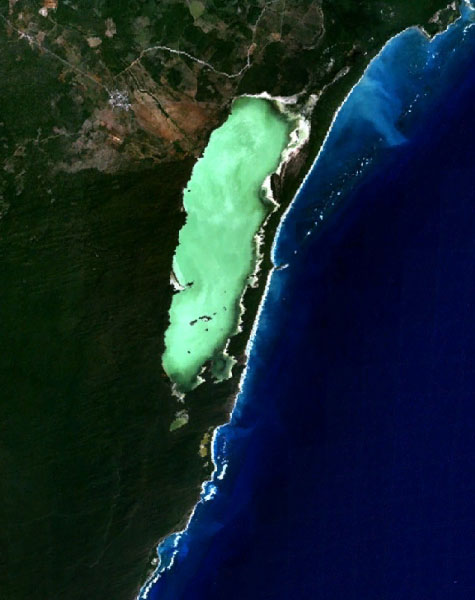
‘Laguna de Oviedo’ is a lagoon with a surface of 25 km2 (9.65 mi2). It is the second largest body of water in the Dominican Republic and due to its nearly isolated terrain in the Jaragua National Park and sparse climate conditions a perfect habitat for Rhinoceros iguanas.
They are of course not living inside of the salty water. On Laguna de Oviedo, there are 24 islands of different size and vegetation.
A satellite view from Laguna de Oviedo. The islands of the lagoon can be seen better here. Rhinoceros iguanas live on these little rocky islands Source: Wikipedia
Some of these islands offer the perfect living conditions Rhinoceros iguanas need to survive.
How do Rhinoceros iguanas get their name?
That’s a good question. Why are these animals called Rhinoceros iguanas? It doesn’t really look like they have something in common with a huge Rhinoceros from Africa.
Iguana Iguana (Parque Seminario, Guayaquil)Rhinoceros iguanas (Laguna de Oviedo)
At first glance, they appear not different to other iguanas. Wrinkled skin with a dark grey, brown and green color, a long swinging tail and flexible claw feet to move rapidly forward and climb up trees. There isn’t any obvious difference between a regular iguana and a Rhinoceros iguanas.
That’s correct and it needs a closer look to distinguish these two species from each other. It becomes quite clear when zooming into the heads of these amphibians:
Face of the Iguana IguanaFace of the Rhinoceros iguanas
The regular iguana doesn’t have on his snout anything. But on the snouts of the Rhinoceros iguanas grow and protrude these characteristic horns. That’s why they are compared with a rhinoceros, although they haven’t met each other before
Of course there are many more differences amongst the iguana species. But the horn from a Rhinoceros iguana is the most defined and special characteristic that distinguishes it from all the other iguanas.
What for some appears as normal, can perceive others are very unusual. On the other way around, it could be seen as very odd what others accepted in their lives as ordinary. Culture is a very interesting concept if you regard it from both perspectives. Like a Gringo in the Colonial Zone of Santo Domingo, you might cherish all the beautiful buildings and ancient European spirit that this area embodies. The same Gringo might, on the other hand, be a little flabbergasted and surprised how Dominicans live their daily life in a normal way and what they do.
I perceive myself as a very open-minded, tolerant and curious character. Not only because I lived in several other countries in Latin America and encountered many thrilling cultures I had to integrate myself. But even for me, it seemed very often suspicious and peculiar what Dominicans were doing. And especially WHY they were doing what they do.
This article is dedicated to all the random but odd encounters in the Colonial Zone of Santo Domingo. Dominicans will probably be bored and stop reading because for them it’s nothing new or special I am writing about. But everyone else will be probably well entertained because of the weird but authentic stories I will share.
To tease you a little bit: You will learn and understand…
why Michael Jackson was actually the ‘King of Bread’ and not the ‘King of Pop’
how the Dominican laziness the worldwide climate change affects
that not all souvenirs from the Dominican Republic are a lovely decoration for your cabinet
…and many more!
The biggest question for you might be after reading this article:
As some people might know, I studied “Innovation and Tourism Marketing” at the ‘Universidad Católica San Antonio de Murcia’ in the Southeast of Spain. It took almost 2.5 years for the Spanish authorities of the university and Ministry of Education to issue and submit my title correctly. But now I can proudly claim that I finally got the title from my Master’s from UCAM! But why the hell did it take so long after graduation?
Approximate reading time: 15 minutes
This review should help other interested people to find out if all the hassle after the official study was really worth it. Especially for those students who consider studying ‘Innovation and Tourism Marketing’ at UCAM in Spain. It gives authentic and detailed insights about the administrational processes, that every graduated alumnus has to face after finishing his studies. Are you planning to study Innovation and Tourism Marketing at UCAM? This article is dedicated to you, so keep on reading!
The ‘C’ in UCAM was always a mystery for us students and a good reason to gossip about the exact name. From lots of administrative calamities on a regular basis, we said very often that the ‘C’ in UCAM should be for ‘Chaotic’ instead of ‘Catholic’. That wasn’t only justified by the deserved feeling of a more than chaotic organization from our impertinent study coordinator in 2016-2017 who didn’t care about us students and acted very arbitrary and despotic. The whole administration around the university itself simply appeared for an ‘insider’ as a massive disaster and a bunch of clueless people going around in circles. No one really knew anything, cared about it, or was interested to solve a problem. Letting things slide was the name of the game.
UCAM by nightUCAM by day
For a rational arguing person and consecutive thinker, it was definitely not a joy to take classes when people were in charge who badly planned a whole study course. It wasn’t about the content of the study itself. I studied the 3rd edition of that course in 2016/2017 and once they found the right mix of subjects, it’s just a repetitive field of education. What we students learned back then about ‘Innovation and Tourism Marketing’ was quite interesting and some professors even have had a real inspirational impact on me. I still like to think back about some techniques and interesting topics I learned during the study.
Advertisements
But already the chronology of the organization to obtain a title was extremely dubious. It all started with the ceremony. If you already read that sentence and didn’t get it, I need to repeat and explain it better:
Setting goals in life is always an ambitious project. I never seriously fought to set new goals, but on the other hand I never shied away from it. After all, I successfully mastered two courses of study and at least learned to speak three foreign languages fluently. Of course, this is quite impressive and at least something to make me say, that I reached my intrapersonal targets.
But I never fulfilled these goals with a feeling of a proud achievement because I couldn’t build up any emotional level to them. Neither before reaching the goal and nor afterwards. During reaching a goal, I also perceived it as a means to an end.
Drivers license? Not needed to know how to navigate a car. Annoying social obligation for individual mobility. But I did my license anyhow for car and motorbike.
High school diploma? Was funny and joyful, but served at the end only for more qualifications.
Apprenticeship? Well, if I have to. Not a bad idea, but not a good or quaint one either.
Bachelor title? Cost a lot of time to receive at the end only a colorful certificate and nice ceremony.
Master title? Still a realistic goal to skim a bit of my own potential. Literally to do something off the cuff.
I have rarely been fed up or satisfied and have only quickly check marked the goal that has always been reached or sometimes even surpassed. The epigraph was always to hurry on and never rest on own success.
I even wanted to continue after my Master’s with a Doctor degree. But my former university in Spain artificially artificially extended the certification of my master’s degree in an unprecedented act of administrative chaos and professional inability. Hence, after three elapsed registration periods for a possible doctoral program at another university, I finally lost the desire to waste even more patience or time because of some dorks. Funny to mention at this point that I am still waiting for the official title after 2.5 years. Incredible!
Goals only exist to be accomplished. Nothing more. I was much more interested in intangible and immaterial dreams and abstract ideas. Having a dream in life is wonderful. You can color it imaginatively for yourself, always navigate onto it and enjoy it quietly and secretly without being affected by others.
A dreaming dog at a lagoon
Nobody can take away your dreams. But goals can be. It only needs one arbitrary and unprofessional decision maker or some administrational obstacles to cross your plans. These external factors can jeopardize your idea to accomplish the goal. Perhaps this was the reason why I could always build up a higher emotional level to dreams than goals. Because what is nicer than following my individual and perspective imagination of life?
Certainly not pursuing a goal and sharing a lecture hall with 100 fellow students, only to end up holding the same documentary wipe in my hands. This is more of a collective goal developed by society to create a certain claim against others. I prefer to stay with my individual dreams in me in my own hemisphere.
Of course, there are also people who advocate the exactly opposite perspective and dismiss dreams as lies. There’s nothing wrong or right about that. But if they don’t judge me, I won’t do the same.
I have often wondered how much a dream weighs. In contrast to a goal, a dream leaves a mental fingerprint and thus has a weight somewhere. The dream has to be stamped and located in a distant place in the brain and this naturally carries weight with it. A goal, on the other hand, is only achieved or not. But it has no mental burden comparable to a dream.
A baby having very active dreams
There are two dreams that I have followed and lived. One was fulfilled and the other was not. Am I physically heavier than before because of the dream came true?
Whenever you hear about carnival, you might imagine the beautiful Samba dancing women in Brazil with their colorful costumes during mile-long parades. But carnival in not only an exclusive Brazilian invention. In fact, this festivity has religious roots and is celebrated in many catholic countries all over the world. And within the countries, even amongst different geographical regions or even cities very distinct interpretations and variations of carnival can happen. But how do people celebrate carnival in the Dominican Republic? Is there carnival in the Colonial Zone of Santo Domingo?
The Dominican Carnival is in comparison to other countries not an event that happens for one week. In various provinces of the Dominican Republic, carnival is celebrated during all weekends in February. You can be sure, that if you are traveling through the Dominican Republic in February and are interested in going to the bigger Dominican cities, that there will be a lot of ballyhoo at the weekends.
What I remembered from my time in Peru is the difference between the capital city and the Peruvian provinces in terms of cultural expressions, activities and religious festivities. In 2018, I have had the chance to take part of a very strange dubious Peruvian concept of carnival in Lima:
What do you think, when you hear the word ‘carnival’? But apart from all the Brazilian Samba carnival we imagine, there are several other places in the world where people celebrate carnival.
Read this blog article to find out more about the peculiar Peruvian way to celebrate Carnaval. Yes, written and pronounced with an ‘a’.
I called Lima in one of my older articles the ‘least Peruvian city’, because these type of interesting happenings were rarely. That’s almost the same for the Dominican Republic. You can discover ‘the real Dominican Republic’ out of the capital city of Santo Domingo. All sorts of cultural festivities usually take place in the provinces and other cities.
Thus, I was kind of surprised to see, that there is a carnival in Santo Domingo AND in the Colonial Zone. You would actually expect from the oldest city on the American continent in a strictly religious city some kind of dedication to carnival. But the parade I visited on February 22 in 2020 in the Zona Colonial was in fact the first edition of its kind.
The First City of the Americas, home of the first Viceroyalty of the New World, will be filled with culture, talent and music with the staging of a colorful parade of troupes and characters, to the delight of the public. The Viceroyalty Carnival of the Colonial City seeks to arouse interest in history, cultural heritage and traditions. It is organized by the Pan American Round Table of the Colonial City and the Tourism Cluster, with the sponsorship of the Ministry of Tourism and Culture. Governor Nicolás de Ovando, Viceroy María de Toledo and Viceroy Diego Colón, accompanied by their court, Buffoon and a troupe that will pay homage to a Dominican painter, will lead the parade.
godominicanrepublic.com
For me on the first glance interesting to note, that apparently there is no connection at all to the Catholic religion. Instead, it gives more the impression to be announced as a historic masquerade ball. Especially the teaser picture reminded me somehow to the ancient traditional carnival from Venice in Italy:
As always, (valid) information are very difficult to obtain in the Dominican Republic. This concerns all sectors, but especially when you’re looking to find out something about an organized festival. Information usually spread in this country by hearsay and aren’t barely communicated electronically. It was for me even difficult to find out any background information about that festival. There isn’t any website to read a bit more about it. Simply couldn’t tell, which edition it is. According to Instagram Hastag #carnavalvirreinal the first picture was uploaded on March 10, 2018 by stodhohotels. I guess, that’s the 3rd edition of the Viceroyalty carnival of the Colonial City in Santo Domingo.
I was definitely curious about how they want to interpret carnival and if the predicate “Carnival” was even vindicated. So let’s find out!
And the parade is really sweet. Probably the shortest carnival parade of the world:
They were marching through a few streets of Santo Domingo’s Colonial Zone and then ended up at Parque Colón, the central square of the city where for example the first cathedral of the is Americas is located.
At the end of the convoy it was quite mixed and it seemed to me that everyone could join and participate. That was quite fun so I decided to join the people:
Many little horse-drawn carriages carried some probably important personalties through the streets of the Zona Colonial. They all seemed to very very happy not having to walk all the way:
Who could afford more than just one horsepower came directly with a motorized vehicle to drive the way:
The prestigous Hotel Billini from the Colonial Zone came with their tiny little transportation vehicle
Those who weren’t equipped with horses or cars have had to walk through the Colonial Zone. Especially the walking orchestra did quite a good workout walking all way AND holding and playing their instruments.
The ‘avant-garde’ of the parade
Especially the infant group was happy and proud to take part at the carnival in the Colonial Zone
These kids represented the mini-dwarfs
One of my favored costumes: The giant dwarf
As mostly during events in the Dominican Republic, it can get quite messy and maybe even chaotic. Same happened when I had to stop where I stood at the end of the video and had to wait for minutes. No one was moving forward and a little congestion was created. That’s why I decided to brake out of the convoy and go behind the stage.
Life as a giant dwarf is hard: He simply needed to take a rest after walking the streets on stilts.Some happy women in their colorful dresses during the Viceroyalty carnival at Plaza Colón
Another funny thing was, that the show officially started and the stage wasn’t even ready and still needed some preparation:
A perfect example for the Dominican comprehension of ‘Just in Time’
That’s why the sound was at the beginning not the best quality and very quite. It was almost not possible to hear what the woman and the man were saying:
From the little bit I understood, they crowned the new king of the Dominican Republic. And he hold a very funny inauguration speech (in Spanish):
All in all, I must say that this tiny parade was funny to watch, had no religious touch and was not as royal as I expected. Okay, I mean there were the horse-drawn carriages transporting some very important people of high degree. But compared to the dress of the promotional picture, the old king looked a bit more royal than the new king:
That’s how the Colonial Zone interpreted their understanding of a Carnival. I hope to have given some interesting insights into the young carnival culture of Santo Domingo. And that you liked my article. If so and you would like to never miss an update in the future, please subscribe to this blog and follow it on Social Media!
I like water and water activities. But I prefer fresh water rather than saltwater. There is a very beautiful construction very close to Sabana de la Mar in the south of Samaná Bay. It’s called Paraíso Caño Hondo and has very inviting installments to discover. Especially the natural waterpark opens up a lot of fun activities for the visitor. I have had a great time there and was surprised, how ample and detailed at the same time Paraíso Caño Hondo was constructed.
Caño Hondo can be found inside of the biggest national park of the Dominican Republic, ‘Parque Los Haitises’. It is a constructed eco hotel with a big natural waterpark.
It’s approximately 9 kilometers (5.5 miles) away from the next bigger city called Sabana de la Mar. That will take more or less 30 minutes.
30 minutes for that little bit of distance? Yes, I was surprised as well, that it took so long to get to Paraíso Caño Hondo. Bad road conditions might explain the reason why. You better go there with a SUV or Jeep, alternatively with a stable motorbike.
One good thing about the Dominican Republic is, that it has much more things to offer than just beaches and seasides. Especially waterfalls are scattered across the whole country. But what makes these waterfalls in the Dominican Republic especially interesting is that they are rather neglected from the local population. They prefer to spend their free time at the beaches than in the mountains where waterfalls can be found. Both attention and references on- and offline about them are rather low. It’s not easy to obtain information about these places. Best thing is to discover themself. And that’s what I did. I visited Salto de Yanigua – A rather secret waterfall in the Hato Mayor province.
I usually show maps of the location to show where to find my visited destination. This one is rather difficult to map – Because there are two ‘Salto de Yanigua’ on Google Maps.
So which one to chose? I checked the metadata from my taken photos to locate the GPS position. There’s nothing more reliable than that in terms of finding out where you are or were. Also Google Maps entries can be wrong – As you saw in this example with the double entry. So whom to trust?
Literally inside of the waterfall!
I recorded this video literally from the inside of the waterfall. You can’t be any closer than that. You can find Salto de Yanigua with the following GPS coordinates:
Latitude: 18° 58′ 18.864″ N
Longitude: 69° 26′ 29.568″ W
Did you know, that you can also search in Google Maps after GPS coordinates? If I use the ones from above, I’ll end up here:
The good news is, that the red dot on the map is with the coordinates 100% exact. The bad news is, that both entries from before are therefore wrong. Even the closer one in the middle with grey color is approximately 100 meters away from Salto de Yanigua.
Montaña Redonda is one of the most sold excursions in the Dominican Republic. With about 1.5 hours distance and a close proximity to Punta Cana, many full tourist buses arrive there and transport a lot of visitors to the top of the mountain.
The name describes nothing more than a ’round mountain’. And it’s true! From there, you have a stunning 360° view to the adjacent valleys and can enjoy nature at it’s best. Thanks to the perfect sights, there are some funny and beautiful motives for photographers possible:
Definitely worth a visit, huh!? I thought the same and wanted to do the same excursion. But of course on my own initiative and not as part of an overpriced tourist bus from Punta Cana.
I visited this place on the same day directly after my trip to Laguna Redonda:
If you are familiar with tourism in the Dominican Republic and like to travel, you probably have heard already of Montaña Redonda. This is a famous tourism excursion on the top of a hilly area where you have a stunning 360 degrees with to the adjacent valleys. But have you ever heard about the little…
First thing to say is, that you definitely need a SUV or Jeep. Something really powerful, because the way to the top of the mountain is in extreme bad condition and very narrow.
This was after passing the entrance. And the surface got much worse than that!
The admission is with 200 Peso (4 USD) quite cheap. Guided tours from Punta Cana start at Trip Advisor from 70 USD. Wow!
I would recommend to go of course off-season (MAR – DEC) and avoid if possible the high season (JAN + FEB and Easter/Christmas holidays). You’ll have definitely a better experience alone without a ton of strangers. next to that, also the way is a bit safer. If a car or bus is coming down while you plan to drive up or vice versa, it can be extremely challenging to pass each other. Highly advanced driving skills are more than necessary and welcome!
Bad weather conditions at Montaña Redonda
During climbing up the round mountain with the jeep, the weather conditions got really bad. It started to rain and dense cloud band came from the Atlantic side to the island. Unfortunately, my experiences were a little bit different, when I arrived on top of the mountain:
We parked not at the parking space, but directly on top of the mountain. At least no one complained about that 🙂
Well…As you can see, there wasn’t any 360° view possible. I had literally a 0° view, because the clouds were all over the place. No idea, where the meteorological difference between a cloud and fog is. But it felt, that I had both of it.
I’m pretty sure, that it’s actually a nice place, ignoring the weather conditions.
The only shelter a visitor can find on top of the mountain is a little shack in the middle of the plateau.
No real shelter possible: The only shack on top of the mountain has, of course, no walls. Rain and wind entered from all sites and made me wet anyways.
It didn’t really matter anymore to look for cover or not. At the end, I was completely soaked of water anyway.
Let’s make the best out of Montaña Redonda!
So why not making the best of it and at least pretending having a good time? 🙂
Easier said than done, but I tried to have the same amount of fun and happiness as people during a clear day. For example with…
The hammock at Montaña Redonda
Could’ve been a wonderful photo without the water drop on the lens AND with a clear view!
How it actually looks like!
The broom at Montaña Redonda
Also this optical illusion didn’t really work out for me!
How it actually looks like!
The swing at Montaña Redonda
What a beautiful view…
How it actually looks!
Let’s make the best out of it and swing!
Never give up mentality!
Advertisements
Montaña Redonda is a beautiful tourism destination, I suppose…?!
Needless to say, that you barely can make the way back, because you don’t like it there anymore. So my girlfriend and me waited for two hours, hoping for a better view. And we got ALMOST rewarded for that patience. The sky brightened up for a little bit and offered a little view through the dense cloudscape…
There was a little hope for a few minutes – But I was waiting in vain for a better view
Please give me at least a bit of a clear view…
…but that was nothing more than just 5 short minutes. Well, at least we tried it! I think, that Montaña Redonda can be a really beautiful tourism destination with a little bit of luck!
Enough space and possibilities to enjoy the view!
A memorable experience at Montaña Redonda (the round mountain) in the Dominican Republic.
It was definitely an adventure to get up. But in the late afternoon and with the bad vision, rain and muddy surface it was a challenge to get down as well. I’m very glad, that nothing bad happened during the way down and that we arrived safe and secure. But there is one announcement I want to bring up to Montaña Redonda:
Santo Domingo Pop is a festival about…Well, the pop culture I suppose. Young, for families, colorful, lots of opportunities to have a bite and many local Dominican artists of literature, music, theater, dance and artesian work. The 2020 edition took part in the botanic garden of Santo Domingo and was by far the best festival of the city I attended so far.
La Poesía de la vida – Lema del festival Santo Domingo Pop 2020
In a former article on my blog I described, that there is a lack in Santo Domingo regarding entertainment. These so called ‘entertainment problems’ make the life in the capital of the Dominican Republic not as interesting as in many other Latin-American cities.
The official newspaper from the Santo Domingo Pop 2020 festival came on recycling paper – Good idea!
But the Santo Domingo Pop festival is a great exception. I’ve visited before some other festivals. This was by far the most beautiful, best organized and pleasant festival I’ve been in Santo Domingo.
Where is the Santo Domingo Pop festival?
In a beautiful area – the national botanic garden – there is enough space to discover the colorful and odd things throughout the whole day.
The festival was held Saturday and Sunday, February 1 and 2. It started at 3pm and I had a really great time there.
Selfie time!
I chose to go there on the Sunday afternoon to avoid the biggest traffic jams. Santo Domingo is a city, where there is always traffic. That makes it quite difficult to get from A to B. A taxi by UBER cost not more than 230 Pesos (4 USD)
First I thought, that I would have with the admission as well entrance to the botanic garden. I visited the botanic garden and really liked the effort and dedication they put into this area. It’s a quiet and peaceful place, maybe I should write another article about it one day.
I think, that you can get a good impression of the whole festival, if you watch the after movie which I created:
Anyway: The festival was held in a fenced area very close to the main entrance. Just from my personal perspective, I need to say, that a little flair and freedom got lost when you realized that you are captured between fences.
Building a fence behind a fence? Good idea!
Too many fences and borders at the festival
Advertisements
How much does Santo Domingo Pop costs?
Uff, it’s not too cheap. Let’s call it like that. But these high costs justify a good festival. Click and check the images below to see the different tickets for Santo Domingo Pop:
Adults – 700 Pesos
(Santo Domingo Pop tickets)
Children – 300 Pesos
(Santo Domingo Pop tickets)
Family Combo 3 – 1.545 Pesos
(Santo Domingo Pop tickets)
Family Combo 2 – 1.818 Pesos
(Santo Domingo Pop tickets)
Family Combo 3 – 2.091 Pesos
(Santo Domingo Pop tickets)
Combo 1 – 1.455 Pesos
(Santo Domingo Pop tickets)
Combo 2 – 2.545 Pesos
(Santo Domingo Pop tickets)
Costs for the admission to the Santo Domingo Pop festival:
Adults: 700 DOP (13 USD)
Children: 300 DOP (5,50 USD)
Combo 1 – Two adults and one child: 1.545 DOP (28.70 USD)
Combo 2 – Two adults and two children: 1.818 DOP (33.75 USD)
Combo 3 – Two adults and three children: 2.091 DOP (38.80 USD)
Combo 4 – One adult and three children: 1.455 DOP (27 USD)
Combo 5 – Four adults: 2.545 DOP (47.20 USD)
What to eat at Santo Domingo Pop?
As a happy food traveler, I must say that there was a lot of variety for the visitor. Of course I couldn’t try it all. My financial and caloric budget per day didn’t allow me to taste all of the great food, snacks and desert. But here are a few of the best munchies I could find:
Empanadas from ‘La Empanadaria’ @ Santo Domingo Pop 2020 festival
A cheesy empanada @ Santo Domingo Pop 2020
Wallys Burgers
My favorite Dominican ice cream dealer ‘Valentino’ expanded and now offers also Shakes!
A tasty and fruity sorbet from Valentino @ Santo Domingo Pop 2020
My new years resolutions are still in progress 🙂 Luckily I can report that I eat definitely less meat than last year. Hence I also tried the vegetarian food I could find at Santo Domingo Pop.
What to do at the Santo Domingo Pop festival
As you can imagine, there were a loooooot of families with children. Hence, the most of the activities you could do during the festival was adapted to the interests of the youngest generation.
Kids Zone at the Santo Domingo Pop festival 2020
Pumping up some clown baloons @ Santo Domingo Pop 2020
Santo Domingo Pop 2020, Chill Area
But especially the picnic and chill areas were beautifully decorated. Enough space was given for everyone to find a table or picnic rug. And luckily, there was enough shade to find. It was with 30 degrees Celsius quite a hot Sunday.
Beautiful arranged picknick area @ Santo Domingo Pop 2020
What I really liked about the Santo Domingo Pop 2020 festival
Okay, I’m not a child anymore. Maybe sometimes. But these activities for children were not what I was deeply interested in.
Everything that had the artesian and handcrafted touch gathered my interest. But what I really liked about the Santo Domingo Pop festival was especially one booth.
One of my favorite exhibitions: Recycled guitars
These people from Atabey recycle things and fabricate guitars. Not only, that these guitars actually work, they also played some songs with them. And it sounded not too bad!
Not sure, if these guitars were also for sale, but I suppose?! Nevertheless, they made me think about these cowboys and hillbillies who play country songs on their self created banjos. Melancholic childhood imaginations came true!
What I didn’t like about the Santo Domingo Pop2020 festival
Advertisements
What I personally didn’t really like was the missing opportunity to exit the festival area and get back in. Unfortunately, you haven’t had any chance to reenter, once you left the botanic garden. That’s something unusual, because the majority of festivals I’ve visited allow you to reenter again.
Another thing I really didn’t comprehend was the exhibition of the local zoo. The ‘Parque Zoologico Nacional’ of Santo Domingo came to present themselves and gather some interest from the visitors. Of course a zoo can only be interesting and convincing, if they show some animals. And they really did that, but not in a pleasant manner:
The local zoo of Santo Domingo also exhibited their animals at the Santo Domingo Pop festival
Parque Zoológico Nacional (The national zoo) hat a booth at Santo Domingo Pop as well and brought some animals
Erizo de tierra @ Santo Domingo Pop festival
A snake @ Santo Domingo Pop 2020 from the local zoo
A little contradictory: Education children about the freedom of the animals and exhibiting them in cages. Didn’t really fit the free spirit of the festival.
I personally didn’t really see the fit of this whole collaboration. First, you as a visitor are not allowed to bring your own pets to the festival. Strict guideline policy!
But on the other hand, some wild animals are exhibited in far too little cages, boxes or compounds. Regardless to say, that these wild animals are held in the zoo to simulate their habitat. While this is anyway an inappropriate handling, they are taken from their artificial biosphere they got familiar with over years to be shown in a far smaller environment.
Closer contact to the visitor, louder noises, direct impact of the sun and the whole transportation of the animals must’ve stressed them out. This all didn’t really fit to the festivals mantra to be a festival of free arts at the fresh air, if animals are captured in cages.
Is it worth visiting Santo Domingo Pop 2020?
In my opinion, definitely yes. The festival combines a lot of interesting activities and addresses several target groups. Whether you come with your children to let them have fun in the ample area or want to enjoy dancing with friends electronic music during one of the many show acts – Santo Domingo Pop is definitely worth a visit. A little pricy, but a really well-organized festival will be promised the visitor.
The Dominican Republic is a magnificent tourism destination in the Caribbean. Many holidays begin in the capital of Santo Domingo and its Colonial Zone to welcome the visitor with a historical flair. But what about life in Santo Domingo? What are good reasons to move and live there? How is life in Santo Domingo for an expat? I lived an expat life in the biggest city in the Caribbean for 1.5 years and would like to help you with 5 good reasons to live in Santo Domingo. I’m sure that you’ll find all the answers you’re looking for.
Approximate reading time: 20 minutes
Read in this article, what life in the oldest city on the American continent really means for a foreigner. And if you should consider to move to Santo Domingo or to rather look for a different city.
Would you like to read this article in another language?
I think, that it’s a good moment to analyze Santo Domingo as a valuable residence destination for expats and foreigners. Whether you are looking for good reasons to live in Santo Domingo, you will find them in this article. I could obtain some valuable insider knowledge from the perspective of an expat, because I lived there as well. And I am gladly sharing them with you!
Some years ago. I lived in Lima, Quito and Asunción. All these experiences in other Latin American capital cities helped me to analyze and assess Santo Domingo.
The 5 good reasons to live in Santo Domingo don’t come from researching other websites. I am creating the content of my own experiences and all photos I share are my own copyright. You won’t find this content elsewhere, if it was not linked or copied from. It’s nothing less than made by own observations and opinions about what’s good and bad about Santo Domingo.
I was quite surprised, that so far no other expat blogger treated this topic on whether living or not living in Santo Domingo in a thorough manner. It’s a quite big and international city and many expats lived here.
Plaza Maria de Toledo in the Colonial Zone
But I couldn’t find any comparable article by giving this information from the inside to interested readers who look for this kind of expat information. I hope, that I’ll fulfill your purpose and deliver some valuable insights from the life in the capital of the DR.
Alright then, hope you enjoy my article and will find what you were (re)searching for!
If you are familiar with tourism in the Dominican Republic and like to travel, you probably have heard already of Montaña Redonda. This is a famous tourism excursion on the top of a hilly area where you have a stunning 360 degrees with to the adjacent valleys. But have you ever heard about the little neighbor Laguna Redonda?
Where is Laguna Redonda?
Laguna Redonda can be found in the northeast of the Dominican Republic. It’s part of the district El Seibo and in a rather scarce populated area of the country.
As you can see on Google Maps, it is quite close to Montaña Redonda and shares even the same name. Both are ‘redonda’ which means ’round’ in Spanish. Okay, if I see it on Google Maps, it might not be perfectly round but I think that you get the idea what I mean.
Laguna Redonda filmed from the top of the hill.
Advertisements
What is Laguna Redonda?
Laguna Redonda is one of the many aquatic and hidden places in the Dominican Republic. The country is rich of lagoons that create habitat for both flora and fauna. Laguna Redonda has an extension of 1.93 mi² (5 km2) and consists of salt water. It’s connected with the near sea through Caño Celedonio.
View from the shoreside
Laguna Redonda has been a livelihood for hundreds of poor families who fish with rustic instruments to survive in this place of just a few opportunities. Some species of fauna that can be observed in the lagoon are: crabs, tilapia, bass, shrimp and guabinas.
Fisher boats at Laguna Redonda
Nice scenery for taking pictures
These fisher boat give the landscape a beautiful touch
Lagoons in the Dominican Republic are a pure paradise for bird watchers. The birdlife around Laguna Redonda is also rich and is represented by Pied-billed grebe (Podilymbus podiceps), the common moorhen (Gallinula chloropus), great egret(Ardea alba), black-crowned night heron (Nycticorax nycticorax), roseate spoonbill (Platalea ajaja), northern pintail (Anas acuta).
This sign welcomes you with additional information about Laguna Redonda
Unfortunately I haven’t had sufficient time and boats to discover the whole lagoon. But what I saw from the shore was kind of beautiful already.
Advertisements
How to reach Laguna Redonda?
Laguna Redonda is not touristically developed and accessed. Meaning, that you need to invest a high effort to reach it. But it’s worth it if you want to have an individual and exclusive feeling.
Usually, tourism destinations and excursions in the Dominican Republic are completely overrun. This one’s not. I had the luck to be there on my own. If we zoom a bit out at Google Maps, we can see, that there is only one single pathway to reach Laguna Redonda:
Only one pathway from the south leads to Laguna Redonda
The Atlantic is in the the north and there are no connections both from east and west towards the lagoon. This makes it a bit more difficult to reach.
Here is how you get there: On the highway 104 (RD-104 Carretera Bávaro) you see a quite an unremarkable green traffic sign with ‘Laguna Redonda’ on it. It’s probably around 1.5 miles (2,5 km) away from the entrance to Montaña Redonda. Just continue driving for about 10 – 12 minutes and you’ll reach Laguna Redonda.
That’s the official part you would guess by planning it from the outside. But I was beneath the surface and can tell you, that you should park the car approximately where you can see the little white square on the screenshot. Why?
Advertisements
Is it easy to access Laguna Redonda?
It’s better to walk the rest of the route to the lagoon. Shouldn’t be more than 1/2 or a 3/4 mile from the marked checkpoint. You should see a gate:
Takes probably 5 -7 minutes walking time from here until you reach Laguna Redonda.
The road conditions are not stable enough and look the following:
Muddy conditions on the way to Laguna Redonda
You better not wear sandals, flip flops, etc. and rely on sturdy shoes. That’s what I can recommend, because I wore flip flops and looked more than dirty after reaching the lagoon 🙂
But on dry days without rain it won’t be easier either. Here is how the path looks like:
Beautiful landscape around Laguna Redonda
To be 100% sure to reach Laguna Redonda safe and to not get stuck in the muddy terrain, you should only access it with a jeep or a SUV. Everything that has a 4×4 engine is the only secure car to go there.
Of course you could as well motorbikes, quads, etc. These vehicles would be even more suitable to enter the difficult terrain. But once you reached Laguna Redonda, it’ll be more than worth it!
Laguna Redonda is a saltwater lagoon in the northeast of the Dominican Republic.
Advertisements
Why is the water at Laguna Redonda green?
That’s a good question, isn’t it? If you took a closer look to the videos and photos above, you’ll see a green shimmer at the water surface.
Green water at Laguna Redonda in the Dominican Republic
The reason for the green water are the mangroves and the rotten leaves from the surrounding trees. In combination with the very salty water, this rare effect of green water is produced. It corrodes at the bottom of the water surface. There are no rocks or stones that could wash the water and make it a little more clear.
That’s why the water at Laguna Redonda shimmers in a light green hue.
I have seen a lot of green water places like stagnant ponds, natural pools or puddles. Mostly, because they are not moving waters. But this was the first time, that I saw a moving water with this green hue.
The water at Laguna Redonda is surprisingly green.
I decided to not swim there, rather enjoy a few silent minutes at the shore and observed the little fisher boat before I continued the trip to Montaña Redonda.
Laguna Redonda is one of these many hidden destinations in the Dominican Republic that are barely known and communicated. Few information are available of it and you have to search for places like that. But once you discovered one of these places, you can be sure to be the only person there.
Are you looking for some real inspiration for your next big travel adventure? A tropical paradise in a coconut shell? Never considered traveling to the most beautiful and diverse destination of the Caribbean? Maybe the Dominican Republic? I would love to inspire with 10 insider facts of the Dominican Republic for individual travelers.
If you answer at least one of these questions with a “Yes”, you are eligible to become an individual traveler in the Dominican Republic. As you can imagine, I wouldn’t write this article, if I couldn’t present some reasons to emphasize, that the biggest country in the Caribbean has at the same time plenty of opportunities and hidden gems to visit as an individual tourist.
During Canyoning – An offroad excursion at “Cola de Pato”
The Dominican Republic is the most visited destination in the Caribbean. Yet it has much more to offer than the usual and expectable things. Naming a few…
Big holiday resorts
All-Inclusive-vacations in Punta Cana
Palms along endless beaches
These are standardized imaginations. Probably these are the imaginations most people expect when it comes to this country.
The Dominican Republic is a paradise for individual tourism
What most people don’t know is the versatility of the Dominican Republic. And that it can satisfy the needs of every ambitious traveler type.
Well, let’s say almost every travel type. Winter sports might be a little difficult to realize because of warm and sunny conditions for all year round. For this reason, the climate of the Dominican Republic is also known as an “endless summer.”
But an endless summer in the Caribbean is probably what you already expected. Rather let us focus on some thrilling and unique features of the Dominican Republic which inspire you to travel instantly.
Did you know, that the Dominican Republic…
was discovered during Columbus first expedition?
is also home of the oldest (capital) city of the entire American continent?
has the highest mountain (10,164 feet – 3.098 m) of the Caribbean?
These are only a few of the triggering facts to create curiosity. Yet, the Dominican Republic has much more to offer.
Read in this article 10 characteristics about the Dominican Republic that might surprise you to create wanderlust and see it with your own eyes.
Advertisements
1
Columbus landed here in 1492
Christopher Columbus landed during his first voyage first on the Bahamas and later on Hispaniola Island on December 5, 1492. In 1493, the colony of La Isabela was built on the northeast coast on Columbus’ second trip. Even though the Republic itself was founded as a sovereign state much later, Columbus landed on today’s Dominican territory.
Columbus’ Landing in the Dominican Republic
La Isabela was depopulated by 1500 due to a hurricane. Furthermore, the discovery of gold one year earlier in 1499 in the interior of the country made people flee to follow the gold rush. But the footsteps of Christopher Columbus are still present. And even 525 years later, the site of La Isabela can be visited. There are still some relics of the very first European settlement in the Americas.
On the first glance the ruins of Isabella might appear a little disappointing to the visitor. Before 1986, almost no one was taking care of that place. Unfortunately, a lot of construction material was cleared up by bulldozers in 1952 because of presidential order of the dictator Trujillo. Only the foundation grounds and the reconstructed House of Christopher Columbus are nowadays visible at the excavations of La Isabela.
At second appearance, you can find with a little bit more patience and an informative tour guide a lot of interesting information about the place. Very impressive are the excavations of La Isabela and the items the people from back then were using. They can be seen in the museum. Even recollections from the old Taino people could be found during the excavations. This first European colony was on a very developed state-of-the-art back then, Spanish style.
La Isabela is perfect for a half day trip. And for everyone who would like to follow Columbus’ path seeing the oldest buildings of the first European settlers. Travelers who love to see historical facts with their own eyes will love the colony of La Isabela.
Columbus’ house in La Isabela
Columus’ Landing in La Isabela
Monument and flag of the Dominican Republic in La Isabela
Cemetery in La Isabela (Dominican Republic)
⏳ How much time should I spend here? Not more than 2 – 3 hours
📅 Recommended visit: All year season (Better in the morning hours before it starts to get hot – There is no shade)
💰 Costs: Affordable
Admission per person 200 Pesos <-> 3.50 – 4 USD.
Spanish speaking local tour guide not more than 500 Pesos <-> 8 – 9 USD)
✅ Suitable for: History lovers, archaeologists
Advertisements
2
Santo Domingo is the first capital city on the American continent
The colony of Santo Domingo became the first permanent European settlement in the Americas. Consecutive upon that, Santo Domingo is the oldest city in the new world. Also at the same time, it is the first capital city, the first place of a Catholic cathedral out of Europe, and has the first university and hospital in Latin America. You can breathe in centuries-old history in the Dominican Republic.
Die koloniale Altstadt von Santo Domingo
Iglesia de Nuestra Señora del Carmen
Santo Domingo is the oldest city on the American continent.
Some of the original buildings have been restored and can be visited in the charming Colonial City of Santo Domingo. For this reason, a visit to the Dominican Republic should always include a few days Santo Domingo and the Colonial Zone with its picturesque and dainty flair which is worth to discover. Additionally, it attracts yearly thousands of visitors for its festivals. Check out the festival schedule – Maybe you can join the local Carnival, Barbarella and Merengue festivals.
Don’t worry too much about not being safe in the Colonial Zone. This neighborhood is one of the most protected areas in Santo Domingo. Next to that, this part of the city is one of the cleanest – Although it might not seem as it is from the perspective of a visitor from a first world country. But compared to many other neighborhoods, the Colonial Zone is in a quite good and clean condition.
To round up your experience in the oldest city of the American continent, I would like to recommend you to visit two more places which are easy to reach from the Colonial Zone. You’ll need a vehicle though, but would be able to get to the destinations in less than 20 minutes driving time.
Columbus Lighthouse (‘Faro El Colon’) – A mausoleum monument, that contains the remains of Christoph Columbus.
The three Eyes (‘Parque Los Tres Ojos’) – An open-air limestone cave with three lagoons. Check also this dedicated article.
Columbus’ Lighthouse
Parque Los Tres Ojos
Santo Domingo is perfect to start your vacation as an individual traveler in the Dominican Republic. Urban lifestyle and city travelers will love the metropolitan part of the country.
⏳ How much time should I spend here? Not more than 2 nights
📅 Recommended visit: All year season
💰Costs: Affordable
Discovering the Colonial Zone is of course free. But with a local tour guide much more informative and worth it. Should be available between 25 – 35 USD.
Admission for Columbus’ Lighthouse is 200 Pesos <-> 3.50 – 4 USD
Entrance for “The three eyes” is 250 Pesos <-> 4.50 – 5 USD
✅ Suitable for: Urban travelers, history lovers
Advertisements
3
The highest peak of the Caribbean
Contrary to sandy and pristine beaches, the Dominican Republic has the highest mountain of all Caribbean islands. ‘Pico Duarte’ is 10,164 feet (3.098 m) high and was named in appreciation of Juan Pablo Duarte, one of the Dominican Republics’ founding fathers.
The mountainous area offers challenging ascents for hikers. Its peak welcomes yearly approximately 3,000 climbers who like to experience its incredible beauty. That’s less than 10 people every day! As a result of this a real insider tip for everyone who likes to discover nature and be all alone on top of a mountain. And who can claim to have made it to the highest point of a geographic area? If you consider visiting the Dominican Republic, you hopefully have now an additional motivation to hike to Pico Duarte and be on top of the Caribbean!
There are several routes with varying difficulty levels from Jarabacoa that lead to Pico Duarte. Depending on your physical condition, you know which routes and which difficult level are best for you. Only experienced ascensionists should consider to do it alone without a tour guide. It’s recommended to climb up the mountain accompanied by pack animals and tour guides with a good knowledge of the area.
Another little recommendation to maximize your individual experience would be to visit it off the high season. You know now, that approximately 3,000 travelers approach Pico Duarte yearly. But almost the half does it only in January and during the Easter holidays! Try to avoid these peak times and reach the peak of the mountain for the rest of the year.
Pico Duarte is the ideal assignment for mountaineers, adventurers and everyone who seeks for an individual challenge.
⏳ How much time should I spend here? You should expect 4 days for the standard route. Starting ideally from Jarabacoa in the mountains.
📅 Recommended visit: NOT during January and Easter. Evade the peak times and go in low season
Conversely to everything that was written before about the highest peak of the Caribbean, the Dominican Republic possesses the exact geographic opposite.
Located in the southwestern region of the country, Lake Enriquillo is the largest lake and the lowest elevation in the whole Caribbean. It covers an area of 145 square miles and the lake level is approximately 140 feet below sea level. Although it can appear seasonable as hypersaline, Enriquillo Lake offers habitat conditions to the largest population of American crocodiles (Crocodylus acutus) in the Caribbean.
Lago Enriquillo in the southwestern part of the Dominican Republic
Very unusual as well as the flooding trend: Since 2004 the lake has grown by almost 130% due to increased rainfall and reduced evaporation caused by milder temperatures. This, on the other hand, helps some endangered species who are living in the lake to keep their habitat protected.
Have you ever seen wild flamingos in their natural habitat? At Lake Enriquillo, you’ll have the chance to! You’re a bird watching expert and need some elaborated challenges? As a hint, you should remain patient and wait for the reason number 8 for individual tourism in the Dominican Republic.
If you’re not interested in birds at all, you can also find an endemic iguana species at Lago Enriquillo. The Rhinoceros Iguana (Cyclura cornuta) has its habitat there and welcomes you with its majestic appearance. Insiders’ tip: Bring some fresh fruits and feed them, they love cherries!
Lake Enriquillo is a very suitable destination for wildlife watching and nature exploration. And everyone who wants to see pink flamingos needs to see Lago Enriquillo.
Now to a very magic characteristic of the Dominican Republic that became over the last years more and more a viral trend. Close to Barahona in the southwestern part of the country, a tiny town called Polo can be found. Here you have one of the few opportunities in the world to trick scientific laws and challenge gravity at the Magnetic Pole (El Polo Magnético).
If you are going to stop your car in neutral gear in the downhill section, your car will roll up! You don’t believe it? Please drive to Polo and check out the gravity hill. Your car rolling up is caused by an optical illusion due to the condition of the road and the landscape itself. Still, a nice and unique experience. Don’t forget to take enough convincing photos or even illusory videos as a memory. Most importantly: No entrance fees are charged and you can discover it for free! For this purpose, it might be a good idea to include the magnetic pole into your road trip.
Apart from that, there is not much to see and do in Polo. But you can use this stop in your road trip as a nice stopover to continue to the unknown southwest of the country.
The Polo Magnético is ideal for everyone who wants a self-drive tour across the Dominican Republic. And for those who want to trick laws of nature.
⏳ How much time should I spend here? 30 minutes
📅 Recommended time: All year season
💰Costs: Free of charge
✅ Suitable for: Nerds, You-Tubers
Advertisements
6
You will be able to play presidential Golf at ‘Teeth of a dog’
Did you know, that even former US-presidents are coming to the island to play golf? Furthermore, the Dominican Republic ranks with more than 30 beautiful golf courses among the best golf destinations in Latin America. Swing and no miss in the Dominican Republic! Most were designed by famous designers like Jack Nicklaus, Robert Trent, Bobby Jones, Nick Faldo and Peter Dye.
The ‘Teeth of the Dog’ course is the most prestigious Golf course in the Dominican Republic. Feel welcome to spend unforgettable golf holidays in the Caribbean. Nine of the Dominican golf courses are mentioned amongst the “Top 50” in the listing of the magazine Golfweek. Many sports champions, enthusiasts and celebrities from around the world came to the Dominican Republic to play Golf. To emphasize some of them: Former U.S. Presidents Bill Clinton and George H.W. Bush came to play at the Dominican designer golf courses.
Teeth of the Dog golf course is for everyone who would like to bring his or her own pair of clubs. And for those who prefer having a luxury holiday in a Caribbean destination.
⏳ How much time should I spend here? Depends on your budget
📅 Recommended visit: All year season
💰Costs: Expensive
✅ Suitable for: Golfers
Advertisements
7
Merengue has its cultural origin in the Dominican Republic
Sugar, coffee, and tobacco are the most important economic export products of the Dominican Republic. But it’s the typical Merengue music and dances who made the country internationally popular and famous in cultural aspects.
Fast-paced rhythmic music from hand-made instruments in combination with close and graceful dancing moves – nowhere else can the Dominican lifestyle be better observed as during the evenings when the Merengue music is played. The good thing is, that you will find it everywhere in the whole country. Merengue is not only the music and not only the dance, it is a cultural Dominican expression!
In July and August there are several Merengue festivals in Santo Domingo that wait to be discovered from you. They take place around the Malecón and the music beats keep pumping all night. A very special insiders’ tip is the visit of the restaurant ‘El Conuco’. It is one of the most typical Dominican restaurants of the city with traditional decoration, staff in folkloric clothing and typical Dominican dishes. I haven’t seen before anyone dancing as wild but controlled as these two people ON a bottle of rum. Yes, ON a bottle, not with a bottle!
‘Festival de Merengue’ is for cultural explorers, active dancers and such who want to move their hips to Caribbean music.
⏳ How much time should I spend here? One day
📅 Recommended visit: Takes place usually late July – early August
💰Costs: Free of charge
✅ Suitable for: Cultural interested people, dancers
Advertisements
8
Most bird species of the Caribbean have their habitat in the Dominican Republic
You remember the little hint I gave the bird watching experts in chapter 4? Now your time has come to discover why!
Bird watchers have been considered lately with a decent interest from travel destinations. Hence, the Dominican Republic is a pure paradise for bird watchers. Especially Los Haitises National Park, Sierra de Bahoruco and Cordillera Septentrional offer stunning opportunities to observe the winging Dominican wildlife. Amongst tropical trees and many other animals, some threatened, endangered and even endemic species can be seen. Under those circumstances, the Dominican Republic is a pure paradise for ornithologists.
Bird watching in the Dominican Republic
Flamingos at Laguna Oviedo
The diversity of bird species in the Dominican Republic is a consequence of Hispaniola’s complex geologic history with various microclimatic zones. In the Caribbean, the island is geographically the most diverse and enables the habitat conditions. As a result, it offers a habitat for 320 birds whereof 32 are endemic bird species.
And the Dominican birds are worth to glass. You should observe them with your own eyes – or your own field glasses. The unknown southwest offers many opportunities for bird watchers and such who want to become it.
📅 Recommended visit: All year season
💰Costs: Expensive
✅ Suitable for: Nature lovers, bird watchers
Advertisements
9
Neither 99% of the local population nor Trip Advisor know the highest waterfall of the Caribbean
Whenever it comes to really secret insider tips, the following Dominican destination shouldn’t be missed in any anecdotes. Totally disregarded by all guide books and excursions in the country, there is one of these secret insider tips. A waterfall with a single-drop of 390 feet (119 m) can be found in the middle of a green area.
We’re talking about the waterfall ‘Salto de La Jalda’. Truly a travel destination, which is unknown to most of the locals and not even listed on Trip Advisor. A trip to this secret waterfall will take you about 4.5 hours by foot or 2.5 hours on horseback. Don’t forget to pack your swimsuit before you go. Chilled water will refresh your mind once you arrive there.
As it can be still considered as an absolute hidden gem, you shouldn’t hesitate too long to go there. See it with your own eyes, before standardized package tour operators will bring thousands of tourists here. Furthermore, this stunning beauty is beside its long hike easy to reach. In detail, it’s just 1.5 hours distance away from Punta Cana and 2 hours from Santo Domingo. For this reason, it would be the ideal destination for an adventurous day trip.
The top-secret waterfall Salto de La Jalda is perfect for explorers, nature lovers and adventurous travel pioneers.
⏳ How much time should I spend here? 1 full day
📅 Recommended visit: All year season
💰 Costs: Moderate
✅ Suitable for: Nature lovers, hikers
Advertisements
10
Giant humpback whales are born in the Dominican Republic
Especially nature lovers who want to enjoy the diversity of animals will get one’s money’s worth in the Dominican Republic. Each year, approximately 2,000 – 3,000 giant humpback whales arrive in the bay of the peninsula Samaná.
They are migrating seasonally from the Northern Atlantic to the milder Dominican waters for calving and breeding. Their newborns don’t have enough fat reserves to be able to survive the cold winter waters in the northern waters, that’s why they come here to the Dominican Republic. In late March, they are returning to North America, Greenland, and Iceland to their feeding sites to prepare for the next season.
Whale watching in the Dominican Republic
In a wider sense, giant humpback whales are native Dominicans who live abroad for the summer and come back home for winter. Of course, they visit their homeland (or better: “homewater”) every year. How cool is that?
The Samaná Peninsula is ideal for whale watchers, animal lovers and everyone who wants to see whales with their own eyes.
⏳ How much time should I spend here? 1 full day
📅 Recommended visit: From January till mid of March
💰 Costs: Moderate
✅ Suitable for: Nature lovers, hikers
Advertisements
Did you like these 10 thrilling and unique features about the Dominican Republic? Do you feel inspired to plan your next dream holidays there?
As described before, the Dominican Republic has many interesting characteristics that every individual traveler would cherish. If you need more recommendations for your Caribbean dream holiday and some more insiders’ tips, be forearmed for other articles on this blog. You’ll read about some destinations that are hard to find and possibly not even communicated elsewhere in the internet.
If you were happy reading this article, I would be very happy if you are happy to subscribe to my blog to never miss an update. Let’s both be happy together!
Did you like this article?
Subscribe to my blog and never miss an update!
I can promise you, that many other articles are currently under construction and just wait for you to be read.
Come back regularly and check out many more interesting stories about the
I can’t say, that I’m a lucky guy, but this day I was very lucky to have had the opportunity to see something very special at ‘El Conuco’ in Santo Domingo. It was November 26, 2019 and I had dinner in a restaurant in the Dominican capital city. Luckily, it was one of the most typical Dominican restaurants of the city with traditional decoration, staff in folkloric clothing and typical Dominican dishes. But the best thing about all this was this specific day itself. Later I found out, that the November 26 is the ‘National Merengue Day’ and that it’s even an ‘Intangible Cultural Heritage of Humanity‘.
To honor this specific day with its traditional music and dances, the employees of the restaurant wore traditional Dominican clothes and showed some Merengue dances. Not the normal dances you’d expect, but on a bottle. Yes, ON a bottle, not with a bottle!
I remember, that I danced myself already very often WITH a bottle, but never ON a bottle. Most of the times, these bottles I danced with contained alcoholic beverages, that let me dance more than usual. But that specific dance the couple demonstrated was something I didn’t expect to see that evening. Almost as good as dancing on a bottle was the finisher of another dance with several pirouettes for the poor lady:
Dominicans call this dance ‘Perico Ripiao’. I haven’t seen before anyone dancing as wild but controlled as these two people. Thank you, dear coincidence, that I was at the time on the right place and could see it with my own eyes!
The Dominican culture is hard to find and for foreigners sometimes even harder to detect. In comparison to many other Latin American countries, they spare out some festivities you would expect from a country like the Dominican Republic. Although they perceive themselves as strictly catholic people, they don’t express it with religious festivities during Carnival and with Easter progressions in a collective and colorful way. The national holiday on February 27 is as well barely recognized with organized and widespread festivities or ceremonies. I had the joy to saw a great exception of that rule in San Cristobal. They celebrate annually on the last Sunday in November a ceremony called ‘Fiesta de Palos’ (Translated: Stick party) close to the capital city of the Dominican Republic. Luckily, I could join this racket and was surprised how Dominicans celebrate their culture on a Sunday afternoon in San Cristobal!
Some 20 miles away from Santo Domingo, a village called ‘San Cristobal’ can be found on the map. Neither my Dominican girlfriend nor her parents I was traveling with knew what to expect from this afternoon.
We were visiting some relatives of that village who organize on their street once in a year the ‘Fiesta de Palos’. Although they are living quite close to the capital of the Dominican Republic in San Cristobal, these types of festivities aren’t celebrated in the urban districts of Santo Domingo. Which means, that also they learned and something new about their own country and fellow citizens.
For me as a Super-Gringo, everything was absolutely new and astonishing. Without having a good connection to the family of my girlfriend, I would never have access to a community like them. Thus, I am quite thankful to have obtained this insight to the Dominican culture, which usually is hidden to foreigners. Comparably to my Eminem-experience in Guallupe in Ecuador in December 2017, I was again the only white and foreign stranger in a black community. And again, they welcomed me with very open arms and with a candid spirit that pleased me very much.
I took my GoPro and took a lot of videos, but unfortunately not many photos. To explain these festivities a little bit better, it could help to read the following questions:
What is ‘Fiesta de Palos’?
‘Fiesta de Palos’ is a cultural festivity in the Dominican Republic to honor Catholic saints or anniversaries of the deceased. It usually takes places in rural areas.
Advertisements
Where does ‘Fiesta de Palos’ has its origin?
‘Fiesta de Palos’ has its roots in Congo, Central Africa. Along with its folkloric African instruments, it’s characterized by its up-tempo rhythms, loud chants, and playful dances.
What instruments are played at ‘Fiesta de Palos’?
Usually, three different long drums are used with a height of up to 3 – 4 feet. The Dominicans call these three drums El Mayor, El Menor and El Alcahuete à The oldest, the youngest and the pimp. And no, that translation is neither wrong translated, nor a joke. They really call this drum a pimp.
Next to the long drums, idiophones accompany the sound to complete the loud noises.
Where is ‘Fiesta de Palos’ celebrated?
Possibly everywhere in the Dominican Republic, but more likely on the countryside and in villages with many inhabitants of Afro-American descent. Fiesta the Palos is not an urban festivity and can’t be found in the touristy areas around Punta Cana. You need to dig a little deeper before finding the true Dominican roots with its culture and music.
How often is ‘Fiesta de Palos’ celebrated?
On a very irregularly basis. ‘Fiesta de Palos’ is associated with the celebrations of virgins and saints. Whenever there is a strong bond between a village and a holy catholic figure, it’s about the villagers to honor them on a yearly basis with this festivity. Depending on which virgin or saint is cherished or adored, the festivity dates also varies. There isn’t any consistent or periodical rule for the entire Dominican Republic. All depends on the favors of the villagers to the saints – Or vice versa as you like.
These types of micro-sized cultural activities aren’t communicated or published transregionally and remain cultural insider knowledge. It’s very hard to find them, even more difficult for foreigners.
What is special about Fiesta de Palos?
One of the most surprising things was for me, that the musicians did not receive any applause. If you carefully watch the videos until the end of their songs, you will notice, that no one of the audience gives applause for the band. It was the first time in my life, that I observed an audience that doesn’t value the performance with clapping their hands although supporting it strongly. I asked a few people, why they don’t applaud to the music. They answered: “It’s not part of this culture and we never do that when someone plays songs like that.”
Another interesting thing is, that each of these long drums is as unique as its creator making it. They are all produced hand-made and never in batch fabrication. Usually, these drums are made from trees hollowed out and covered with goat or cow skins for the head. Each drum makes a different sound.
Fiesta de Palos is a big get together with people drinking, dancing, chattering all day. Not very different to a usual Dominican Colmado at night. But with the desire to maintain the Afro-American culture in the Dominican Republic. As you can imagine, these rural traditions with its music and dances die out, because of the lack of communication and recordings. I hope, that I could contribute at least a little bit to conservate a little piece of the Dominican tradition and publication of this article.
Advertisements
I couldn’t even tell, which specific Catholic saint was honored that day. The little table with the candles in the videos showed the devotionals. But the whole time I was there, it was not communicated, whom to honor that day. Neither did I really understand what they were singing about, their words were very loud and fast and slang. But it was a very special day for me to see Fiesta de Palos in the Dominican Republic.
This is the second article I am dedicating to this festival. I was writing earlier this year an article about the Zoneo Fest 2019. A festival in Santo Domingo about the…with…where you can do…
Well, to be honest, there is a lot to do for many different audiences. Whether you come with family and kids, discover gastronomic specialties, have an ice-cold coffee, want to walk over the street market and look for handcrafted goods or just listening to live music you can do that. And you can bring your dog. Thus, there is a lot to do and everybody is welcome to spend two days at Fortaleza Ozama, right in the Colonial Zone in Santo Domingo.
If you’re interested in the first article, you should click here.
Peru Street Food
Contrary to my first visit at the end of June 2019, I didn’t focus this time on all the offered food variations from the trucks. The reason for that was the lack of time. At the respective weekend, I had only time for a few hours on one of the two days. And on Sunday afternoon under the burning Caribbean sun, I wasn’t that hungry to try them all.
Nevertheless as always where you would expect tasty food freshly prepared, it was Daniel from Peru Street Food who served his specialties from the Andean kitchen.
If you are interested in the Peruvian kitchen and why it is the best kitchen in the world, you should read the following article about my 10 favorite Peruvian dishes I tried during my time in Peru. If you rather want to see a crash course on how to prepare the most famous and internationally known dish called Ceviche, take a look at the following video:
Advertisements
Street vendors
A lot of artesian work was offered by many vendors. Here you could find valuable alternatives to the whole Made-in-China industry from the supermarkets. Most of them offered products and packaging material from sustainable sources and most of the things were themed to the upcoming Christmas time.
Unfortunately, I couldn’t spend this time more hours there. I am looking forward to the next Zoneo fest in 2020!
After the mysterious deaths of several US-American citizens within a short period of time in 2019, many vacationers highly doubt that the Dominican Republic is still a safe country to go on holiday. Is their perception correct or is it maybe only collective hysteria created by the powerful US-American media manipulation? What are the causes? Even more interesting: What are the effects of all the incidents? I encourage you to read this article if you are curious about the opinion of a regular guy like me and how I can contribute to this topic with a little research and without being part of the mass media.
First things first, let me please introduce myself, and explain why I want to write this article. My name is Phil and I have lived for 6 months in Santo Domingo, the oldest capital on the American continent and at the same time the most heavily populated city in the Caribbean and the Dominican Republic. Although I live in the same country where all these incidents happened, I can’t claim that I have insider information. The only thing I can do is analyze the given information and compare them with the regular tourism statistics. I can’t do magic or unravel the deaths of the US-American citizens. That’s not my goal, neither my task to play Sherlock Philmes here. It should be actually the job of every journalist to reveal all the information to create an objective article with high quality. But the media nowadays…
Let’s forget about this. I might be neutral enough to write about it. Neither am I Dominican, nor a US-American. That gives me a little distance from the hot topic. But I am not unconcerned either. I work for a Dominican DMC (destination management company) and the company suffers as well from several cancellations from US-Americans. Major fears are: “I don’t feel safe anymore” and “What if that also could happen to me?”.
This is a general risk which no one can take away from another person. Nearly every day, tragic accidents can happen to you. Most accidents happen at home, some on the way to work, several when you exercise and go to the gym and even during your working time you’re not spared from them. But if you visit a county that you didn’t know before, surely everyone has his/her concerns. Same with me – And I came to the Dominican Republic to stay for longer, not only for a ten-day all-inclusive vacation in a hermetically sealed resort. I need to live in this country and with all the circumstances of Santo Domingo (e.g. cleanliness, order, medical care, etc.) are even worse than in paradisiac appearing Punta Cana where international visitors encounter a highly modern and neat looking area.
US-Americans are far more likely to be killed in the US than in the Dominican Republic
To directly counteract against the negative news propaganda, it would be worth it to watch a powerful video with interesting content:
The odds of a US visitor dying unnaturally in the Dominican Republic in 2017 was about 0.82 per 100,000. Those odds dropped even further last year to 0.58 unnatural deaths per 100,000 American visitors.
Source: CNN
Advertisements
If you take a closer look at the death statistics…
In this video, you will hear the Dominican minister of health speaking about the deaths. The US embassy in Santo Domingo says, that they have no proof that these deaths are related.
Sure…That’s what a minister of health has to say to defend his country in this situation, aight? But what, if he and the US-embassy in Santo Domingo would be right? What, if the death US-tourists are not related?
I found a very interesting article on the American Council on Science and health. They basically tried to answer the two questions I asked before: “Is It Safe to Go To The Dominican Republic?“ All data about US citizens who died out of the United States can be found publicly here:
Non-natural US-American deaths in the Dominican Republic: from 2018 – 2018
What are non-natural deaths? According to its definition, non-natural causes of death include motor vehicle accidents, falls, suicides, homicides, drowning, poisoning, complications from medical or surgical treatments, and exposure to smoke and fire. These deaths are in total responsible for less than 10% of total all-cause mortality.
Source: American Council on Science and health
From these numbers of 2017, you can make a comparison between the Top-5 tourism destinations for US-American citizens.
Keeping in mind the caveats that (1) the non-natural death data includes not only tourists but business travelers and expatriates; (2) the non-natural death data includes accidents and suicides; and (3) the calculated mortality “rate” is just a rough estimate since Americans don’t generally spend an entire year in a foreign country. The numbers are pretty clear. Among the top five most popular tourist destinations for Americans, Mexico is by far the most dangerous (in 2017, anyway).
Source: American Council on Science and health
Well, 6.12 deaths per 1 million US-visitors – Is that now a good or a bad statistical result?
Advertisements
The coherence of African killer bees, shark attacks and the Dominican Republic
For me, this information is very interesting to see and shows – of course – the general failure of the US-American media. Whenever something produces interest to be able to create supreme hysteria to the US-American population, the effects on that related topic is drastic. Whether speaking about the African killer bees from the ’90s or – as mentioned in the video – Summer of the sharks from the early ’00, the US-American media created a class enemy, a major scare and anxiety because they were bored to death during their silly season in the summer. Nothing to report about? Let’s create something!
Unfortunately, this media frenzy continued for a long time and solidified in the perception of the US-American civilization. It took several years before US-journalists lost their interest and looked out to terrify the population with other topics. Instead of reporting in a dedicated and critical manner about these incidents, journalists speculate and try to force an opinion. Still, nowadays, sharks are seen as a major threat. Although we know the urban legend, that coconuts are more dangerous than sharks.
I hope, that the US-media doesn’t try the same with the Dominican Republic, what they before succeeded with bees, sharks and other topics. Bees and sharks can nothing do than continuing living their feral lives. Dominicans can’t. They are dependent on tourism as one of their major GDP sources.
Heavy losses for the Dominican economy due to US-cancellations
The following statistics made by CREES are from 2015, I couldn’t find a more recent comparison. Although these statistics aren’t up to date, they show significant data about the dependency of tourism for the Dominican Republic. We can be of course sure, that these figures raised until 2018.
This statistic shows the total Income of tourism in Latin AmericaThis statistic shows the tourism income per capita in Latin America.
Both income per capita and the total amount shows the dependence of tourism for the economy of the Dominican Republic. Tourism itself exceeds 20% of the country’s GDP. Approximately 12% of the whole Dominican GDP is coming from US-American tourists.
The United States are the masters of marketing, the media circus, and mass manipulation. These three ‘Magic M’s’ are responsible for a jab into the Dominican economy. I’m curious about the final statistics for 2019 and which impact it all had on the economy.
The Dominican Republic announced a 6.2 percent increase in 2018 for overall tourism to the country, welcoming a total of 6.5 million tourists. This growth exceeds the world average growth of 6 percent and solidifies the Dominican Republic as the top destination in the Caribbean, representing 20 percent of all travel to the area in 2018.
Source: Global News Wire
Followed by these good statistics from 2018, the first two months in 2019 looked appealing as well:
In the first two months of 2019, Dominican Republic welcomed 604,977 tourists, an increase of 8 percent compared to this time last year. In that timeframe, 65 percent of those tourist arrivals came from North America, specifically the United States which continues to be a key market for the Dominican Republic.
Source: Global News Wire
But then, the slump started to affect the statistics due to the US-American casualties. With only having data from the first six months of the year, it is too early to inference whether or not 2019 is going to be an overall bad year for the Dominican Republic. According to ForwardKeys, a good reliable source for references to tourism trends, the cancellations from US-citizens exceeded 70% in June compared to the same months in 2018:
Source: ForwardKeys
Even more distinct and obvious are the statistics of the cancellation without comparing them to the prior year. Taking a look at the cancellations since April 2019 shows the real impact and power of the US-American media hysteria:
Source: ForwardKeys
Not only mass media has worsened the situation with the cancellations to the Dominican Republic. Now, air carriers like Delta Airlines aggravate this situation and hysteria and inspire US-citizens to cancel their trips to the Dominican Republic for free.
Can other Caribbean countries produce the same tourism quality like the Dominican Republic?
What we learned earlier from CNN was that Americans are far more likely to be killed in the US than in the Dominican Republic. Consequently, US-American citizens still want to spend their vacations in a country with sunshine, palms, rhythmic music, and fruity cocktails. Hence the people shift to other Caribbean destinations which might provide comparable holidays:
Source: ForwardKeys
One remaining question is if these destinations can fulfill the customers’ expectations regarding quality and excellence experiences. Due to statistics, the Dominican Republic offers the highest quality for travelers in the Caribbean. As a result of eight sub-rankings (culture, entertainment, sightseeing, sports and adventure, culinary, lodging, safety and connectivity), the Dominican Republic ranks number one here. 21 out of 25 of the region’s highest-rated hotels are in the Dominican Republic.
This heat map shows the crime index of the Caribbean in 2017. Source: numbeo.comThe Dominican Republic has the lowest crime index and the highest safety index of the Caribbean
But…What if I get killed in the Dominican Republic?!
Another statistic shows the Top 25 countries by Americans killed per capita. These statistics exclude any country that received fewer than 100,000 American visitors between 2009 and 2016.
Source: data.world
The chance to get killed for a US-American is highest in Pakistan. But where is the Dominican Republic?
Other Latin American countries (e.g. Nicaragua, Costa Rica, Colombia, Mexico, etc.) and such from the Caribbean (e.g. Jamaica, Haiti, Grenada, Barbados) could be seen here as direct competitors for a tourism destination. Even they are likely to represent a higher danger for US-American citizens. The Dominican Republic doesn’t come off badly in this ranking, particularly if you consider the mass of people who are traveling to that country.
Advertisements
Is the Dominican Republic still safe to visit?
Soooo, what did you learn from this article? You learned about the coherence amongst killer bees, killer sharks and killer Dominicans thanks to the US-American media hysteria. You learned about the importance of tourism for the Caribbean island. And you learned that the Dominican Republic produces the highest tourism quality in the geographic region.
Is the Dominican Republic still safe to visit? The best answer should be: That depends on your own perspective and what you do during your vacations. It’s safer for US-American tourists to visit Mexico than the Dominican Republic, but more unsafe than visiting France. Does this help? Of course not. But it replaces ‘panic thinking’ with ‘rational thinking if you consider soberly the statistics and keep emotions far away from decision making.
A beach is a beach. No matter if it’s in the Dominican Republic, Mexico, Brazil, Dubai, Thailand or Australia. And people die everywhere in the world during their vacations, regardless of their nationality. Not only US-Americans.
You can still visit the Dominican Republic and have a good time, fun and what is most important: a safe feeling. Even if you are a US-American. But please don’t binge-drink at an All-Inclusive resort all day in the sun at 100°F if you suffer from heart failure and are currently on meds. I don’t want to see yourself included either into these or in Jamaican, Cuban or Barbados statistics. Have a long, successful and healthy life!