Thema: Analyse und Verbesserungspotenzial des Onboarding Screens der Anwendung “SWK”
Gerät: iPhone 13
Kunde: Stadtwerke Krefeld AG
Leistung: Pro Bono
In einem Mini-Projekt lautete der Auftrag, den Onboarding Screen der App “SWK” der Stadtwerke Krefeld auf mögliche Verbesserungen zu prüfen. Als Onboarding Screen wird die informativ und schrittweise portionierte Einrichtungsphase für Erstnutzer genannt. Bis man als User also erfolgreich ‘on board’ ist und die App nutzen kann, durchlaufen User einen manuellen Prozess und konfigurieren grundlegende Inhalte einer Anwendung.
Insgesamt gab es sehr viel Verbesserungspotenzial zu berichten auf jedem einzelnen der Schritte. Mein iPhone war zu dem Zeitpunkt in den Grundeinstellungen in englischer Sprache eingerichtet. Folglich ist auch der gesamte Onboarding Screen auf Englisch.
Als kritisch und analytischer UX-Designer habe ich mir die Brille als First User aufgezogen, jeden Bildschirm einzeln per Screenshot gesichert und in Power Point eine einheitliche Präsentation zusammengestellt. Diese wurde zur PDF konvertiert und dem Kunden übermittelt. Hier sind die 11 Seiten der finalen PDF über das Verbesserungspotenzial der SWK App der Stadtwerke Krefeld:
Travelers seem to be interested in the characteristics of what makes destinations delicious. Not only to find out about the delicious surprises and how locals eat. Sometimes it is challenging to plan and execute a full meal plan when being on the road and having limited time. Road trips are by nature fast and adventurous. The same holds true for food and drinks along the way. I was doing a road trip in Yucatan Peninsula, Mexico, and tried my very best to follow vegan nutrition. Without meat, eggs, and dairy products in Mexico? You should read this blog article if you are curious about how to travel (and survive) Mexico as a vegan.
Expectation vs. Reality hits hard for vegans in Mexico
México? That’s always ‚Chili con Carne’ and not ‚Chili sin Carne’. Meat greets you from every ambulant street food wagon on each menu and is a steady part of recommendations for what to eat in Mexico. Burrito, Taco, and Fajitas? Mexican dishes always come with chicken, cow, or pork meat inside. No exceptions possible. Good luck traveling to Mexico then…
In a way these assumptions are true. Like many other Latin American cuisines, meat and animal products heavily influence the Mexican kitchen. It’s also deeply rooted in Mexican culture, and people would impute Mexican dishes as spicy and meaty. Can you travel to Mexico as a vegan to survive having sufficient meals?
If I write ‚to travel Mexico‘, I want to highlight those vacations that don’t include All Inclusive supplies. Full buffets with rich options in Mexican All Inclusive Resorts are great because they offer preferred meals by choice. But all other vacations with plenty of visits to different places imply being fully responsible for one’s food supply. That’s quite a difficult challenge with very few plant-based options in the authentic parts of Mexico far away from touristic hotspots.
No, we are talking about old-school traveling. Hitting the road with a car and seeing what’s along the way. Eating when hungry, drinking when thirsty.
How to supply yourself as a vegan in Mexico?
Of course, this lifestyle also has its price. Vegan products are much more expensive than regular products. What is a general rule of thumb in every country is even more distinct and visible when paying for vegan products in Mexican supermarkets. You can expect 20-25% more costs for vegan products as many are imported from other countries.
Only bigger cities have supermarkets with a good range of vegan products. You would find in a typical Walmart everything a vegan needs. Smaller villages or towns have more convenience stores and tiny shops. It is much harder to encounter a decent variety of vegan products here. Especially oatmeal milk was a real hassle to find and gave me headaches regularly.
Some of the meaningful characteristics of Latin American countries like Mexico are fruit and vegetable vendors with their fresh products. It’s easy to spot them because usually, their little stores are literally bursting with colorful stacked natural products. These vendors sell fresh and ripe products that are ready to eat. I visited these stores frequently to supply myself with everything I need to prepare fresh meals in my accommodations or simply enjoy a sweet taste. And fruits accompanied me and always helped me when I was driving for a couple of hours and felt suddenly hungry again.
Are there a lot vegan dishes in Mexico?
Fully vegan plates are difficult to find in Mexico. Mexican people love to eat meat and animal products in Mexico and the supply of carnivore meals is omnipresent. Street food for example is fully staffed with meat options.
All in all, I must say that it was tough to find vegan options during my road trip to Mexico. The smaller villages are the lesser vegan plates they were offering there. Some regular people in the streets or in the restaurants didn’t even know the word ‘comida vegana’ and confused it with vegetarian meals.
I remember also proper restaurants with dozens of tables and capacities that were not even serving ONE fully vegan plate. Doing a road trip as a vegan in Mexico is a culinary trial and error endeavor. Patience is needed to find the needle in a haystack.
Usually, there are only very few options to encounter them on a menu what takes a lot of time to read the whole menu. Once finding a vegan alternative in the menu, it didn’t have a plant leaf icon or was highlighted otherwise. That made it very difficult to identify the vegan plate. Without language skills and waiter’s consultings it would have been a complicated issue for me. Most of the times, restaurants have meat or animal products on every menu. Vegan options are not marked as such and are difficult to find. To be fully sure I also ask how they prepare the food and what type of oil they use.
I am proud that a typical glutton with a blessed and proper appetite like me survived Mexico without consuming any animal-based product. But the journey to only consume plant-based products was a tough one. If you are interested in the best vegan dishes in Mexico on my road trip to the Yucatan Peninsula, you should continue reading.
Top 10 Vegan foods in Cancún, Mexico
Chia Pudding @Herbívoro Tofu revuelto con frijoles y papas @HerbívoroHamburguesa con tofu y Fajitas @Al Turrón in Cancún Burritos con verduras at Las Mestizas in Pisté Panuchos at Las Mestizas in PistéBeyond Meat Burger with Tomato Sauce and Potatoes @Hüper in ValladolidGuacamole natural, Tortillas y Tamales @Eladios Bar in Mérida Vegan Tacos @Taquería de la Unión in Mérida Humble vegan breakfast at @Casa 411 in Mérida Swag and Mexican Wrap @Crush in Mérida Pasta Primavera @Hacienda UxmalPasta Pomodoro @Hacienda UxmalBurritos @Espacios Mayas 2012 Yucatán in Mérida Pizza con Avocados and Spinach @Menta in CampechePizza Calzone con Salsa de Tomate y Chipotle @Casa Vittoria in CampecheVermicelli (Salteado de calabacita italiana, champiñones, brócoli, elote y pasta de arroz en salsa de soya, servida con queso vegano) @Casa Vittoria in CampechePan tostado con queso vegano, oregano y tomates @Casa Vittoria in CampecheVitola (Salteado de calabacita italiana, champiñón, brócoli y elote en salsa alioli, servido con parmesano) @Casa Vittoria in CampecheA fried mix of potatoes, rice and vegetables @Restaurante El Voladero, artistically arranged on the plate.Some hungry stray dogs knock the kitchen doors of the restaurantNot a very good pasta with semi-crude vegetables @Sazón VeracruzanoPizza with fresh vegetables (looks weird without cheese but was super crispy) @El TemazateTaco de Chicharrón, Taco al Pastor, Taco de Fajitas @YasaiTaco Baja (Yes, it’s with fried cauliflower, but was amazing) @YasaiSushi @NaoChilaquiles with peppery tomato sauce @Waah CovinaAvocado Toast @Waah Cocina
Did you like this article?
Never miss an update and subscribe to my newsletter!
Many other articles are under construction and will be published soon!
Als orthopädische Rehaklinik ist die cts Klinik Schlossberg in Bad Liebenzell mitten im Herzen des Schwarzwaldes gelegen und therapiert seit langen Jahrzehnten Patienten bei orthopädischen Erkrankungen. Seit September 2023 gehören auch psychosomatische Therapiegruppen zum Portfolio der cts Klinik Schlossberg. Ebenfalls ermöglicht die Klinik auch eine Kur für pflegende Angehörige. Doch wie gut oder schlecht verbringt sich dort als Patient die Zeit? Was erwartet mich in der cts Schlossklinik in Bad Liebenzell? Als pflegender Angehöriger konnte ich viele Einblicke gewinnen und weiß von vielen Herausforderungen eines in die Jahre gekommenen Kurhauses zu berichten.
Die cts Schlossklinik in Bad Liebenzell bietet momentan Therapien für drei verschiedene Zielgruppen an:
Orthopädische Rehabilitation
Psychosomatik
Kur für pflegende Angehörige
Ich gehöre kaum zur üblichen Zielgruppe der Patienten der cts Schlossklinik. Mit 35 Jahren war ich nicht nur altersbedingt in der dritten Patientengruppe der pflegenden Angehörigen der mit weitem Abstand jüngste Patient. Auch insgesamt gab es bereichsübergreifend nur wenige Ausnahmen, die in meiner Altersklasse rangierten. Das ist auch soweit in Ordnung, schließlich habe ich in einer Rehabilitationsklinik mit dem Schwerpunkt Orthopädie und als Teilnehmer der pflegenden Angehörigen jene Altersstruktur fast schon erwartet.
Warum schreibe ich diesen Artikel?
Wie so häufig bei längerfristigen Aufenthalten in meinem Leben gelange ich in die Position des stillen Beobachters und versuche zu bemerken, analysieren, verstehen, beschreiben und empfehlen. In diesem Fall war ich überrascht, dass sich noch niemand bisher die Mühe gemacht hat, diesen Aufenthalt aus der Perspektive eines Kurpatienten zu beschreiben. Schließlich erwähnte einer der Therapeuten, dass es diese Kur für pflegende Angehörige seit bereits seit 1997 gäbe.
Zwar existieren auf Google Maps und einschlägigen Websites über Kuren/Rehas viele Rezensionen. Allerdings lesen sich diese wie so häufig als eher impulsive Kommentare. Man kennt es vielleicht bei vielen vergleichbaren Äußerungen auf anderen Plattformen: Es finden sich eher inhaltsarme aber impulsive Aussagen bei Lob oder Kritik. Diese Lücke an detaillierten Inhalten möchte ich mit viel Text und Bildern versuchen zu schließen. Möglicherweise nützt dieser Artikel dem einen oder anderen Patienten bei der Informationsfindung oder Planung eines möglichen Kuraufenthalts.
Einige Abschnitte dieses Artikels lesen sich also stark aus der Position eines pflegenden Angehörigen. Aber grundsätzlich richtet sich der Artikel an alle Leser, die in der Vergangenheit, Gegenwart und Zukunft diese Einrichtung als Patient besuchen durften oder es noch planen möchten. Vielleicht hat sich der Eindruck bestätigt? Oder gab es in der Zwischenzeit Verbesserungen in der Kurklinik und der Artikel ist nicht mehr auf dem neuesten Stand? Es ist jederzeit möglich, ein Kommentar am Ende dieses Artikels zu hinterlassen und die eigene Sicht der Dinge zu beschreiben.
Zustand der Klinik
Ich habe mehrere Jahre in Lateinamerika gelebt und schon die eine oder andere Bausünde bestaunen und begehen dürfen. Die Kurklinik in Bad Liebenzell hat jedoch bisher alles getoppt, was ich mir nicht mal in meinen kühnsten Albträumen hätte vorstellen können. Die Gebäude sind wirklich in die Jahre gekommen und bedürfen einer dringenden und allumfassenden Erneuerung. Alles hat einen veralteten und ausrangierten Charme, Grünanlagen waren zum Zeitpunkt meines Aufenthalts nicht gepflegt und so langsam blätterte überall außen und innen der Putz ab. Optische Mängelzustände waren nicht mehr zu übersehen, so manches medizinische oder sportliche Gerät hatte sicherlich schon mehrere Jahrzehnte auf dem Buckel oder gehörte noch zum Originalrepertoire.
Als ursprüngliche Rehabilitationsklinik für orthopädische Patienten liegt das Gebäude äußerst ungünstig an einem Hang, hat viel zu wenige Aufzüge und bedingt je nach Therapieplan sehr weite Wegstrecken für die Patienten. Problematisch neben dem eklatant vorhandenen Mangel an Aufzügen ist deren Fehleranfälligkeit. Während meines dreiwöchigen Aufenthalts war einer von drei Aufzügen im Haupthaus die gesamte Zeit außer Betrieb.
Ab ungefähr der Hälfte meiner Zeit dort funktionierte dann ebenfalls einer von zwei Aufzügen im Therapiehaus nicht mehr. Das alles hatte dann natürlich zur Folge, dass Patienten entweder beschwerliche Wege im Treppenhaus auf sich nehmen mussten oder aber sich sehr lange Schlangen an den wenigen funktionierenden Aufzügen bildeten. Insgesamt eine untragbare Situation für all jene, die ausschließlich auf dieses Fortbewegungsmittel angewiesen sind.
Die Parkplatzsituation ist ebenfalls sehr herausfordernd. Neben eines stark begrenzten Parkdeckes, stehen den Patienten wenige Parkflächen vor dem Haupteingang zur Verfügung.
Insgesamt reichen die Kapazitäten jedoch bei Weitem nicht aus und es muss auf die umliegenden Straßen ausgewichen werden. Auch hier müssten dann im ungünstigsten Fall viele Meter zurückgelegt werden. Das sich im Gebäude befindliche Parkhaus ist jedoch lediglich den Beschäftigten der Klinik und ambulanten Patienten vorbehalten.
Darüber hinaus hätte ich mir nicht vorstellen können, dass der Haupteingang im 5. Untergeschoss ist und sich die Patientenzimmer vertikal bis in das 7. Obergeschoss in einem völlig anderen Gebäude erstrecken. Verbunden ist das Therapiehaus mit dem angebauten Haupthaus über einen Korridor. Wem ein Zimmer auf der Terrasse zugewiesen wurde, darf dann bei An- und Abreise mit den Koffern nochmal bis zu zwei Etagen im Treppenhaus zurücklegen. Nur Irrgärten sind komplizierter.
Als wären diese Wege nicht schon missverständlich genug, werden manche Termine in einem weiteren angrenzenden Gebäudetrakt abgehalten, das wiederum mehrere Minuten Fußweg bedarf und deren Etagen ohne Aufzug nur durch Treppensteigen erreicht werden können. Alles in allem höchst konfus geplant und umgesetzt.
Mir selbst hat diese ganze Fortbewegung kaum etwas ausgemacht. Ich habe es als Herausforderung verstanden und jede Entfernung so oft ich konnte zu Fuß zurückgelegt um meinen Schrittzähler zu neuen Bestleistungen in die Höhe zu treiben. Wer altersbedingt jedoch nicht viele Treppen zurücklegen kann oder sich aufgrund der Behandlung auf Krücken fortbewegen muss, hat hier deutlich das Nachsehen und muss sehr viel Geduld aufbringen. Das kann in einem eng gestaffelten Terminplan schon mal sehr frustrierend sein und auch zu Verspätungen führen.
W-LAN
Unvermeidlich in der heutigen Zeit ist das W-Lan. Für Patienten natürlich die beste Gelegenheit, um mit Freunden und Familie in Kontakt zu bleiben. Aber auch sonst für individuelles Entertainment auf dem Zimmer unersetzlich.
Sowohl die Verfügbarkeit, Signalstärke als auch Up- und Downloadgeschwindigkeit erinnerte mich an Zeiten, an denen in Deutschland noch mit der D-Mark gezahlt wurde. Es ging nur im digitalen Schneckentempo vorwärts, wenn überhaupt. Lediglich in der Cafeteria war in einem ganz eingeschränkten Bereich ein minimales Signal vorhanden. Auf den Patientenzimmern ging leider gar nichts, was meinen Konsum an mobilen Daten in diesen drei Wochen auf ca. 20 Gigabyte anschwellen ließ. Also war erst mal vorbei mit den modernen Streamingdiensten für Musik und Film, was das digitale Entertainment für mich ziemlich minimiert hatte.
Keine Ahnung, ob das ein gewolltes Konzept für mehr analogen Austausch zwischen den Patienten innerhalb der Kurklinik war oder in einer weiteren Sparmaßnahme begründet lag. Vielleicht war es dort einfach so gewollt weil nicht anders gekonnt. Digitalisierung war jedenfalls ein Fremdwort und in jenem Fall war der Zustand im November 2023 bei Weitem nicht mehr zeitgemäß.
Waschraum
Es gibt auf der 3. Etage einen Waschraum mit einer einzigen Waschmaschine, die zweimal täglich von den Patienten reserviert werden kann. Wir erinnern uns gerne, dass die Klinik maximal 130 Patienten gleichzeitig beherbergen kann. Bei Aufenthalten von 3-6 Wochen verstehe ich das Verhältnis zwischen Waschmöglichkeit und Patient als sehr unausgewogen.
Ganz besonders übel war, dass ich den Wäschetrockner nicht nutzen konnte. Die Tür vom Trockner ließ sich nicht schließen und ich musste dann in diesem winzigen Waschraum meine Wäsche auf einem Reck aufhängen. Da der Schlüssel für den Waschraum nur zweimal täglich zu festen Zeiten rausgegeben wurde, konnte die Wäsche im Spätherbst nicht bis zur Übergabe rechtzeitig trocknen. Ich musste also alles feucht abhängen, in den 7. Stock tragen und dort notgedrungen über den Heizkörper meines Badezimmer aufhängen. Nur blöde, dass die Badezimmer in diesem Gebäude über keine Fenster verfügen und Schimmelbildung leider begünstigt wird.
Therapien und Anwendungen
Ich erinnere mich an eine Aussage der Sozialberaterin beim ersten Treffen. Die Patientengruppe der pflegenden Angehörigen genieße einen Sonderstatus innerhalb aller zu behandelnden Patienten und kann über den gesamten Aufenthalt frei über die Teilnahme entscheiden. Falls eine aktive Teilnahme an allen Behandlungen und Therapien nicht gewünscht sei und stattdessen der gesamte Aufenthalt außerhalb der Klinik verbracht werden möchte, stellt das kein Problem sondern eine Gelegenheit zur freien Gestaltung und Zeiteinteilung dar. Nichts ist verpflichtend und dieses Privileg gilt nur für pflegende Angehörige.
Diesen eher als freiwillig zu verstehenden Therapieansatz fand ich etwas merkwürdig und gleichzeitig ereignisarm. Glücklicherweise empfanden das alle anderen pflegenden Angehörige ebenfalls so und ich war bei diesem Gefühl nicht alleine. Bei durchschnittlich drei Anwendungen á 30 Minuten pro Tag gelangt kaum Dynamik oder Ablenkung vom Alltag in den Kuraufenthalt. Es war insgesamt also viel zu wenig los und erst gegen Ende meines Aufenthaltes steigerte sich langsam das Pensum.
Um einen Einblick in meinen individuellen Therapieplan zu geben, dient diese Übersicht ganz gut:
Montag
Dienstag (Anreise)
Mittwoch
Donnerstag
Freitag
/
10:00 Arztgespräch
10:30 Gymnastik
09:00 Gymnastik
09:30 Gesprächskreis
/
13:00 Patientenaufnahme
13:30 Gerätetraining-Einweisung
10:00 Gerätetraining
/
15:00 Offizielle Begrüßung
13:30 Entspannungstherapie
Woche 1/3 (17. – 22. Oktober)
Montag
Dienstag
Mittwoch
Donnerstag
Freitag
07:35 Blutentnahme
09:00 Gymnastik
10:30 Wärmepackung
09:00 Gymnastik
10:00 Gesprächskreis
10:00 Stressbewältigung durch Bewegung
09:30 Arztgespräch
11:30 Wannenbad
13:30 Entspannungstherapie
13:30 Wassergymnastik
11:30 Gerätetraining
11:00 Hydrojet
15:00 Seminar Sport
14:15 Wärmepackung
13:30 Wassergymnastik
15:30 Rückenschule
Woche 2/3 (23. – 29. Oktober)
Montag
Dienstag
Mittwoch (Feiertag)
Donnerstag
Freitag
09:00 Gerätetraining
09:00 Gymnastik
/
09:00 Gesprächskreis
09:00 Arztgespräch
13:45 Wärmepackung
10:00 Vortrag Pflegeversicherung
/
10:30 Wannenbad
11:45 Wärmepackung
13:30 Wassergymnastik
/
11:30 Gymnastik
12:30 Sozialberatung
/
13:30 Entspannungstherapie
13:30 Wassergymnastik
/
14:30 Psychologisches Gespräch
15:00 Offizielle Verabschiedung
Woche 3/3 (30. Oktober – 03. November)
Natürlich ist es ebenfalls schwierig, die wahren Hintergründe für diese Therapieplanung verstehen zu können ohne hinter die Kulissen zu blicken. Als Resultat kommt dennoch ein recht magerer gestalteter Terminplan dabei raus.
Ich vermute, dass sich auch der grundsätzliche Fachkräftemangel in Deutschland und der Fokus auf die orthopädischen Patienten der Klinik hierdurch ein stückweit erklären lässt. Das ist dann widerum bedauerlich, wie sehr die vorhandenen Therapeuten dann bis an die Leistungsgrenze gehen müssen, um es bei eingeschränkten Kapazitäten allen Recht zu machen. Teilweise fanden die Therapien für die othopädischen Patienten in den Korridoren oder Treppenhäusern der Klinik statt und manche Therapeuten mussten ebenfalls aufgrund der Bausünde von einem Gebäude weite Wegstrecken laufen.
Personal
Das Personal ist wirklich sehr nett, hilfsbereit und zuvorkommend. Sehr liebe Seelen, von den Servicekräften im Speisesaal bzw. Cafeteria über Therapeuten, Krankenschwestern und Reinigungskräfte. Ich habe viele gute Gespräche führen können und bei kleineren Fragen immer gute Antworten und oftmals auch hilfreiche Tipps bekommen. Bei vielen Therapeuten hatte ich das Gefühl, dass sie sehr motiviert sind und Behandlungserfolge bei ihren Patienten anstreben. Also das genaue Gegenteil von Dienst nach Vorschrift und im Sinne der Patienten.
Zwei Minuspunkte gab es lediglich für meinen behandelten Arzt und die Rezeption.
Sowohl beim Aufnahmegespräch als auch beim Zwischengespräch hatte ich nicht unbedingt den Eindruck, gemeinsam mit dem Arzt Inhalte meines Aufenthaltes individuell auf meine Bedüfnisse gestalten zu können. Selbst wenn es sprachliche Barrieren zwischen meines behandelnden Arztes und mir gab, so ist es für mich dennoch als Laie unerklärlich, wieso er meine medizinischen Vorgeschichte nicht notierte, mitgebrachte Dokumentation anderer Ärzte völlig ignorierte und eine Sehnenscheidenentzündung + Golf- und Tennisarm als HWS-Syndrom interpretierte. Ähnlich uninspiriert verlief dann das 5-minütige Zwischengespräch nach einer Woche, bei dem ich keine Änderung meines Therieplans zu meinen Gunsten erwirken konnte. Somit hätte man sich diesen Vorgang eigentlich auch sparen können. Glücklicherweise verlief das Abschlussgespräch dann beim Stationsarzt etwas professioneller ab als die beiden vorigen Termine.
Auch die Rezeption ist leider nicht auf einem einheitlichen Qualitätsniveau besetzt. Einer sehr professionellen und hilfsbereiten Tagschicht stand leider das genaue Gegenteil in der Spätschicht und an den Wochenenden gegenüber. Wo die Dame tagsüber Horden an Patienten gekonnt ein- und auscheckte und jedes Anliegen aller Patienten zu bearbeiten wusste, so offen blieb jede Frage bei allen anderen Beschäftigten außerhalb der Stoßzeiten. Entweder mit dem Verweis auf keine Ahnung, keine Zuständigkeit oder kein Zugriff. Jedem zukünftigen Patienten dieser Klinik würde ich daher in Anbetracht einer schnellen und effizienten Bearbeitung des individuellen Anliegens oder Lösung eines Problems empfehlen, sich ausschließlich an Yvonne zu wenden.
Wofür man das Personal aber ganz und gar nicht verantworten kann, ist das Essen…
Essen
Liebe geht eben auch durch den Magen. Was diese sehr wichtige Eigenschaft für einen erfolgreichen Aufenthalt betrifft, so hat es zwischen mir und der Klinik nicht gefunkt. Ganz im Gegenteil: Kulinarisch hat sich kein leidenschaftliches Feuerwerk entzünden können. Der Ofen blieb nicht nur im übertragenen Sinne aus.
Denn selbst wenn die vorhandene Kantine/Küche über alle notwendigen Gerätschaften für eine frische Zubereitung verfügt, werden die Mahlzeiten von externen Lieferanten verschafft. Aus wirtschaftlichen Gründen kann ich das schon nachvollziehen, da es insgesamt nicht nur günstiger pro Mahlzeit sondern wahrscheinlich auch logistisch einfacher abzuhandeln ist. Allerdings geht das voll auf die Qualität und den Zustand der Speisen, was auch in der Lieferzeit bzw. den Transport- und Lagermöglichkeiten begründet liegt.
Sinn und Unsinn von Essensgruppen
Aufgrund von gesundheitlichen Sicherheitsmaßnahmen zur Vermeidung von Infektionskrankheiten wurden die Patienten in zwei Gruppen eingeteilt, welche zu unterschiedlichen Zeiten in den Speisesaal essen durften. Wo sich eigentlich alle Patienten unterbringen ließen, wurde also eine strikt zeitliche Trennung vorgenommen. Doch damit nicht genug: Auch an den Tischen wurden nochmal die Sitzplätze um die Hälfte reduziert und Scheiben aus Plexiglas verschraubt um die Kontaktmöglichkeit und den gesellschaftlichen Austausch zu verhindern.
Was nützt eine solche Aufspaltung zur Kontaktvermeidung, wenn wiederum an der Salatbar oder am Wasserspender die Patienten Schlange stehen und die gleichen Kontaktflächen mit Knöpfen, Zangen oder Suppenkellen nacheinander gebrauchen? Effekt gleich Null. Am Tisch hat man in Gesprächen den Gegenpart auf der diagonal gegenüberliegenden Seite akustisch wegen dieser durchsichtigen Trennwand nicht verstehen können, sich zum besseren Verständnis also rübergelehnt und damit dann das gesamte Schutzvorhaben in zwei Sekunden problemlos ausgehebelt. Überraschenderweise scheint es ein Infektionsrisiko in der cts Schlossklinik ausschließlich im Speisesaal zu geben. Weitere Maßnahmen konnte ich während meiner Zeit dort nicht beobachten. Hinterher nutzten dann auch wieder Patienten aus beiden Gruppen den gleichen Aufzug oder saßen am gleichen Tisch in der Cafeteria. Es war also insgesamt ein sehr merkwürdiges Schauspiel.
Allerdings hat sich das Personal im Speisesaal wirklich außerordentlich Mühe gegeben und einen sehr guten und zuvorkommenden Eindruck hinterlassen, das lässt sich nicht anders sagen.
Ich durfte mich also in Gruppe 2 eingliedern, was auch völlig in Ordnung ist. So früh um 11:15 Uhr bekomme ich in einem geregelten Tagesablauf normalerweise auch keinen Bissen eines Mittagessens runter. Um diese Uhrzeit verdaue ich erst die morgendliche Tasse Kaffee.
Qualität und Quantität auf Sparflamme
Die Einteilung in zwei Gruppen hatte jedoch auch viele negative Auswirkungen auf die Speisen: Geschnittenes Gemüse trocknete aus, die Suppe war maximal noch lauwarm zu verzehren und gelegentlich war von den Buffets auch nicht mehr viel übrig. Wer zuerst kommt, mahlt nun mal zuerst. Ebenfalls wirkten die warmen Speisen auch häufig verkocht, verwässert und ungewürzt. Zum Mittagstisch werden die Speisen bereits vor der Anlieferung gekocht und sowohl während des Transportes als auch vor Ort im Speisesaal warmgehalten. Das geht natürlich auf Kosten von Konsistenz und Qualität.
Die Verpflegung in der cts Schlossklinik rangiert qualitätsmäßig zwischen Knast und Kloster, quantitätsmäßig sind es meist eher genügsame Seniorenteller. Während meines Aufenthaltes habe ich sehr viel in den lokalen Supermärkten hinzukaufen müssen, um an ausreichend Nahrung mit gesunden Inhaltsstoffen zu gelangen. Ebenfalls lernte ich die lokalen Restaurants in Bad Liebenzell dadurch nicht nur kennen, sondern auch lieben.
Wo ich gerne sonst immer fleißig Fotos von köstlichen Speisen aufzeichne, so ließen mich die dargebotenen Speisen meist zutiefst enttäuscht zurück. Zu entmutigend war die Auswahl und Darbietung der Speisen. Selten wollte ich eine fotografische Momentaufnahme festhalten. Nicht nur gibt es keine veganen Alternativen in der Menüauswahl, bspw. fehlten auch für Diabetiker wichtige Hinweise auf dem Speiseplan.
Frühstück
Das Frühstück war leider ein unvergleichliches Trauerspiel ohne jegliche Variation. Es gab jeden Tag das exakt gleiche Angebot aus Käse, Wurst und allerlei in Plastik verpackten Brotaufstrichen. Wer auch immer das Frühstück als die wichtigste Mahlzeit des Tages erklärt hat, wäre über jene Darbietung im Speisesaal der cts Schlossklinik mehr als entsetzt gewesen.
Ich für meinen Teil musste jeden Morgen mit mir ringen, ob ich mir das antun oder lieber bis zum Mittagessen warten sollte. Den Verzehr des Frühstücks habe immer von morgendlichen Aktivitäten oder einem gefüllten Therapieplan abhängig gemacht und bin an ca. der Hälfte aller Tage ohne Nahrungsaufnahme in den Tag gestartet. Der Kaffee war allerdings überraschend gut und wurde tassenweise von mir getrunken.
Mittagessen
Hier gab es wochentags die Möglichkeit, zwischen drei Gerichten zu wählen: Vollkost, Schonkost und Vegetarisch. Ergänzt wurde die Speisenwahl durch ein SB-Buffet aus Tagessuppe und der Salatbar, welche leider aus säuerlichem Gemüse bestand. Es war leider für die Geschmacksnerven kaum zu unterscheiden, ob es sich hierbei um vergorene oder in Essig getränkte Speisen handelt.
Am Wochenende jedoch war die Auswahl recht eingeschränkt. Quasi der kulinarische Lockruf zur Flucht in andere Örtlichkeiten.
Abendessen
Ich hätte lieber “Abendbrot” schreiben sollen, statt Abendessen. Denn es wurde ähnlich wie zum Frühstück ein Buffet mit Brot angeboten und dem gleich verpackten Honig, Frischkäse, Nutella, etc. wie schon zum Frühstück. Immerhin wie schon zum Mittagessen ergänzt durch die in Essig getränkte Salatbar.
Insgesamt also war die Verpflegung dort ein Wechselbad der Gefühle. Hätte ich vorher gewusst, was mir dort drohte, so hätte ich wahrscheinlich das eine oder andere elektrische Küchengerät zur Herstellung oder Kühlung eigener Speisen mitgenommen und auf dem Zimmer zubereitet.
Wo wir aber gerade über die Zimmer sprechen…
Zimmer
Ich habe während meines Aufenthaltes zwei verschiedene Zimmerkategorien kennen lernen dürfen. Für zwei Nächte war ich in einem Zimmer mit Terrasse im 2. UG untergebracht und die restliche Zeit in einem Zimmer im 7. Stock. Grundsätzlich war die erste Zimmerkategorie besser: Neben der besonderen Charakteristik mit Terasse und Sonnenliege hatte das Zimmer sowohl mehr Quadratmeter und Schränke zu bieten.
Möglicherweise durch den sanierungsbedürftigen Zustand bedingt, waren viele Handwerker zu Reperatur- und Instandhaltungen unterwegs. Das hatte in meinem Fall zur Folge, dass direkt neben meinem Terassenzimmer zwei Baustellen waren und schon ab 8 Uhr morgens bis nachmittags 17 Uhr gebohrt und gehämmert wurde. An Ruhe und Erholung war aus diesen Gründen während des Tages kaum zu denken, Schlaf gar unmöglich.
Aus diesem Grunde habe ich bei der Rezeption nach zwei Nächten um einen Wechsel des Zimmers gebeten. Die neue Zimmerkategorie im 7. Stock war insgesamt kleiner und kompakter, bot aber einen weiten Ausblick über das Tal. Gebohrt und gehämmert wurde glücklicherweise nicht im 7. Stock. Allerdings lag mein Zimmer direkt gegenüber vom Aufzug und damit in einem höchst frequentierten Bereich zu den Stoßzeiten. Ob dieser Tausch wirklich so sinnvoll und nachhaltig war, lässt sich im Nachhinein kaum mehr feststellen 🙂
Grundsätzlich war das zweite Zimmer jedoch recht überschaulich. Ohne W-LAN Verbindung hat auch mein mitgebrachtes AppleTV vollig den Zweck verfehlt.
Wenn also schon das Zimmer recht spartanisch eingerichtet und unwirtlich erscheint, so sind dann hoffentlich die außerplanmäßigen Aktivitäten vielseitig und bieten Abwechslung…?
Außerplanmäßige Aktivitäten
Für mich war es sehr spannend zu erfahren, was die Klinik den Patienten außerhalb des offiziellen Therapieplanes an Aktivitäten anbietet. Was gibt es sonst noch zu tun? Werden vielleicht Ausflüge oder kleinere Reisen am Wochenende angeboten? Gibt es sonst noch Möglichkeiten, etwas an den Abenden auf freiwilliger Basis dazuzulernen?
Die Realität hingegen war eher ernüchternd. Während meines Aufenthaltes gab es nur ganz wenig sonst zu tun. Vielleicht war auch das eine zusätzliche Motivation, diesen Artikel zu verfassen. Schließlich musste ich mich irgendwie selber beschäftigen.
Extraschichten waren im Kraftaum lediglich von Freitag bis Sonntag für jeweils zwei Stunden abends möglich.
Ebenso extra Schwimm-Schichten ganze 6x die Woche.
Was mir gefallen hatte, war das überdimensionale Schachspiel auf der Terasse vor der Caféteria. Allerdings habe ich während meines Aufenthalts keine einzige Partie Schach beobachten können, was vielleicht auch witterungsbedingt war.
Toll war aber die Gelegenheit, einmal pro Woche Badminton zu spielen:
Das war es allerdings auch schon. Die Cafeteria selbst war auch kein uriger Ort zum Verweilen:
Die letzte Möglichkeit wäre noch, den Therapieraum im 7. Stock außerhalb der Behandlungszeiten zu nutzen.
Glücklicherweise wird dieser nie abgeschlossen und kann für kleinere Sporteinheiten oder ein paar ruhige Minuten außerhalb des eigenen Zimmers genutzt werden.
Über Bad Liebenzell und die nähere Umgebung
Bad Liebenzell liegt für theapeutische Zwecke in einer sehr guten Lage. Inmitten eines Tals liegt die Klinik an einem Hang und bietet Patienten viele Grünflächen, Wanderwege und direkte Sonneneinstrahlung. Allerdings sind die daraus resultierenden Aktivitäten an der frischen Luft sehr saisonal bedingt und auch nur in einem gesunden bzw. fitten Zustand zu genießen. So kann es witterungsbedingt an einem Tag völlig rauf und runter mit Temperaturen und Niederschlägen gehen, was den Aktionsradius eines Patienten einschränken kann.
Morgens ist der Nebel so dicht, dass keine 30 Meter Sichtweite bestehen, vormittags strahlt dann die Sonne vom Himmel und nachmittags regnet es unaufhörlich bis in die späten Abendsstunden.
8 Uhr morgens vs. 10 Uhr morgens
Diese wechselhaften Bedingungen habe ich während meiner Zeit von Mitte Oktober bis Anfang November 2023 alle erleben dürfen. Sicherlich ist in den stabileren Sommermonaten der Aufenthalt noch etwas angenehmer und mit viel mehr Außenaktivitäten zu genießen.
Neben den orthopädischen Erkrankungen ist dort im September 2023 auch die Gruppe der psychosomatischen Patienten etabliert worden. Das ist auch völlig in Ordnung so. Allerdings wurde ich niemals das Gefühl los, dass die Kur für pflegende Angehörige als dritte Patientengruppe eher stiefmütterlich behandelt und als willkommenes Beiwerk interpretiert wird.
Um ein konkretes Beispiel zu nennen: Es gibt für pflegende Angehörige keinen zentralen Ansprechpartner, Kursleiter oder vergleichbare Kontaktperson. Sowohl der Begrüßungs- als auch Abschiedstermin wurde von zwei unterchiedlichen Physiotherapeuten abgehalten, die Gruppengespräche von einer Sozialberaterin geleitet und Vorträge theoretischer bzw. informeller Natur von ganz unterschiedlichen Therapeuten.
An wen kann man sich also bezüglich spezifischer Fragen wenden? Als ich während der offiziellen Verabschiedung hörte, dass es diese Kur bereits seit 1997 gibt, konnte ich meinen Ohren kaum trauen. Viel eher wirkte es auf mich so, als steckte noch alles in den Kinderschuhen und hätte Startschwierigkeiten.
Bis zum heutigen Tag habe ich diesen vormals erwähnten Sonderstatus für pflegende Angehörige nicht als Privileg verstanden. Vielmehr wirkte dieses dreiwöchige Angebot für pflegende Angehörige in der Nachbetrachtung eher wie ein willkommenes Nebenprodukt für das medizinische Portfolio der Klinik. Wenig spezifische Therapieangebote, eher günstig im Unterhalt und was man gerne auch nebenbei macht und anbietet.
Auch die Informationen auf der Webseite www.zeit-fuer-mich.net lesen sich widersprüchlich zu den Erfahrungen vor Ort. Als allererstes fällt einmal auf, dass jene Seite schon mit dem Namen der Domain inhaltlich von der Hauptseite www.cts-reha-bw.de/ abgegrenzt wurde. Der zentrale Leitsatz lässt sich jedoch kinderleicht enttarnen:
“Die Klink in Bad Liebenzell auf dem Schlossberg gelegen, bietet zu jeder Jahreszeit beste Aussicht auf den Schwarzwald. In Fußnähe zur Stadt gelegen erreichen Sie das moderne Thermalbad und einen aktiven Kurbetrieb mit interessanten Veranstaltungen und Angeboten.”
Mal abgesehen von den äußerst nebligen, grauen und verregneten Herbsttagen ist der Rest dieser Textpassage missverständlich formuliert und löste nicht nur für mich falsche Vorstellungen aus. Auch viele andere Patienten sind vor der Anreise von der gleichen Situation ausgegangen, dass das ‘moderne Thermalbad’ Teil der Reha-Einrichtung sei, da es im gleichen Satz mit dem aktiven Kurbetrieb verwendet wird. In der Realität jedoch existieren beide Einrichtung unabhängig voneinander, haben rein gar nichts miteinander zu tun und sind nicht unbedingt für alle Patienten in Fußnähe zu erreichen:
1,4 Kilometer bei 25 Metern Aufstieg und 17 Metern Abstieg sind je nach Alter und gesundheitlichem Zustand zu Fuß alles andere als ein Zuckerschlecken und bedürfen bei Wind und Wetter durchaus Überwindung. Wir erinnern uns ebenfalls an die orthopädischen Patienten, die teils auf Krücken die an einem Hang gelegene Klinik niemals Entfernungen ‘in Fußnähe’ erreichen konnten.
Davon abgesehen habe ich keinen aktiven Kurbetrieb mit interessanten Veranstaltungen beobachten können. Sicherlich ist es subjektiv und Geschmacksache, was wer wirklich interessant findet. Wenn jedoch rein gar keine Veranstaltungen angeboten werden, kann aber gar nichts interessant sein.
Lohnt sich die Kur für pflegende Angehörige in der cts Schlossklinik in Bad Liebenzell?
Im Gegensatz zu Patienten aus den anderen Gruppen kommen pflegende Angehörige nicht ins Schwitzen, wenn sie es nicht wirklich wollen. Während des ersten Gesprächskreises hob die Dozentin den Sonderstatus für pflegende Angehörige in der Kurklinik hervor. Im Gegensatz zu allen anderen Patienten der Klinik wird für pflegende Angehörige mehr Wert auf die individuelle Gestaltung des Therapieplans gelegt und kein fixes Pensum vorgegeben. Alle Termine an den Behandlungstagen seien als freiwillige Einheiten zu verstehen und nicht als Pflichtprogramm. Wer mochte, konnte auch an keiner einzigen Behandlung teilnehmen und den gesamten Aufenthalt nach freien Vorstellungen gestalten, solange man sich rechtzeitig abmeldet und die Nacht in der Klinik verbringt.
Dieser Ansatz hat mich doch dann ein wenig überrascht. Ich für meinen Teil habe keine 400 Kilometer Wegstrecke mit dem Auto zurückgelegt, um am dritten Tag meines Aufenthalts bereits die Ernsthaftigkeit dieses Angebots von einer Mitarbeiterin der Kurklinik in Frage gestellt zu bekommen. Dieser prägende Satz gleich zu Beginn der Anwesenheit hat dann doch Spuren in meinem Gedächtnis hinterlassen und mich für den Rest der Dauer ein stückweit entmutigt zurückgelassen. Ich hätte ein wenig mehr Hingabe seitens der Klinik für die Patientengruppe der pflegenden Angehörigen und dem von ihnen angebotenen Leistungen erhofft. Das Prädikat “Sonderstatus” ließ mich zuerst aufhorchen, dann aber etwas enttäuscht zurück. Das einzig Besondere war, dass man sich nicht besonders um die Gruppe der pflegenden Angehörigen gekümmert hatte.
Die Kur für pflegende Angehörige war für mich persönlich jedoch wichtig. Eine willkommene Auszeit aus dem turbulenten und ereignisreichen Alltag, quasi eine geplante Entschleunigung. Es war für mich ein gesunder Mix aus Sport und Erholung zugleich, jeweils im gut aufeinander abgestimmten Wechsel. Sehr gerne hätte ich jedoch abseits des Therapieplanes auch wirklich etwas Neues oder Gehaltvolles dazugelernt.
Mit den vielen zeitlichen Freiräumen während der Behandlungstage und an den Wochenenden war es mir dennoch möglich, die Zeit bestmöglich nach meinen Vorstellungen zu verbringen. Somit lag es also an mir, wie ich was wann und in welchem Umfang mit wem gestalte. Ich habe mich für die aktivere Variante entschieden, bin mehr als ausgiebig gewandert, habe viele Extraschichten im Kraftraum geschoben und die eine oder andere Ortschaft bzw. naheliegende Stadt erkundet.
Genauso erholsam waren für mich aber die vielen Stunden in der lokalen Paracelsus-Therme und die angenehmen Spaziergänge in Bad Liebenzell an den milden Herbsttagen. Ich habe endlich wieder den Kopf frei genug bekommen um mehrere Bücher mit vielen hundert Seiten zu lesen. Ebenfalls konnte ich meine selbstauferlegte Handy-Diät durchziehen und die Bildschirmzeit am Telefon um mehr als die Hälfte reduzieren.
Die Kur für pflegende Angehörige in der cts Schlossklinik in Bad Liebenzell lohnt sich schon – Wenn man weiß, was einen erwartet bzw. nicht zu hohe Ansprüche an den Therapieplan hat und rechtzeitig Aktivitäten und Entertainment außerhalb der Kur einzuplanen weiß. Ich hoffe, dass dieser Artikel interessierte Patienten ein wenig sensibilisieren konnte und möglicherweise einen wertvollen Blick hinter den Kulissen geliefert hat.
Was nehme ich mit in meinen Alltag?
Ich bin mit gemischten Gefühlen angereist und werde mit ebenjenen gemischten Gefühlen wieder abreisen. Es ist immer die Frage, in welchem Gemütszustand man eine Kur antritt und auch wieder verlässt. Eine ganz andere Frage ist jedoch, wie viel Abstand man in drei Wochen wirklich gewinnen kann bzw. wie sehr einen die Probleme und Herausforderungen aus dem heimatlichen Alltag beschäftigen, nicht loslassen und vielleicht sogar verfolgen. Für mich waren die besten und erholsamsten Momente in jener zweiten Woche, in der ich mal nichts aus der Heimat wahrnehmen durfte.
Während meines dreiwöchigen Aufenthalts habe ich die von der cts Schlossklinik Bad Liebenzell als “Zeit für mich” deklarierte Auszeit weniger als Kur verstanden und mehr als herausforderndes Trainingscamp akzeptiert. Meine Erwartungen an das Angebot der Einrichtung waren nach neugierigem Lesen der Rezensionen auf verschiedenen Portalen ohnehin nicht allzu hoch, wurden dann aber noch einmal unterboten. Trotz vieler lieber Menschen und einem modernen Schwimmbecken im Kurhaus bleibt vor allem ein unwirtliches Patientenzimmer, katastrophales Catering, kaputte Aufzüge und ein eher mager gestalteter Therapieplan über die cts Schlossklinik in der Erinnerung haften.
Ohne ruhigen Aufenthaltsraum bzw. Rückzugsmöglichkeit, einem sehr eingeschränkten Entertainment und keine außerplanmäßigen Aktivitäten war der Aufenthalt in der cts Schlossklinik in Bad Liebenzell eher ungemütlicher Natur. Wirklich lieben gelernt habe ich das Wandern durch den Schwarzwald, die vielen Wellness-Aktivitäten im Thermalbad und insgesamt achtsamer den Moment wahrzunehmen bzw. genießen zu können. Wie so häufig bei längerfristig auswärtigen Aufenthalten ist die wahre Kunst, alle guten und förderlichen Momente mitzunehmen und erfolgreich in den Alltag zu integrieren.
Is it worth doing a day trip to Isla Blanca in Cancún?
My time was quite limited in Cancún. Only one full day after the arrival by plane and before the road trip. What to do? I decided to investigate a little bit and look for a rather unknown tourist destination accessible by car. That’s already quite a thing to find in a very commercialized area. Real insider tips are hard to find in Cancún. I decided to drive to Isla Blanca which looked paradisiac and untouched in some photos. Only 45 Minutes away by car from the city center of Cancún. But is a day trip by car to Isla Blanca in Cancún worth it?
Mi tiempo era un poco limitado en Cancún. Después de llegar y antes de comenzar el viaje por carretera, tenia solo un día disponible. Que hacer? Decidí investigar un poco y buscar destinos turísticos poco conocidos y accesibles para llegar con auto. Es algo complicado de encontrar algo así en una área tan comercializada. Recomendaciones o datos reales son dificiles de encontrar en Cancún, entonces decidí manejar hacia Isla Blanca, lugar que luce tan paradisiaco e inaccesible en algunas fotos. Fueron solo 45 minutos para llegar en auto desde el centro de Cancún, pero vale la pena pasar un día en Isla Blanca?.
How to get to Isla Blanca by car? Como llegar?
Driving these routes to the beach is very challenging. I had a tiny rental car, a ridiculous Chevrolet Aveo. But still, it was possible without concerns or regrets. This small car accomplished the off-road challenge on the bumpy road. Surely, the car became dirty on the unpaved surface from time to time.
Manejar estas carreteras hasta la playa es desafiante. En mi caso, rente un auto pequeño, un ridículo Chevrolet Aveo, pero cumplió el objetivo. Pude manejar y llegar sin problemas, ni arrepentimientos, considerando que es una carretera llena de baches y tiene ciertos tramos sin pavimentar.
But I even made these trails without an all-wheel drive. A bit of off-road driving experience and patience is required to be successful. Just never drive too fast, and always be cautious. The slowest sequences during the way there was maybe 10-15 km/h max (6 – 10 mph).
Incluso maneje estas rutas sin todas las “all-wheel drive”. Encontraras un poco de trocha y la paciencia será requerida para lograrlo. Solo no manejes muy rápido y siempre con precaución. La velocidad minima durante el viaje fue quizas 10-15 km/h max (6 – 10 mph).
Although I recommend checking the weather conditions before driving. Heavy rainfalls can influence driving conditions. Potholes are usually full of water because of the missing outlets. Experiencing rainfall is usual in this area and can happen daily. But usually, there are just a few scattered raindrops or just some minutes. If a shower of rain happens with heavier precipitation, the road might be impassable the same day or the day after.
Siempre recomiendo revisar el clima antes de manejar ya que las fuertes lluvias pueden influir al conducir. En estas condiciones, los baches estarán llenos de agua ya que no hay drenajes. Experimentar fuertes lluvias es usual en esta área y puede suceder a diario, pero usualmente, solo dura unos minutos. Si la lluvia fuese abundante y con fuerte precipitación, la ruta puede ser intransitable, quizás hasta el día siguiente.
Where do I park the car at Isla Blanca? Donde estacionarse en Isla Blanca?
That’s a tricky question because it depends on your time of arrival and on the tides. If you arrive on low tide, you should be able to park the car where I left it. But if there is high tide, you better leave the car on the main path. Quicksand would complicate your movements, and I suggest playing it safe. Better safe than losing your car or being towed.
Es una pregunta capciosa porque depende de la hora de llegada y la marea. Si llegas en marea baja, podrás estacionarte donde yo lo hice, pero si la marea esta alta, es mejor dejar el auto en la camino principal. La arena movediza podría complicar tus movimientos y te sugiero quedarse a salvo. Es mejor estar a salvo que perder tu auto o tener que remolcar.
The last sign of civilization from the road is the surf school half a mile away from the beach (21°19’28.2″N 86°48’10.5″W)
Finally arrived at the beach of Isla Blanca in Cancún
You can observe some sea birds…
…on the other side of the beach.
The beach was not easy to reach but it was worth it!
Oh, and by the way: Parking is free at Isla Blanca. No single person is charging you for parking your vehicle. Another advantage of a pristine destination. It’s still not exploited.
Ah! y me olvidaba: el estacionamiento en Isla blanca es gratis. Ninguna persona te cobrará por estacionar tu auto. Una ventaja más de un destino intacto, es que aún no fue explotado.
But that means at the same time that your car is all the time unattended. I suggest that you don’t leave any belongings in the car. Take what’s inside with you to the beach. Be smart, and don’t bring too many things on your trip to Isla Blanca. The more you carry, the more you lose.
Aunque este detalle también significa que todo el tiempo tu auto estará sin supervisión. Por eso, te sugiero que no dejes ninguna pertenencia dentro del auto, no lleves muchas cosas y lo que lleves, cárgalo contigo.
Seaweed and algaesThere is a lot of seaweed and algae on the beach of Isla Blanca in CancúnBut other than that, it is very remote and beautiful on Isla Blanca.
What to expect after arrival at Isla Blanca? Que esperar al llegar a Isla Blanca?
You can expect a beach. Waves. Seabirds. Coconut palms and of course a lot of sand. These are the general characteristics of a great day and if the sun shines, you have the best combination possible.
Lo que esperas de una playa: olas, aves playeras, palmas de coco y por supuesto, muchísima sal. Estas son las características generales de un excelente día y si el sol brilla, tendrás la mejor combinación posible.
But the best thing is that there are very few people around. You can have a very private part of the beach the further you walk on. 5-10 minutes after parking should be enough to reach a spot at the beach where you can be on your own.
Pero lo mejor es que hay muy poca gente alrededor. Podrás llegar a una zona muy privada si caminas un más. Calculo que después de estacionarte, demoraras entre 5 a 10 minutos para encontrar tu lugar en la playa.
There are no sanitary facilities in Isla Blanca. The further you leave the semi-civilized kite schools and beach bars, the more difficult it could become with your human necessities. Be advised to take whatever you need with you. Sand and palm leaves could become sandpaper.
No hay baños en la playa. Al alejarte de la semi-civilación, escuelas de kitsurf y bares en la playa, más difícil será tener baños cerca. Te recomiendo llevar contigo lo que necesites, la arena y las hojas de palmera no son buena opción.
Neither would you find any vendor. You need to bring food and drinks yourself. A couple of hundred meters before I arrived at my final parking spot, some surf camps might have something to offer you need. But you’ll be responsible for a successful day at Isla Blanca. There are no services to find that could support you if you need them.
Tampoco encontraras vendedores ambulantes. Necesitas llevar tus bebidas y comida. A 200 metros aproximadamente antes de llegar a donde estacione, algunos campamentos de surfeo quizás puedan ofrecerte o venderte algo que necesites pero tu serás responsable de un día de playa exitoso. No hay servicios alrededor que puedan asistirte si los necesitaras.
The mysterious blond girl…
Enjoying the waves
A gate that seems to separate off-road from semi off-road…
The gate from the other side of the beach
What sports can I do at Isla Blanca? Que deportes puedo practicar en Isla Blanca?
When there is sand, there need to be ball games. Everything that can be thrown, kicked, or played is welcome at this beach. Although there are a lot of algae and seaweed on the shore, you can find a good spot to play some games. Some seashells and stones are in the sand but shouldn’t be of too much concern. You probably won’t disturb any other visitors on the beach.
Donde hay arena, es necesario juegos con pelotas. Cualquier cosa que pueda ser lanzado, pateado o jugar con, es bienvenido en esta playa. Aunque hay mucha alga marina en la orilla, puedes encontrar un buen espacio donde jugar. Encontraras algunas conchas marinas o piedras pero no hay de que preocuparse. Probablemente no te distraerás con ningún visitante en la playa.
Other than that, water sports activities are more than possible. A few hundred meters back are a few surf camps and schools. If they are present and offer surf lessons for beginners, the beach has good enough waves to ride the board.
Aparte de eso, actividades o deportes acuáticos son perfectos para experimentar aquí. Como les comente, un par de metros atrás, podrás encontrar campamentos o escuelas de surfeo, si están abiertas, podrás tomar clases de surfeo para principiantes, la playa tiene buenas olas para esta actividad.
There is a big palm tree on the shore
The tree is too tall for a photo…
…and can only be captured by a panoramic picture
The palm tree touches the waves
And waves can make it difficult to take a swim. I didn’t dare to go deep the water than chest height. Surprisingly, waves were quite strong at Isla Blanca. Better safe than sorry – There is, of course, no lifeguard on the beach who rescues you in case of emergency.
Cuando estuve allí, las olas hicieron difícil poder nadar. Yo no me atreví a sumergirme más de la altura de mi pecho. Asombrosamente, las olas eran fuertes en Isla Blanca. Es mejor estar a salvo que lamentarlo. Y por todo lo comentado, obviamente no hay salvavidas que pueda asistirte en caso de emergencia.
Is it worth to do a day trip to Isla Blanca? Finalmente, vale la pena hacer este viaje de un dia a Isla Blanca?
I would say, that all people who enjoy a day at Isla Blanca are looking for an adventure. It is something special, far away from any mass tourism activities. It’s a hassle to get there and get back again. Especially with a little micro car, I drove. But that’s the exact thrill that some people are looking for. Others might claim it is too risky and dangerous for their vacations in Cancún.
Creo que todas las personas que disfrutaron un día en Isla Blanca estaban buscando aventura. Es un lugar especial, alejado de la masa de actividades turísticas. Es difícil llegar y regresar, especialmente con un auto pequeño, como el que manejé, pero es exactamente esa la aventura que algunas personas pueden estar buscando. Otros podrán decir que es muy peligroso para disfrutar sus vacaciones en Cancún.
Yes, it is worth to do a day trip to Isla Blanca in Cancún!
But be aware that you won’t have a stunning beach because of all the seaweed and garbage washed up at the coast. Of course, no one takes really cares about that. Good photos are difficult to capture and need good perspective to exclude them from your angle. If you accept that and can look over it, Isla Blanca could be your day trip to Cancún to have a great time.
Pero recuerda que no será una maravillosa playa por las algas marinas y basura que llega a la costa. Por supuesto, a nadie le importa eso considerando lo que es la playa. En cuanto a las hermosas fotos que podrías capturar, necesitarías tener una buena perspectiva para excluir de tu ángulo los puntos antes mencionados. Si aceptas todos estos puntos detallados y puedes manejarlos, Isla Blanca podría ser una excelente opción para un viaje de un día en Cancun.
Hat Dir der Artikel gefallen?
Verpass niemals ein Update und abonniere den Newsletter!
Viele weitere Artikel sind bereits in Planung und werden bald veröffentlicht!
¿Vale la pena hacer una excursión de un día a Isla Blanca en Cancún?
Mi tiempo fue bastante limitado en Cancún. Solo un día completo después de la llegada en avión y antes del viaje por carretera. ¿Qué hacer? Decidí investigar un poco y buscar un destino turístico bastante desconocido accesible en coche. Eso ya es bastante para encontrar en un área muy comercializada. Los consejos reales de expertos son difíciles de encontrar en Cancún. Decidí conducir a Isla Blanca que se veía paradisíaca e intacta en algunas fotos. A solo 45 minutos en auto del centro de la ciudad de Cancún. Pero, ¿merece la pena un viaje de un día en coche a Isla Blanca en Cancún?
¿Cómo llegar a Isla Blanca en coche?
Conducir estas rutas a la playa es muy desafiante. Tenía un pequeño coche de alquiler, un ridículo Chevrolet Aveo. Pero aun así, fue posible sin preocupaciones ni remordimientos. Este pequeño automóvil logró el desafío todoterreno en la carretera llena de baches. Seguramente, el auto se ensuciaba en la superficie sin pavimentar de vez en cuando.
Pero incluso hice estos senderos sin tracción total. Se requiere un poco de experiencia en conducción todoterreno y paciencia para tener éxito. Simplemente nunca conduzca demasiado rápido y siempre sea cauteloso. Las secuencias más lentas durante el camino fueron quizás de 10 a 15 km/h como máximo (6 a 10 mph).
Aunque recomiendo comprobar las condiciones meteorológicas antes de conducir. Las fuertes lluvias pueden influir en las condiciones de conducción. Los baches suelen estar llenos de agua debido a la falta de salidas. Experimentar precipitaciones es habitual en esta zona y puede ocurrir a diario. Pero por lo general, solo hay unas pocas gotas de lluvia dispersas o solo algunos minutos. Si ocurre un chaparrón con precipitaciones más intensas, el camino puede quedar intransitable el mismo día o el día siguiente.
¿Dónde aparco el coche en Isla Blanca?
Esa es una pregunta difícil porque depende de tu hora de llegada y de las mareas. Si llegas con la marea baja, deberías poder estacionar el auto donde lo dejé. Pero si hay marea alta, mejor dejar el coche en el camino principal. Las arenas movedizas complicarían tus movimientos, y te sugiero que vayas a lo seguro. Es mejor estar seguro que perder su automóvil o ser remolcado.
The last sign of civilization from the road is the surf school half a mile away from the beach (21°19’28.2″N 86°48’10.5″W)
Finally arrived at the beach of Isla Blanca in Cancún
You can observe some sea birds…
…on the other side of the beach.
The beach was not easy to reach but it was worth it!
Ah, y por cierto: el aparcamiento es gratuito en Isla Blanca. Ninguna persona le está cobrando por estacionar su vehículo. Otra ventaja de un destino prístino. Todavía no está explotado.
Pero eso significa al mismo tiempo que su automóvil está todo el tiempo desatendido. Te sugiero que no dejes ninguna pertenencia en el coche. Llévate lo que hay dentro contigo a la playa. Sea inteligente y no traiga demasiadas cosas en su viaje a Isla Blanca. Cuanto más llevas, más pierdes.
Algas y algas y aún más algasHay muchas algas y algas en la playa de Isla Blanca en Cancún Pero aparte de eso, es muy remoto y hermoso en Isla Blanca.
¿Qué esperar después de la llegada a Isla Blanca?
Puedes esperar una playa. Ondas. Aves marinas. Palmas de coco y, por supuesto, mucha arena. Estas son las características generales de un gran día y si luce el sol, tienes la mejor combinación posible.
Pero lo mejor es que hay muy poca gente alrededor. Puedes tener una parte muy privada de la playa cuanto más caminas. 5-10 minutos después de estacionar deberían ser suficientes para llegar a un lugar en la playa donde pueda estar solo.
No hay instalaciones sanitarias en Isla Blanca. Cuanto más te alejes de las escuelas de kitesurf y los chiringuitos semicivilizados, más difícil podría volverse con tus necesidades humanas. Se recomienda llevar lo que necesite con usted. La arena y las hojas de palma podrían convertirse en papel de lija.
Tampoco encontraría ningún vendedor. Tienes que llevar comida y bebida tú mismo. Un par de cientos de metros antes de que llegara a mi lugar de estacionamiento final, algunos campamentos de surf podrían tener algo que ofrecerte. Pero tú serás el responsable de un día exitoso en Isla Blanca. No hay servicios para encontrar que puedan apoyarlo si los necesita.
The mysterious blond girl…
Enjoying the waves
A gate that seems to separate off-road from semi off-road…
The gate from the other side of the beach
¿Qué deportes puedo hacer en Isla Blanca?
Cuando hay arena, es necesario que haya juegos de pelota. Todo lo que se pueda tirar, patear o jugar es bienvenido en esta playa. Aunque hay muchas algas y algas en la orilla, puedes encontrar un buen lugar para jugar. Algunas conchas marinas y piedras están en la arena, pero no deberían ser motivo de gran preocupación. Probablemente no moleste a ningún otro visitante en la playa.
Aparte de eso, las actividades de deportes acuáticos son más que posibles. Unos cientos de metros más atrás hay algunos campamentos y escuelas de surf. Si están presentes y ofrecen clases de surf para principiantes, la playa tiene olas lo suficientemente buenas como para andar en tabla.
There is a big palm tree on the shore
The tree is too tall for a photo…
…and can only be captured by a panoramic picture
The palm tree touches the waves
Y las olas pueden dificultar nadar. No me atrevía a profundizar en el agua más allá de la altura del pecho. Sorprendentemente, las olas eran bastante fuertes en Isla Blanca. Más vale prevenir que curar – Por supuesto, no hay salvavidas en la playa que lo rescate en caso de emergencia.
¿Vale la pena hacer una excursión de un día a Isla Blanca?
Diría que todas las personas que disfrutan de un día en Isla Blanca están buscando una aventura. Es algo especial, alejado de cualquier actividad turística de masas. Es una molestia llegar allí y volver de nuevo. Especialmente con un pequeño microcoche, conduje. Pero esa es exactamente la emoción que algunas personas están buscando. Otros podrían afirmar que es demasiado arriesgado y peligroso para sus vacaciones en Cancún.
¿Debo hacer un viaje por carretera a Isla Blanca en Cancún? Sí, definitivamente deberías hacerlo si quieres escapar del turismo de masas.
Pero tenga en cuenta que no tendrá una playa impresionante debido a todas las algas y basura arrastradas a la costa. Por supuesto, a nadie le importa realmente eso. Las buenas fotos son difíciles de capturar y necesitan una buena perspectiva para excluirlas de su ángulo. Si aceptas eso y puedes revisarlo, Isla Blanca podría ser tu viaje de un día a Cancún para pasar un buen rato.
En México pero sobre todo en una zona turística superpoblada y atropellada como Cancún, estos lugares valen mucho porque son difíciles de encontrar. La tranquilidad, nadar en el mar y observar animales sin perturbaciones son raras ocasiones en México. Para mí, este viaje por carretera a Isla Blanca en Cancún valió la pena.
¿Te gustó mi artículo?
¡Suscríbete a mi blog y no te pierdas ninguna actualización!
Puedo prometerle que muchos otros artículos están actualmente en construcción y solo esperan a que los lea.
Vuelve con regularidad y echa un vistazo a muchas más historias interesantes sobre la
Meine Zeit in Cancún war ziemlich begrenzt. Alles musste mal wieder schnell gehen nach der Landung. Nur einen ganzen Tag nach der Ankunft mit dem Flugzeug und vor dem Roadtrip zur Verfügung. Was tun? Irgendwo in touristischen Massenabsteigen sich Gespräche aufzwingen lassen? Ich beschloss, ein wenig zu recherchieren und suchte mir ein eher unbekanntes Reiseziel, welches dennoch mit dem Auto erreicht werden kann. Das ist in einem sehr kommerzialisierten und touristischen Reiseziel wie Cancún schon per se eine Herausforderung. Echte Geheimtipps sind in Cancún eher schwer zu finden, viel zu überrannt ist dieser Ort von Pauschaltouristen. Ich beschloss, zur Isla Blanca zu fahren, die auf einigen Fotos paradiesisch und unberührt aussah. Nur 45 Autominuten vom Stadtzentrum von Cancún entfernt. Doch lohnt sich ein Tagesausflug mit dem Auto zur Isla Blanca in Cancún?
Would you like to read this article in another language?
Diese holprigen Strecken zum Strand zu fahren ist sehr herausfordernd. Ich hatte einen winzigen Mietwagen, einen lächerlichen kleinen Chevrolet Aveo. Völlig ungeeignet für jegliche Offroad-Erfahrungen. Aber trotzdem war im Nachhinein betrachtet eine Fahrt zur Isla Blanca ohne Bedenken möglich. Dieses kleine Auto hat die Herausforderungen abseits der betonierten Piste und auf der unebenste Wegen erfolgreich gemeistert. Natürlich wurde der kleine Chevrolet Aveo auf dem unbefestigten Untergrund hin und wieder seiner weißen Farbe beraubt und gnadenlos verdreckt.
Aber ich bin diese Trails auch ohne Allrad gefahren und sicher angekommen. Ein bisschen Fahrerfahrung über Stock und Stein sowie mannigfaltige Geduld am Steuer sind neben allerhöchster Konzentration unbedingt erforderlich. Fahr einfach niemals nie zu schnell und sei stets vorsichtig, wenn Du ebenfalls eine Reise zur Isla Blanca in Cancun planst. Die langsamsten Sequenzen auf der Strecke dorthin waren vielleicht nicht schneller als 10-15 km/h. Der letzte Streckenabschnitt wird Dir wie eine halbe Ewigkeit vorkommen.
Jedoch möchte ich stark empfehlen, die Wetterbedingungen vor der Fahrt zu überprüfen. Starke Regenfälle können die Fahrbedingungen deutlich zum Negativen beeinflussen. Schlaglöcher sind wegen der fehlenden Abflüsse und Versiegelungen auf denn Pfaden meist voller Wasser. Regenfälle sind in dieser Gegend üblich und können täglich vorkommen. Aber normalerweise sind es nur ein paar vereinzelte Regentropfen und dauern lediglich einige Minuten. Kommt es zu einem Regenschauer mit stärkeren Niederschlägen, kann die Straße am selben Tag oder am Tag danach unpassierbar sein. Das gilt es, unbedingt bei der Reiseplanung zur Isla Blanca in Cancun zu beachten.
Wo parke ich das Auto auf der Isla Blanca?
Das ist eine knifflige Frage, denn sie hängt sehr von Deiner Ankunftszeit und den Gezeiten ab. Wenn Du bei Ebbe den Strand erreichst, solltest Du das Auto dort parken können, wo ich es abgestellt habe. Aber bei Flut lässt man das Auto besser auf dem Hauptweg stehen, weit weg von allen nahen Ufern. Im Treibsand würdest Du Dich festfahren und ich schlage vor, hier auf Nummer sicher zu gehen. Das ist besser, als das Auto zu verlieren oder abgeschleppt zu werden.
The last sign of civilization from the road is the surf school half a mile away from the beach (21°19’28.2″N 86°48’10.5″W)
Finally arrived at the beach of Isla Blanca in Cancún
You can observe some sea birds…
…on the other side of the beach.
The beach was not easy to reach but it was worth it!
Übrigens auch ganz gut zu wissen: Auf der Isla Blanca ist das Parken kostenlos. Niemand berechnet Dir Gebühren für das Parken Deines Fahrzeugs am Strand der Isla Blanca in Cancun. Ein weiterer kleiner Vorteil eines unberührten Reiseziels. Der Ort wird immer noch nicht kommerzialisiert und Du kannst Dein Auto dort kostenfrei Parken.
Das bedeutet aber gleichzeitig, dass Dein Auto die ganze Zeit unbeaufsichtigt ist. Mitunter ist das eine der leichtsinnigsten Dinge, die man als Reisender in Mexico machen kann. Ich empfehle Dir, keine Sachen im Auto lassen. Nimm alles mit an den Strand und lasse nichts zurück. Sei also schon beim Packen clever und nimm nicht zu viele Dinge mit auf Deinen Ausflug zur Isla Blanca. Je mehr Du mitschleppst, desto mehr musst Du tragen und kannst am Ende verlieren.
Seetang und Algen so weit das Auge reichtAm Strand der Isla Blanca in Cancún gibt es definitiv zu viel Grünzeug.Aber ansonsten ist es sehr abgelegen und beschaulich auf der Isla Blanca.
Was erwartet mich nach der Ankunft auf der Isla Blanca?
Dich erwartet ein Strand. Wellen. Seevögel. Kokospalmen und natürlich Sand, viel Sand. Dies sind die offensichtlichen Merkmale eines großartigen Tag am Meer. Wenn dann auch noch die Sonne scheint, hast Du die bestmögliche Kombination für einen gelungenen Ausflug.
Aber das Beste ist, dass nur sehr wenige Menschen aufzufinden sind. Du kannst einen sehr privaten Teil der Isla Blanca für Dich alleine haben. Je weiter Du Richtung Norden spazierst, desto einsamer wird es. 5-10 Minuten Fußweg nach dem Parken des Autos sollten in der Regel ausreichen, um einen verlassenen Platz am Strand zu erreichen, an dem Du völlig alleine sein kannst.
Auf der Isla Blanca gibt es keinerlei sanitäre Einrichtungen. Je weiter du dich von den halbzivilisierten Kiteschulen und Strandbars entfernst auf dem Hauptweg, desto schwieriger könnte es mit deinen menschlichen Bedürfnissen und deren Beseitigung werden. Für den Notfall solltest Du also alles dabei haben, was man so für den Fall der Fälle gebrauchen kann. Sand und Palmblätter könnten wie unangenehmes Schleifpapier wirken.
Ebenfalls würdest Du keine Standverkäufer finden. Für Speisen und Getränke müsstest Du also selbst sorgen und diese ausreichend mitbringen. Ein paar hundert Meter vor meinem endgültigen Parkplatz haben einige Surfcamps vielleicht rudimentäre Verpflegung zu bieten. Mit hohen Kosten muss beim letzten Stop vor der Isla Blanca in Cancun jedoch gerechnet werden. Für einen erfolgreichen Tag auf der Isla Blanca solltest Du lieber selber verantwortlich sein. Bei Bedarf würdest Du keine Services finden, die Dich in irgendeiner Form unterstützen könnten.
The mysterious blond girl…
Enjoying the waves
A gate that seems to separate off-road from semi off-road…
The gate from the other side of the beach
Welchen Sport kann ich auf der Isla Blanca ausüben?
Wo Sand ist, müssen zwangsläufig Ballspiele her. Alles, was geworfen, getreten oder gespielt werden kann, ist an diesem Strand prima auszuüben, denn kein Ball kann in einen benachbarten Picknickkorb fliegen. Obwohl es viel Seetang und Algen am nahen Ufer gibt, findet sich sicherlich ein guter Platz für ein paar Spielchen. Einige Muscheln und Steine sind auf der Oberfläche, sollten aber nicht allzu hinderlich für schnelle Bewegungen im Sand sein. Ansonsten wirst Du kaum andere Besucher am Strand stören können. Weil der Strand kaum besucht sein wird.
Ansonsten sind Wassersportaktivitäten mehr als möglich. Ein paar hundert Meter vor dem Parkplatz sind ein paar Surfcamps und Schulen aufzufinden. Wenn gerade keine Siesta herrscht, finden sich bestimmt ein paar Teufelskerle, die Surfunterricht für Anfänger anbieten. Ausreichend Wellen für ein Surfbrett sind auf der Isla Blanca in Cancun definitiv vorhanden.
There is a big palm tree on the shore
The tree is too tall for a photo…
…and can only be captured by a panoramic picture
The palm tree touches the waves
Und Wellen können wiederum das Schwimmen erschweren. Ich traute mich nicht tiefer ins Wasser zu gehen als bis auf Brusthöhe. Überraschenderweise waren die Wellen auf der Isla Blanca ziemlich stark. Better safe than sorry – Am Strand gibt es natürlich keinen Rettungsschwimmer, der Dich im Notfall rettet.
Lohnt sich ein Tagesausflug zur Isla Blanca in Cancún?
Reisende Abenteurer und abenteuerliche Reisende möchten möglichst ungestört einen Tag auf der Isla Blanca genießen. Es ist etwas ganz Besonderes, fernab jeglicher Massentourismusaktivitäten die Sonne und gleichzeitig seine Ruhe genießen zu dürfen. Allerdings auch äußerst mühsam, dorthin zu gelangen und wieder zurückzukommen. Vor allem mit einem winzigen Kleinstwagen, welchen ich durch die Schlaglöcher gefahren bin. Aber das ist genau der Nervenkitzel, den manche Leute suchen. Ich auch! Manch anderer würde wahrscheinlich behaupten, es sei zu riskant und gefährlich für ihren Urlaub in Cancún.
Yes, it is worth to do a day trip to Isla Blanca in Cancún!
Aber sei Dir bewusst, dass wegen all der angespülten Algen und des Plastikmülls kein atemberaubender Strand vorgefunden wird. Natürlich kümmert sich niemand wirklich um die Beseitigung. Gute Fotos am Strand der Isla Blanca in Cancun sind schwer aufzunehmen und benötigen eine gute Perspektive um zu wirken. Wenn Du über diese kleineren Mängel hinwegsehen kannst, könnte Isla Blanca Dein Roadtrip und Tagesausflug nach Cancún sein, um eine tolle Zeit zu haben bis es weiter ins Landesinnere geht.
Hat Dir der Artikel gefallen?
Verpass niemals ein Update und abonniere den Newsletter!
Viele weitere Artikel sind bereits in Planung und werden bald veröffentlicht!
La costa norte de República Dominicana se hizo famosa por sus hermosas playas. A diferencia del lado sur de la isla, el norte tiene temperaturas más bajas que ofrecer, más viento para refrescarse y practicar deportes acuáticos. Además, encontrarás menos algas y arena de grano más fino en las playas. Estaba feliz, pasé tiempo en una playa en particular y me gustaría recomendarla a todos los viajeros interesados. Enterate en este artículo por qué Playa Las Ballenas es la mejor playa de Las Terrenas y merece una visita.
Situada en la parte norte de la península de Samaná en República Dominicana, Playa Las Ballenas es una visita obligada en Las Terrenas. Flanqueada por muchos hoteles y casas de vacaciones, Playa Las Ballenas se puede encontrar fácilmente en la zona noroeste de Las Terrenas. Es una de las playas más visitadas del pueblo.
Debido a su buena y céntrica ubicación, es de esperar que esta playa sea invadida por muchos turistas. Sorprendentemente, tuve diferentes experiencias. Está cuidada, en buen estado y limpia. Siempre que estuve allí, tuve casi toda la playa para mí:
Foto Panorámica de una de las playas más hermosas de Las Terrenas
Las Terrenas es una de las zonas más visitadas de República Dominicana. Quizás tuve suerte de haber estado en el momento adecuado. Pero, ¿qué pasa con el nombre Playa “Las Ballenas”? ¿Por qué se llama así?
¿Por qué se llama Las Ballenas?
LLeva este nombre debido a tres rocas que en la distancia asemejan ballenas jorobadas, esta espaciosa y ancha playa de arena blanca cuenta con un mar poco profundo y calmado justo en el corazón del pequeño pueblo de Las Terrenas.
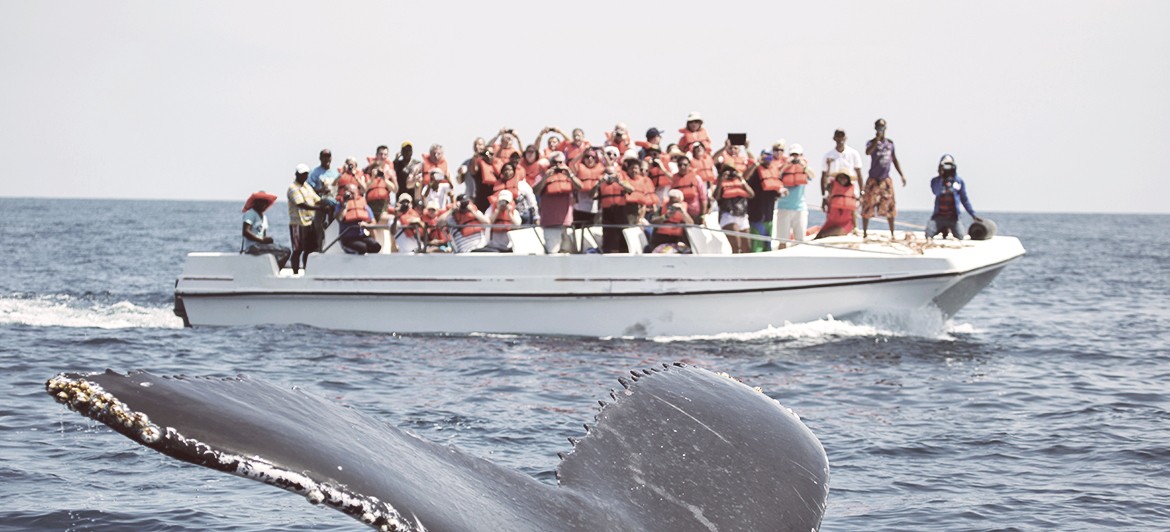
Este nombre es un toque de bienvenida a una de las excursiones turísticas más populares que se pueden realizar en el país: el avistamiento de ballenas. Todos los años, de noviembre a marzo, puedes disfrutar de la temporada de avistamiento de ballenas jorobadas gigantes, que vienen todos los años a la bahía de Samaná a parir sus crías y criarlas.
El avistamiento de ballenas también se puede realizar desde otras playas del país, pero la idea de observar ballenas desde esta playa fue una transición fácil y notable. Nombrar una playa entera por sus ballenas, crea curiosidad y hace que la gente quiera visitarla.
Pero la razón por la que me gusta tanto no es por las muchas características que mencioné anteriormente.
¿Qué más tiene de especial Playa Las Ballenas?
Caminar unos kilómetros sin aglomeraciones y observar hermosos atardeceres es lo que me enamoró de esta playa. Disfruté algunos días allí durante la temporada baja y nunca me decepcionó. Debe estar más concurrido durante la temporada alta, pero en meses como abril a junio (excepto las vacaciones de Semana Santa) y de septiembre a diciembre (excepto las vacaciones de Navidad), vale la pena visitarlo.
En mi perfil de Instagram, me llamo cazador de atardeceres. Las puestas de sol tienen un efecto muy relajante y calmante en mí. Es como la despedida de un caluroso y soleado día caribeño y se convierte en una cálida y estrellada noche. Pero la última hora de luz solar antes de anocheser es maravillosa.
Si disfrutas de las puestas de sol de la misma manera que yo, recopilarás valiosos recuerdos en Playa Las Ballenas en Las Terrenas. No estoy seguro de por qué esta playa me encantó más que otras en la isla, pero esta playa tuvo las puestas de sol más fascinantes que he visto hasta ahora en República Dominicana.
La belleza caribeña de Playa Las Ballenas
Es una playa muy limpia y tranquila en República Dominicana con el típico estilo caribeño. Los atardeceres pintorescos invitan a los viajeros a observar los hermosos colores de los atardeceres y amaneceres.
Quien tenga talento para la fotografía o la videografía puede desahogarse en Playa Las Ballenas y las muchas condiciones de iluminación suave y cambios de color que puedes disfrutar. Pocos visitantes pueden obtener más información sobre todo el bulevar de la playa.
Para mí, Playa Las Ballenas es una de las más hermosas de Las Terrenas y Samaná.
Vale la pena planificar al menos una noche allí. Con un poco de suerte, capturarás las mismas fotos y videos que hice. Allí iempre tuve veladas memorables. Perdido en mis pensamientos, observé los últimos tonos anaranjados y rosados de la luz del día.
Consideraría Las Ballenas como la mejor playa de Las Terrenas y una de mis favoritas en Samaná. Quizás incluso en toda la costa norte de República Dominicana. Pronto informaré más sobre las maravillosas playas de República Dominicana.
Pero este artículo debería dar a todos los lectores una buena impresión de qué esperar de los atardeceres caribeños en República Dominicana. También podrías leer otro artículo que escribí sobre una puesta de sol en el Caribe. Uno de los recursos más importantes de República Dominicana son los atardeceres infinitos.
Los Patos is one of the most visited beaches in the southwest of the Dominican Republic. I had the opportunity to visit this beach to see a breathtaking sunset. Luckily, I could take some nice photos and videos before it got dark at Las Patos in the Dominican Republic.
The online shop for auxiliary devices and services animals for seniors and people with disabilities
Introduction
WHO
Primary target group: People with temporary or permanent physical disabilities
• They need tools or aids to compensate for their missing abilities and readjust their behaviors and routines • Both sensory and movement aids after surgeries or accidents • Everyday tools to simplify life • Customized items for their individual purpose Service animals
Secondary target group: All relatives, family members, medical personnel, care attendants, etc.
WHAT
• A mobile app that shows users the inventory of items to support their daily lives • Especially elderly users AND users with visual or other impairments could use the app • Very large font types and images are needed • Voice control of the app must be implemented
WHEN
• Users would use this application situative once they need these aids
• There are no other special temporal or seasonal times than ‘during day time’
WHY
• Disabilities often come with a lot of costs that are barely covered by health insurances • To counteract this overproduction of goods and reuse existing resources before being demolished, people with lower incomes should have the opportunity to rebuy them • Especially elderly and disabled people are often tricked or pushed into purchasing goods or services they don’t fully comprehend, want or require for their needs. Hence, transparency is a major aspect when designing this app
CHAPTER ONE
Cohesive branding
1.1 Guiding Principles
Brand values
Transparency, competence and professionalism. We understand the market of health devices and services and see the abundance of production. Some monopolistic structures could be broken through with the idea of reusing components.
Personality
In a hectic world of constant movement, Helping Hand is not only a consultant and facilitator – We have an open ear as well and listen thoroughly to our users and their needs.
Mission
To counteract the overproduction of health-related goods, reuse existing resources and help people with lower income to purchase items they need.
Base foundations
Whenever you need a helping hand.
1.2 Optical identity
Strong coherence 1
Between logo and name: “Helping hand”.
Simplicity
The heart is always associated with positive emotions and medical care.
EYE FOR THE DETAIL
The brown hand is bigger, stronger and edgier – Should represent the hand of a caregiver. The black hand is rounder and slimmer – Should represent the target group.
Unidentifiable
In times of confused societies around genderism, these two hands are neither male nor female nor have any gender to avoid any discussions.
Helping Hand Logo – DraftHelping Hand Logo – Final
STRONG COHERENCE 2
Between logo and business idea: “Second-hand shop”.
Optical illusion
The hands in the heart are technically not there and adapt well to light backgrounds (Excluded selection).
Shape
The heart is softly rounded without hard edges.
Inclusion
Did you recognize, that the black hand has only three fingers? While the thumb might be hidden under the brown hand due to its perspective, this is an indication of a disability and handicap to foster inclusion.
1.3 Colors
Color theory
• All colors are monochromatic • They have a serious and mature personality • No funky or distracting signal colors • Colors look great in combination – All color tests passed successfully
Vision yellows with age
‘Older eyes are less able to distinguish the difference between blues and greens. Avoid using a color palette that is predominately blue, green or another “cool” color. Warm colors like red and yellow are best!’ (Source)
1.4 Imagery
• Simple icons, numbers are in extra large size, easy-to-understand data visualization
• Product images are clean and aesthetic with a white background
• Images should be shown in a realistic use case and as a problem solver
• NO complexity in data visualization needed
• NO reflections, shades or dark backgrounds
• NOT in unrealistic or heroic situations
1.5 Textual work
Principles
• Sans Serif • Strong contrast between background • Good legibility starts with text size • Letter Spacing should help straighten out the reading experience + 5% Kerning
‘Older adults and people with low vision have less difficulty processing typefaces like Arial or Helvetica. Without the serifs, it’s easier to recognize characters. The thing you’ll hear the most from older adults, though, is to make the type larger.’ (Source)
CHAPTER TWO
ARCHITECTURAL WORK
2.1 Low wireframes – it starts with pen and pencil
Same as always
I have a certain process in mind and only sketch the most distinct ideas. From originally 6 hand-drawn outlines I ended up with more than three times as much. All the other ideas “develop themselves” along the way.
Informational architecture
Low Wireframes are the start of every (good) project. I have my issues with pen and pencil because I don’t really like my analog outcomes. But for this project, it was very important to understand the informational architecture of a webshop for mobile devices and to follow the ‘less is more’ approach.
⬆ News feed is Home screen
After the register/login screen (left) a user should see a feed that adapts to the individual needs (right). The more information of the customer is known, the better additional services can be shaped for the medical conditions and product categories.
Multiple product views ⬇
You can see on the bottom two different search results (left and middle). I wanted to make sure, that users have the opportunity to select how many products they want to display horizontally at the same time.
2.2 Mid wireframes – Let’s digitalize ideas
Creating real shapes
Mobile screens are small and impaired eyes need help with cleaner and bigger shapes to be stronger perceived. Edgy shapes have a maximum radius of 12pt and all tapping elements should be bigger than usual and distant from each other.
Modeling architecture
Following the low wireframes, the mid wireframes give now a first impression on how to structure the final screens. The less text, the better. Images should be self-explaining and buttons easy to perceive and understand.
⬆ Never lose focus
To simplify information and avoid information overload, the screens only offer what is necessary. This might look minimalistic, but for overview pages, much space is the key. If the user taps on menus or interact with tap and hold, all other elements than the focus are blurred out (right screen).
Better legibility for reviews ⬇
Users are interested in what others review about products they need as well. The app should only include trusted reviews from verified customers. These reviews can be perceived in three different sizes to enlarge both into text and image.
2.3 High wireframes – Why adapted design matters
A smooth match
Both texts and images are adapted to the target group’s interests. They should be easy to read and impossible to misunderstand. The selected colors might calm the eyes and do not stress out a user during the interactions.
Design architecture
Now with the combination of the selected colors and the bigger elements to tap, a user can barely get lost within the application. The app bar on top of each screen appears after the registration/login and helps users to always understand where they currently are.
⬆ Mildly hues, artistic photos
This app wants to give an artistic glimpse of the products and services it offers. In contrast to many smiling and happy consumers in dubious brochures, photos should only indicate a product category and be either darkened or brightened to emphasize the text. Product photos should demonstrate a professional feeling.
Always give users the option to decide ⬇
Users should be able to always enter a product after searching for it. The button ‘put in cart’ will only be available on the product level. A helpful button for accessibility assists if users need additional help on this page to read out loud or zoom texts for better legibility.
2.4 Desktop version
1920*1080px
More white space, three columns
Two fixed bars to facilitate website access
1st level: Contact information, shopping cart, language settings and user menu
2nd level: Main product categories
Two verticle widgets on the sides which follow scrolling
Left: Accessibility (a sub-menu with extensive functions to support impaired users)
Right: Help Finder (a clickable survey to make users help with the right filters to know what they need)
CHAPTER Three
REFINEMENT
3.1 Final mockups
3.2 Prototype
Are you interested to test it on your device?
• Android large (360*800px) • Works best on your computer
An 80’s music player app with a dark mode and flashy neon colors for music enthusiasts. Retro feelings guaranteed!
Initial situation
Objective
To design the UI and 2 to 3 key functionalities for an 80s music player mobile app.
Target audience
The target audience is primarily 35 to 55-year-olds.
Competitor research
In times of online music streaming such as Spotify, Deezer, and Amazon Music, I was surprised to find some competitors of 80’s music players in the app stores. Soo…what do they have to offer?
Best 80s Music from THISOTHO DEV
Good:
(overall) Black main navigation, white text: Easy to read
(1st screen) The main focus of the first three images isn’t shown, but our mind completes it ‘automatically’. These are very good examples for the ‘Law of Closure’ and I like the creativity.
(2nd screen) All proportions seem to be work out and fit vertically and horizontally better into the scheme. All songs seem to be numbered, have artist and song name and come with the additional info of the release date.
Neutral:
The player is too simple to use to do something wrong. Simplicity and minimalistic behaviour overrule deep design and multiple functions.
Bad:
The app randomly lists music. As a user, I don’t have a search function which is frustrating.
Although it’s a cool guitar in the background, it makes it too difficult to perceive.
Good:
Well…it plays music. And it was free.
Neutral:
The player is too simple to use to do something wrong. Simplicity and minimalistic behaviour overrule deep design and multiple functions.
Bad:
The app randomly lists music. As a user, I don’t have a search function which is frustrating.
Just the song title. No artist, year of release, etc. Terrible!
Awful relation between background and front. Font is almost illegible. Too busy and hurts both eyes and feelings.
Red as primary color in the navigation bar is too aggressive and white elements are hard to read to sensitive eyes.
There are no functions at all. You open the player and music starts yelling at you. There isn’t any other thing to do.
The Best 80’s Hits from ELI LABS APPS
First, I was surprised about other 80’s music player apps. Later on, I was surprised about how badly designed both were. There were even many other 80’s music player apps in the app stores. But all seem to have the same approach: Just play the music and earn money with the in-app-ads. All in all, it was disappointing to see, what they were trying to do with this great decade of music. No one really tried to put dedication and appreciation into their work.
Low wireframes
After analyzing the competitor apps, it was now time to design some first steps into the app. I was brainstorming my cerebral CPU, it was now the time to design the naked skeleton that should support the overall feeling once a user interacts with the app.
I must admit, that I won’t become the next Picasso anymore and my hand-drawings can’t even compete with the ones from a 7-year-old. Still, it’s enough to comprehend, what I was trying to convey with my pen and paper sketches.
Ideation
Okay, first things first. Now I know what competitors do and have already set up a bony skeleton with my low wireframes. But I miss the essential parts that distinguish my application from other 80’s music player apps. Where should I go?
Before I decide to run in a direction, I should at least take a look at a map to define my position. North, east, south, or west?
Damned, these ’80s were really an inspiration and not for nothing considered in modern media as ‘the last decade with real style’. So much to discover, so many looks and feels, and such a variety of visuals. Where should I start?
With a good Mood Board, I suppose.
Mood Board
Colors, colors, colors!!
So I designed and researched about ’80s typical album covers, fashion styles, and contemporary technology.
The mood board really helped me to later define my project and design it with the resources I gathered during the inspirational session with my mood board. Here are the major outcomes:
Font Type
I like the font type ‘Flash Rogers’ because of its bold appearance and toothed edges. Typical 80’s, very rough and placative! But then I figured, that this would be a bad choice for mobile devices and could serve at most as a stylistic headline.
I rather selected a pretty normal font type (SF Pro Text) than this extraordinary one. Better safe than sorry!
David Bowie
Especially the flash on David Bowie’s face caught my interest. Although it comes from his album ‘Aladdin Sane’ that was released in 1973, I always think about David Bowie with this funky flash in the face. And David Bowie was always an icon that survived decades and was really successful in the ’80s.
So why not choose him and the flash as the major visual anchor?
Colors
These soft pastel shades and gaudy neon colors are somehow typically 80’s style. Miami Vice, Aerobics, video games, illuminated advertising, Glamour, and Punk Rock. But all in all too bright for apps with a white background and too much of a signal color if it was chosen as the main attribute.
With all these aforementioned typical 80’s components in mind, I thought about experiencing the dark mode for my project. I love dark modes! Having a dark background and these typical 80’s colors as a strong accent would surely make an impression!
Technology
Technology was rapidly developing and former analog mechanics were digitalized step by step. It was an interesting transition phase. But we still talk about the early phase of them. Bulky forms, big screens, heavy control mechanisms, and linear regulators represent the 80’s for me.
Maybe this can help to convey the ’80s retro feeling inside the app!
Hands on mentality: Let’s start the real 80’s design!
Finally, it is time to clean brushes and open up the paint pot. Sharpen all pens and calibrate compass and grids. You know, what I want to express: All the necessary, but time-consuming pre-work is completed. Now the real fun part starts, that every designer is looking forward to: Rolling up the sleeves and acting out the hands-on mentality!
Mid-wireframes
I wanted to call this app first ‘Gr80vy – Your favorite 80’s radio station from the golden age of music’ and designed my mid-wireframes accordingly. After doing some more intensive research, I corrected myself and gave up that idea. Here’s why:
Problem with ‘the golden age of music’
Some say that the golden age of music was from the 1960s to the 1990s. Others claim, that the golden age ended with the ’60s. I also found out that this term was used often to describe classical music as a whole. To sum it up: This term is probably too broad and every generation likes to refer in a retrospective their favorite decade as the ‘golden age’. In any event, some music genres have their own ‘golden ages’ and heydays.
Mid wireframe: Login fields
Mid wireframe: Home screen
Mid wireframes – Play artist next
Mid wireframes – Music player
Problem with Gr80vy
The double OO of ‘groovy’ with the 80 was supposed to help the user to identify quickly the right decade. It was a provoked eye-catcher to quickly gain attention. Later, I found out after some additional research that both ‘groovy’ were a linguistic term that doesn’t represent the 80’s exclusive. It was heard amongst jazzmusicians in the 1920s but is widely associated with the hippie era of the ’60s. It was in the 80’s not predominantly used anymore and already considered an outdated term.
Logo
Remember the flash in David Bowie’s face? The font type ‘Flash Rogers’? A colorful mix of neon and pastels? Half analogous and half digitalized technology? I was subliminally influenced by all of these components without taking notice of it. The melancholic feeling of being born in the wrong decade emerged stealthily during my work on the designs for this application.
In any event: Please let me visually show you the outcome I was describing before. I created this logo by myself and it is not part of another font type. The word ‘synthy’ comes from the synthesizer and is purely 100% associated with the ’80s as this was one of the principal audio tools to produce music.
Synthy – Flashy as the 80’s
I was trying to use the exact same color codes as the flash in David Bowie’s face. Depending on the digital image and brightness, it might not be as accurate like the original photo quality on the album cover.
#ED1651 – Pink Red
#077BCF – Water Blue
Drawing every letter by hand was almost a side project. I wanted to incorporate the S as the flash, but couldn’t risk alienating all letters as well in the same method. Especially the two ‘Y’ were challenging to design. N and T and H are the middle of the logo and should be therefore easy to recognize and comprehend.
The Dark Mode is Pitch Black with #000000 to ensure that other hues highlight the contrast of pastel or neon colors in the best possible manner.
And by the way: From now on we talk about the iconic age of music 🎸⚡️🤘🏼
High wireframes
From low to middle to high. It is now the time to shape the user flows into their final version. This project was a real joy and I had a lot of fun with the transfer to the high wireframes to inhale some life and spirit. Here is the outcome:
Pre login experience
I wanted to create a certain feeling before a user registered or logged in for the first time. Something I always wanted to call a ‘pre-login experience’. The idea for that term came to me when I was designing the screens for this app. In my mind, I wanted to convey the 80’s feeling already after a user downloads successfully the application from an app store and before the actual set up.
A user should have the opportunity to preconfigure the application and style it as desired. Thus, I researched and decided on four iconic music styles – New Wave, Electro, Punk, and Glam Rock. All of them with appropriate neon colors.
Although technology is rapid nowadays, I wanted to include a loading screen that vertically opens up with the loading progress. People are usually impatient. But remember the target group? We talk about users of the age group 35 to 55. These people are used to waiting and knowing loading screens. It’s a compelling feature that happens only one single time and is a literal real eye-opener.
So let’s go for the Punk color and rely on purple for the rest of that simulation. I designed all screens accordingly with this color code to style the accents of the app in the same look and feel:
#D6A1F7 – Lilac
#C568A5 – Purplish Pink
Surely, a user should have later the opportunity to reconfigure his color style. It should not be an exclusive functionality during the login and is always available to adjust later on.
Home screen
Three very horizontally chosen images on top with each 410px width to offer quick actions for the user. Other than that, icons have thin lines and appear as circles with a neon sign, all with 100*100px.
(v1) – I decided you use these thematic and ambient photos on top. To improve the visibility, I lowered the saturation to 0% to make them b/w and absorb all colors. They are still visible and every image has a radial overlay of the same color characteristics as we chose before during the pre-login experience.
(v2) – Originally, I had this version in mind with the original colors of the photo. But they make the visual experience too busy and are colorful overkill for users. Thus, I discarded it it went for the more artistic (v1) to prefer no colors and b/w.
The first screen of the search function come quite empty but encourages the user to tap the search bar. A total number of search results should be always visible inside of the search bar on the bottom right to give indication about the search term.
In this example, I want to look for the most difficult search term ‘the’. I have too many search results of different categories and should use a category filter (e.g. album, artist) to find what I am looking for. All search terms are bold and in capitals to facilitate UX.
A click on the filter icon of the previous screen helps the user now to decide what category filter should be applied. In my example, I only want to search for artists with ‘the’.
We can see, that all search results now have the right category icon and that the number of search resulkts decreased. I want to listen to The Cure now.
Search a song
Equipped with an extensive database, you should always have the chance to search for your favorite song and not solely have to rely on a player that shuffles randomly music. Now is a good moment to show photos in their original colors.
1st screen: Empty state.
2nd screen: Being overwhelmed by search results with ‘the’.
3rd screen: Applying a filter to improve search results.
4th screen: Reduced search results of the desired filter category.
Play a song
Before I listen to the music of The Cure, I can swipe through the top screen area to decide which LP I want to listen to. I am on the artist level and have more options to chose from. Round icons are again 100*100px to ensure an easy selection and quick tapping.
1st screen: Artist level, main overview.
2nd screen: Music player, song metadata.
3rd screen: Lyrics of my selected song.
4th screen: LP cover to convey some more 80’s feelings.
Now I am on the artist level of ‘The Cure’ and can swipe through their album (covers). Icons below are again in round neon signs. A user has quick access to decide what to do now.
I am listening now to one song of the previous selected album. This screen shows you the music player and the song meta data with all necessary information. The horizontally organized arrows allow more visuals for the music player. Icons have changed again.
Instead of the generic meta data, I can also simply read the lyrics if I want to.
If I like to see the the original LP cover to get some more 80’s feelings, I can select that as well.
Tired of ads? Go full version!
I felt reminded about the competitor apps. Both of them showed below the bottom navigation bar advertisements for mobile users. Somehow you have to finance these applications and want to get reimbursed for your efforts and the expensive licensing costs to stream the music. In my designs, I spared out the ads because I wanted to of course design very clean and neat screens.
You can see on the bottom of all screens an ad placeholder for the mobile leaderboard (320*50px). I would like to give users the option of a full version without seeing advertisements during the usage of the app. Thus I developed three different bundles where users can benefit from an increased performance level and more functions.
A location-based recommendation app that helps users with the transition to find like-minded offline gaming partners for their favorite games.
Connect online.
Meet offline.
Play Fline.
Philosophy of Fline
Fline aims to become the first contact point and transition for offline gamers. The main goal is to create and foster communities and make people have a great time when they play games.
Who is the target audience?
Two main groups exist:
Hosts of catering establishments (owners)
Guests of catering establishment (offline gamers)
Why an app for that?
no real competition
support the catering industry after Covid
help offline gamers to find each other
profit from micro transactions
User research
I did compelling research and the outcome was a big success for me and my project. I gained valuable insights about offline gamers and their preferences.
Daniel searches for other gamers to connect and to build up new friendships. He doesn’t know where to find other gamers or locations in the city.
Daniel wants to find:
new people
ways to connect
free WiFi
free games, fun, no payments
cool functions and gamification
Tommy (medium user)
40-49 years old
Mechanic
Captain of a Darts Club
Income: $30.000 per year
Goes out 7/30 days
🇬🇧
Tommy can’t find new players and always competes with the same people. He loves his game but is bored of the repetition. He looks for the right people.
Tommy wants to find:
challengers
competition
players on his level
bet and win money
record and save games
Raquel (heavy user)
30-40 years old
Divorced and kids
Gambles and bets
Salary: $45.000 per year
Goes out 11/30 days
🇪🇸
Raquel searches for organized tournaments and gambling rounds to earn money close to where she lives. But she would also travel to play with others.
Raquel wants to find:
other gamblers
entertainment
good locations
people who bet money
easy payment transactions
Gathering requirements and product development
Why do users need Fline?
plan and organize their nights
find people with mutual interests
find hosts that offer their offline games
reserve a table and gaming equipment
Why do hosts need Fline?
attract new customers
promote their business
organize events
offer new services
save marketing budget
MVP Objective
To realize get-togethers between offline gamers with the same interests and make them play offline games with each other at their desired catering industry location.
JTBD and Feature Requirements
Users need to create a profile and adjust it to their interests
Users need to search for locations that offer offline-games
Users need to search for other members with the same interests
Users need to interact with each other and exchange messages
Style guide
Now we need some brand identity.
Tone of voice
Fline wants to be perceived as…
a little funny like an entertainer
a little distant like a croupier
a little crazy like a Poker Player
a little professional like a gambling manager
a little challenging like a competitor
a little straightforward like a bouncer
= like a sloppy, extraordinary, surprising and extroverted visit in Las Vegas
Icons
Simple. Minimalistic. Thin Lines.
Buttons
Earthy colors. Warm and ignified atmosphere. Softer perception for the eyes.
Color palette
• Black and red are the traditional gaming colors. But shiny red acts too much as an aggressive signal color and might disturb users eyes. I still used a red hue, but in a darker and softer version. Only for fine tuning and in the logo to create a visual anchor to the traditional gaming colors and to enable a gaming atmosphere.
• Touch of golden colors were used to pimp up an elegant and pricy accent.
• Some elements in this app have lateral linear transitions and color combinations to foster an illuminated gaming atmosphere.
The northern coast in the Dominican Republic got famous for its many beautiful beaches. In contrast to the southern side of the island, the north has lower temperatures to offer and more wind to cool down and do some water sport activities. Additionally, you’ll find fewer algae and finer-grained sand at the beaches. I was happy, spending time at one particular beach and would like to recommend it to every interested traveler. Read in this article, why Playa Las Ballenas is the best beach in Las Terrenas and worth a visit.
Approximate reading time: 5 minutes
Advertisements
Would you like to read this article in another language?
Located in the Northern part of the Samaná Peninsula in the Dominican Republic, Playa Las Ballenas is a must-visit in Las Terrenas. Flanked with many apart hotels and vacation homes, Playa Las Ballenas can be easily found in the northwest area of Las Terrenas. It’s one of the most visited beaches in Las Terrenas.
Due to its good and central location, one would expect this beach to be overrun by many tourists. Surprisingly, I was able to have completely different experiences. This beach is not littered and in a much better and clean condition than I expected. Whenever I was there, I almost had the whole beach to myself:
Las Ballenas in the Dominican Republic
Las Terrenas is one of the most visited areas in the Dominican Republic. Maybe I was just lucky to have had the right timing for my visits. But what about the name Playa Las Ballenas? Why is this beach called Playa Las Ballenas?
Why is this beach called Las Ballenas ?
Named Las Ballenas because of three rocky stones in the distance that resemble humpback whales, this spacious, wide white sand stretch with a shallow, calm sea sits right in the heart of Las Terrenas’s small town.
The name ‘Las Ballenas’ is therefore a welcoming hint to one of the most popular tourist excursions that can be done in the Dominican Republic: Whale watching. A ‘ballena’ is the direct translation of ‘whale’ in Spanish. Every year from November to March, you can enjoy the whale watching season in the Dominican Republic. Giant humpback whales come every year to the bay of Samaná to give birth to their calves and breed them.
Whale watching is not an exclusive feature of this beach and can be done from other beaches in the Dominican Republic, too. But the idea to observe whales from this beach was an easy and remarkable transition. Naming a whole beach after its whales creates curiosity and make people want to visit it.
But the reason I like Playa Ballenas so much is not because of the many features I mentioned above.
What else is special about Playa Las Ballenas?
Walking a few miles without crowds of people and observing beautiful sunsets is what made me fall in love with this beach. I enjoyed some days there during the off-season and was never disappointed. It must be more crowded during high seasons. But in months like April till June (except Easter holidays) and from September till December (except the Christmas holidays), it’s worth a visit.
In my Instagram profile, I call myself a sunset hunter. Sunsets have a very relaxing and soothing effect on me. It’s like the farewell of a hot and sunny Caribbean day and turns into a warm and starry night. But the last hour of sunlight before it sets is a marvelous one.
If you enjoy sunsets the same way I do, you’ll collect some valuable memories at Playa Las Ballenas in Las Terrenas. Not sure, why this beach charmed me more than others on the island. But Playa Las Ballenas had the most fascinating sunsets I’ve seen so far in the Dominican Republic.
The Caribbean beauty of Playa Las Ballenas
Playa Las Ballenas is a very clean and peaceful beach in the Dominican Republic with the typical Caribbean flair. Picturesque sunsets invite travelers to observe the beautiful colors of sunsets and sunrises.
Whoever has a talent for photography or videography can let off steam at Playa Las Ballenas and the many soft lighting conditions and color changes that can be enjoyed by a loved one. Few visitors can find out more about the entire beach boulevard.
For me, Playa Las Ballenas is one of the most beautiful beaches in Las Terrenas and Samaná.
It’s worth planning at least one evening there. With a bit of luck, you’ll capture the same photos and videos I did. I always had memorable evenings at Playa Las Ballenas. Lost in thought I observed the last orange and pink hues of the daylight.
I would consider Las Ballenas as the best beach in Las Terrenas and one of my favorites in Samaná. Maybe even on the whole northern coast of the Dominican Republic. Soon, I’ll report more about the marvelous beaches in the Dominican Republic.
But this article should give every reader a good impression of what to expect from Caribbean sunsets in the Dominican Republic. You should also check out another article I wrote before about a Caribbean sunset. One of the most important resources in the Dominican Republic are the infinite sunsets.
Los Patos is one of the most visited beaches in the southwest of the Dominican Republic. I had the opportunity to visit this beach to see a breathtaking sunset. Luckily, I could take some nice photos and videos before it got dark at Las Patos in the Dominican Republic.
Did you like this article? I can promise you, that many other articles are currently under construction and just wait for you to be read. Come back regularly and check out many more interesting stories about the Dominican Republic 🇩🇴
Die Nordküste der Dominikanischen Republik ist bekannt für die vielen schönen und endlos langen Strände. Im Gegensatz zur Südseite der Insel bietet der Norden dank niedriger Temperaturen und mehr Wind bessere Konditionen für Wassersportler und Sonnenanbeter gleichermaßen. Außerdem finden sich an den Stränden weniger Algen und mehr feinkörniger Sand. Ich hatte das Glück, viel Zeit an einem bestimmten Strand an der Nordküste zu verbringen und empfehle jedem Reisenden einen Besuch dort. Lies Sie in diesem Artikel, warum Playa Las Ballenas der beste Strand in Las Terrenas und auf jeden Fall einen Besuch wert ist.
Ungefähre Lesezeit: 5 Minuten
Advertisements
Would you like to read this article in another language?
Playa Las Ballenas liegt im nördlichen Teil der Halbinsel Samaná in der Dominikanischen Republik und gilt fast als Pflichtbesuch bei einem Aufenthalt in Las Terrenas. Flankiert von vielen Hotels und Ferienhäusern befindet sich Playa Las Ballenas im Nordwesten von Las Terrenas. Eigentlich kaum zu verfehlen, ist es einer der meistbesuchten Strände in Las Terrenas.
Aufgrund seiner guten und zentralen Lage würde man erwarten, dass dieser Strand von vielen Touristen übersät ist. Überraschenderweise habe ich andere Erfahrungen machen dürfen. Playa Las Ballenas begrüßt seine Besucher in einem guten und sauberen Zustand. Immer wenn ich dort war, hatte ich fast den ganzen Strand für mich allein:
Foto Panorámica de una de las playas más hermosas de Las Terrenas
Las Terrenas ist eines der meist besuchten Gebiete in der Dominikanischen Republik und touristisch sehr gut erschlossen und kommerzialisiert. Vielleicht hatte ich einfach das Glück, das richtige Timing für meine Besuche gehabt zu haben. Aber was ist mit dem Namen Playa Las Ballenas? Warum heißt dieser Strand Playa Las Ballenas?
Warum heißt der Strand Playa Las Ballenas?
Den Namen Las Ballenas verdankt dieser breite Strand drei großen Felsen, die aus der Ferne wie Buckelwale aussehen. Er liegt direkt bei dem kleinen Ort Las Terrenas und erwartet Sie mit seinem weißen Sand und flachem, ruhigem Wasser.
Der Name ‘Las Ballenas’ ist ebenfalls ein willkommener Wink mit dem Zaunpfahl auf einen der beliebtesten Touristenausflüge in der Dominikanischen Republik: Walbeobachtung. “Ballena” ist die direkte Übersetzung von “Wal” auf Spanisch. Von November bis März lassen sich jährlich Buckelwale in der Dominikanischen Republik beobachten. Jedes Jahr kommen riesige Buckelwale in die Bucht von Samaná, um ihre Kälber zur Welt zu bringen und sie großzuziehen.
Wale zu beobachten kann auch von anderen Stränden in der Dominikanischen Republik aus durchgeführt werden. Wenn aber schon der gesamte Strand wie ein beliebter Ausflug heißt, ist das eine clevere Namensgebung an dieser Stelle. Wo ‘Wale’ drauf steht sind meistens auch Wale drin.
Aber der Grund, warum ich Playa Ballenas so sehr mag, liegt nicht am lustigen Namen oder der Möglichkeit zur Walbeobachtung, die ich oben beschrieben habe.
Was ist das Besondere an Playa Las Ballenas?
Ein paar Kilometer ohne Menschenmassen zu laufen und wunderschöne Sonnenauf- oder Untergänge beobachten zu dürfen, schuf eine ganz besondere Verbindung zwischen Playa Las Ballenas und mir. Ich habe dort einige Tage in der Nebensaison genießen dürfen und wurde nie enttäuscht. In der Hochsaison muss es dort natürlich deutlich aktiver sein mit viel mehr Trubel und Lärm. Aber in den Monaten von April bis Juni (ausgenommen die schwer frequentierten Osterferien) und von September bis Dezember (mit Ausnahme der Weihnachtsferien) ist Playa Las Ballenas definitiv einen Besuch wert.
In meinem Instagram-Profil erkläre ich mich unter anderem als ‘sunset hunter’. Sonnenuntergänge wirken sehr entspannend und beruhigend auf mich und sich für mich ein fester Bestandteil meiner Tages,- bzw. Abendplanung. Es ist wie der Abschied von einem heißen und sonnigen karibischen Tag um eine warme und sternenklare Nacht willkommen zu heißen. Aber die letzte Stunde mit Sonnenlicht ist in der Dominikanischen Republik oftmals ein Grund um gedankenversunken am Strand zu sitzen und den Horizont zu beobachten.
Wenn Du Sonnenuntergänge genauso genießt und wertschätzt wie ich, wirst Du am Playa Las Ballenas in Las Terrenas einige wertvolle Erinnerungen sammeln können. Ich bin mir nicht sicher, warum dieser Strand mich mehr bezauberte als viele andere Strände auf der Insel. Aber Playa Las Ballenas hatte die faszinierendsten Sonnenuntergänge zu bieten, die ich bisher in der Dominikanischen Republik gesehen habe.
Die karibische Schönheit von Playa Las Ballenas
Playa Las Ballenas ist ein sehr sauberer und beschaulicher Strand in der Dominikanischen Republik mit dem typischen karibischen Flair. Malerische Sonnenuntergänge laden Reisende ein, die wunderschönen Farben von Sonnenuntergängen und Sonnenaufgängen zu beobachten.
Wer auch immer ein Talent für Foto- oder Videographie hat, kann sich am Playa Las Ballenas austoben und an den vielen sanften Lichtverhältnissen und Farbwechseln während eines Sonnenunterganges erfreuen. Wenige Besucher ermöglichen eine beinahe freie Sicht und Aufnahmen über das gesamte Strandboulevard.
Für mich gehört Playa Las Ballenas zu einem der schönsten Strände in Las Terrenas und Samaná.
Es lohnt sich, mindestens einen Abend dort zu planen. Mit etwas Glück kannst Du ähnliche Fotos und Videos aufnehmen, die ich am Strand machen durfte. Ich habe immer unvergessliche Abende am Playa Las Ballenas verbracht. In Gedanken versunken beobachtete ich am Strand die letzten Orange- und Rosatöne des Tageslichts.
Ich würde Las Ballenas als den besten Strand in Las Terrenas und als einen meiner Favoriten in Samaná bezeichnen. Vielleicht sogar einen der schönsten Strände an der gesamten Nordküste der Dominikanischen Republik. Bald werde ich mehr über die Strände in der Dominikanischen Republik berichten und neue Artikel schreiben.
Dieser Artikel soll Dir jedoch einen guten Eindruck davon vermitteln, was Dich bei all den Sonnenuntergängen in der Karibik in der Dominikanischen Republik erwartet. Lies Dir bei Gelegenheit auch einen anderen Artikel durch, den ich zuvor über einen Sonnenuntergang in der Karibik geschrieben habe. Eine der wichtigsten Ressourcen in der Dominikanischen Republik sind die unendlichen Sonnenuntergänge und ich könnte noch viel mehr Fotos und Videos aufnehmen und Artikel schreiben.
Los Patos ist einer der meist besuchten Strände im Südwesten der Dominikanischen Republik. Auch der kürzeste Fluss der Dominikanischen Republik mündet in die Karibische See. Ich hatte die Gelegenheit, diesen Strand gegen Einbruch der Dunkelheit zu besuchen. Mir sind ein paar schöne Fotos und Videos mit dem Sonnenuntergang bei Las Patos in der Dominikanischen Republik…
¿Cómo se siente cuando estamos atrapados entre dos mundos? Aunque solo hay un planeta en el que vivimos los humanos, este dicho se usa a menudo. ¿Hay algo más en este dicho expresado casualmente que la falta de orientación y la búsqueda de identificación? Me di algunas reflexiones profundas sobre el concepto de expatriado y analicé diferentes perspectivas cuando estás atrapado entre dos mundos y por qué era lo mismo para mí.
Would you like to read this article in another language?
También he tenido la sensación de estar atrapado entre dos mundos. Por tanto, me resulta un poco más fácil describir este extraordinario estado. Estar atrapado entre dos mundos debe entenderse más como un símbolo. Este artículo no trata sobre viajes espaciales interestelares. Estos dos mundos simplemente simbolizan sociedades diferentes que están geográfica y culturalmente distantes entre sí.
Requisitos para sentirse atrapado entre dos mundos
Es necesario cumplir algunos requisitos antes de que podamos sufrir este dilema. Porque estar atrapado entre dos mundos es más fácil decirlo que hacerlo. ¿Qué se necesita exactamente antes de que se pueda desencadenar una sensación de estar atascado?
Requisito mínimo: otro mundo
La primera premisa es que tiene que haber al menos el segundo mundo. Sin la existencia de tal segundo mundo, ningún sentimiento extraño puede desarrollarse en nosotros. En un solo mundo puede permanecer cómodamente sin la sensación de estar atrapado en otro mundo.
La gaviota también tiene pasión por los viajes y está mucho más interesada en la costa extranjera que en la que se encuentra.
Pero tan pronto como llegamos a conocer un segundo mundo de al menos la misma naturaleza y calidad o de diferente tipo, se puede desarrollar en nosotros un dilema intrapersonal. Eso es fácil de explicar: nos atrae tanto en el otro mundo al menos como en nuestro mundo ancestral.
Ahora, de repente, ya no sabemos a cuál de los dos mundos nos gustaría dar preferencia. Después de todo, ambos mundos tienen muchas ventajas y desventajas que ofrecer y estamos librando una dura batalla por nuestras preferencias.
Cuanto más peculiares son estos mundos, más carácter ofrecen
Además de la mera existencia de un segundo mundo, estos dos mundos siniestros deberían ser tan distintos y diferentes entre sí como sea posible. Se puede desarrollar un fuerte contraste y un carácter definido entre las dos opciones a través de las diferencias deliberadas entre las características individuales.
En la selva ecuatoriana con indígenas. Los mundos que chocan en esta foto no podrían ser más diferentes. Las mujeres de esta foto nunca pensarían en usar calcetines amarillos.
Cuanto más se diferencia un mundo del otro en determinadas formas y características, más nos damos cuenta de las diferencias mutuas y de las ventajas respectivas.
Sin embargo, tanto la percepción como la identificación de un segundo mundo son de naturaleza puramente individual y son difíciles de determinar o incluso de calcular. Donde una visita a una parte diferente de la ciudad o un pueblo cercano ya parece ser ‘un mundo completamente diferente’ para algunos, hay muchas otras personas que necesitan otros países, idiomas, culturas y grupos étnicos para determinar otro mundo.
Diferentes tipos. Barbas similares.
Cuando se abre un segundo mundo, es bastante difícil de expresar con palabras y ciertamente no se determina por números. Es solo un impulso individual que se siente diferente para todos. Sin embargo, se necesita una variable concreta antes de que se desarrolle el sentimiento de un segundo mundo: el factor tiempo.
Advertisements
El factor tiempo determina el grado de intensidad de nuestro punto de referencia al otro mundo
¿Quién se cuestiona por estar atrapado entre mundos?
Todas aquellas personas que pasan un tiempo particularmente largo en un lugar que antes les parecía tan extraño, en algún momento sentirán una cierta pertenencia. Porque solo cuando ha pasado el tiempo suficiente, sentimos y desarrollamos un punto de referencia emocional hacia el otro mundo. Los puntos de referencia pueden ser verdaderamente todos los elementos y aspectos que otro mundo tiene para ofrecer.
Muchos puntos de referencia emocionales en una imagen: arte, colores, cultura, estilo de vida.
Todas las expresiones interpersonales como el lenguaje, todo tipo de bellas artes, moda y maquillaje, cultura, comportamientos extravagantes, incluso ciertos movimientos caprichosos, delicias culinarias y un estilo de vida extrovertido. Cuanto más expresionista y perceptible sea un punto de referencia que emana de los humanos, antes podremos desarrollar cierta emocionalidad, encontrar placer en ella y finalmente identificarnos con estas características del otro mundo.
Pero elementos naturales como la flora y fauna local o las zonas microclimáticas y sus elementos asociados pueden despertar nuestra admiración. Después de todo, es más probable que asociemos la singularidad de un entorno natural con un punto de referencia emocional que una estructura hecha por el hombre en los desiertos de hormigón.
Los animales también pueden representar un punto de referencia emocional que asociamos con un lugar determinado.
Así que supongamos que dentro del otro mundo tanto los humanos como la naturaleza ejercen cierta atracción sobre nosotros y que también nos gusta. Tal vez incluso a nosotros nos gusta tanto que nos hechizaron. Entonces decidimos quedarnos en este lugar por un período más largo.
En resumen: cuanto más tiempo pasamos en un mundo extraño, más intensos son nuestros puntos de referencia emocionales y nuestro sentido de pertenencia a él. Desde cierto momento X en el tiempo, somos parte del nuevo mundo, sobrevivimos ya al choque cultural diferente y nos establecimos firmemente en la nueva sociedad. Un segundo corazón comienza a latir en el pecho por el nuevo mundo.
Advertisements
¿Quién es elegible para este sentimiento y quién no?
Los viajeros sospechan que están sufriendo este fenómeno. Si se sienten particularmente cómodos en más de un lugar y siempre comunican fotos y videos asombrosamente hermosos, pueden pensar que están atrapados en algún lugar entre mundos. Sin embargo, siempre asumimos que los viajeros son aventureros extraviados que se apresuran de un lugar a otro sin el deseo de comprometerse con un lugar.
Apenas se quedan en ningún lugar por más tiempo y permanecen en el mismo lugar. Si lo hicieran, por supuesto, dejarían de ser viajeros y perderían este título elegante y autoproclamado que le gusta llamar mucho la atención.
Un viajero
Un expatriato
Visto de esta manera, todos los viajeros y trotamundos no califican para estar atrapados entre mundos. Pueden hacer esto como máximo en la zona de tránsito de un aeropuerto si perdieron su vuelo de conexión y no pueden perseguir el próximo destino objetivo.
¿Qué ó quién es un expatriado?
Si ni siquiera los viajeros, los trotamundos y otras personas errantes pueden quedarse atrapados entre los mundos, ¿quién lo hace? La selección de un posible grupo objetivo se desvanece lentamente. Pero a la inversa, significa que nos estamos acercando cada vez más al asunto.
Advertisements
¿Quién es un expatriado?
En el lenguaje moderno y de moda, simplemente se llamarían expatriados y no emigrantes. Describe a todos aquellos que han buscado fortuna en otro país y han dejado atrás su tierra natal con buena suerte para vivir allí.
La palabra ‘expatriado’ se compone de las dos partes ‘Ex’ (antes / de) y ‘Patria’ (hogar). Si la palabra ‘expatriado’ se traduce y define correctamente, el resultado es una persona que ha abandonado su propio país de origen. Mira cómo el Diccionario Oxford define esta palabra:
A person living in a country that is not their own
Fácil y sencillo. No se da ninguna motivación a esta definición. Puedes ser estudiante, trabajar o simplemente perder el tiempo en un país que no es el tuyo. ¿Puedes llamar tuya a tu propia patria? En este caso, debes ser un hombre o una mujer muy rica. ¡Felicidades!
En última instancia, los expatriados no son más que trabajadores migrantes de países más desarrollados que buscan la residencia permanente en el país de destino por su cuenta. Esto distingue el término de inmigrantes o trabajadores invitados. Y por supuesto también de todos aquellos privilegiados que son enviados al exterior por una empresa durante unos años con un contrato de trabajo riquísimo.
Los expatriados son mucho más que viajeros temporales, pero aún menos arraigados que los nativos locales de un ‘nuevo mundo’ sin una historia en ese lugar. Esta posición de expatriado, difícil de definir, se refleja en la naturaleza fundamental de lo que hace.
Deambulando por Huancaya, Perú
Lo describí anteriormente con dos palabras clave en el primer párrafo de este capítulo.
Fortuna y suerte 🍀
Ningún expatriado en este mundo sabe sobre el posible éxito o fracaso de su proyecto antes de dejar su país de origen. Todo sucede a riesgo de la suerte, equipado con el principio de esperanza y una pizca de aventura.
No hay un tiempo mínimo para ser o convertirse en expatriado
Pero solo nos convertimos en expatriados cuando hemos podido vivir en nuestro nuevo mundo durante varios años y asimilarnos. Hay más que solo afianzarse. Echar un ancla en el nuevo mundo y echar raíces es una simbolización mucho más apropiada. Establecerse y ser capaz de mantener la vida con recursos propios parece encajar mucho mejor en el contexto.
Pero pueden pasar muchos meses y años antes de que eso suceda. Después de unos días, semanas o meses, nadie podrá afirmar haberlo hecho en el país de destino. Más que un objetivo firmemente definido, este proceso es lo que madura en un expatriado.
Restaurante ‘Tiroler Adler’ en Pozuzo ¿Quién de esos dos es peruano y quién es alemán?
Advertisements
¿Cuándo empiezo a quedarme atrapado entre dos mundos?
Y dentro de este proceso, se puede desarrollar el mismo sentimiento que describí al principio. Estar atrapado entre dos mundos. Esto suele ocurrir cuando todo el proceso de emigración es cuestionado por nosotros mismos. La mayoría de las veces, este sentimiento no surge por sí solo, sino que se desencadena por problemas y / o desafíos.
‘Feeling lost’ es la mejor expresión en inglés. Esto se expresa mediante los siguientes fenómenos:
• Sentirse perdido sin estar perdido • Extrañar ciertas cosas del viejo mundo, pero por otro lado apreciar los sabores locales del nuevo mundo • No saber realmente cómo continuar en el nuevo mundo, pero tampoco querer volver al viejo mundo. • Moderar un duelo interno de las dos preguntas “¿Qué estoy haciendo realmente aquí?” Y “¿Por qué me fui?”
Sin duda, un verdadero dilema. Sentir al mismo tiempo dos mundos pulsando dentro de ti es un estímulo latente y atormentador. Por un lado, ya nos hemos establecido en el nuevo mundo, pero no nos hemos separado del viejo mundo. Y por otro lado, echar anclas y arrancar raíces no funcionó.
Al final, se trata de la aglomeración de información y la perspectiva vertical de nuestro juicio. Cuanto más se acerque la lente de una cámara, más borroso será el resultado. Las fronteras parecen desaparecer. Una nube simplemente nos recuerda a las ovejas o al algodón de azúcar cuando los observamos desde una gran distancia. Vista desde un avión o helicóptero, la información visual de la nube anteriormente poderosa y contorneada es más borrosa en una mezcla de gas difusa y opaca.
La zona incómoda del tránsito emocional
Todos esos expatriados se encuentran en una especie de zona de tránsito. Esto mapea exactamente la intersección que se acumula dentro de ambos mundos. Entre el mundo antiguo y el nuevo, esta zona de tránsito brillaría en gris en lugar de adoptar un tono definido. Quizás similar a la nube que, vista de cerca, puede que ya no brille en blanco y en su lugar brille en gris.
¿Cómo se siente cuando estamos atrapados entre dos mundos?
Lo peligroso de esta zona de tránsito es cuestionar sus propias decisiones sobre su proyecto en el extranjero sin encontrar una respuesta útil. Una zona de tránsito puede convertirse en una verdadera espiral descendente emocional incluso sin ayuda externa.
Lo más importante es hablar de este fenómeno de expatriados
Sin la ayuda y el consuelo de los oídos abiertos, esta condición empeora. Es particularmente problemático que los amigos y familiares del viejo mundo, lamentablemente, no puedan ser de ayuda. Muy pocas son sus experiencias en una situación tan comparable.
Por el contrario, todos los expatriados que están pasando por el mismo dilema pueden ayudar. Cuanto más similar sea la cultura del país de destino, mejor será el consejo. De dónde viene el expatriado asesor es incluso de importancia secundaria, ya que casi todos están en el mismo barco. En este caso, es importante hablar entre ellos.
El intercambio de ideas y problemas con expatriados de ideas afines nunca puede hacer daño, solo puede ayudar
Pero cuanto más larga sea la respuesta a la pregunta “¿Qué estoy haciendo aquí?” está ausente, más inseguro se volverá un expatriado acerca de sus planes. Estar atrapado entre dos mundos puede ser bastante incómodo y paralizante.
¿Cómo puedo liberarme de la zona de tránsito emocional?
Sin embargo, no puedo ofrecer una solución real a este dilema. Cada expatriado se enfrenta a un problema individual y a sentimientos individuales. No pude desarrollar o encontrar una fórmula de oro de acuerdo con un enfoque convencional.
En mi opinión, sin embargo, lo más importante es apreciar tu propia perspectiva y nunca perder el coraje y la paciencia. Aunque sea más fácil decirlo que hacerlo, son precisamente estos dos puntos los que siempre me han causado más problemas.
Aprecia siempre tu perspectiva: el viejo mundo tampoco está libre de problemas.
Tu perspectiva también se puede valorar en esos momentos en los que un expatriado se siente perdido. Después de todo, los expatriados han llegado mucho más lejos a través de la entrada a largo plazo al otro mundo que todos los que se quedaron en casa en el viejo mundo.
Por supuesto, en general pensamos en el viejo mundo en casa y lo asociamos con una época mucho más simple y menos complicada de la vida. Es mucho más probable que recordemos y preferimos recordar los momentos hermosos e ignorar los momentos difíciles anteriores. Pero tampoco estuvo libre de problemas en la antigua patria. Y no es una historia simple volver y reintegrarte.
¿Tuve también mis problemas en la hamaca caribeña en ese momento? ¡Seguro! Pero fueron menos importantes porque fui mucho más capaz de apreciar mi propia perspectiva en el nuevo mundo.
Y todas las competencias interculturales aprendidas, los idiomas extranjeros y las metodologías de solución innovadoras son habilidades valiosas que no se le pueden quitar a ningún expatriado. Sentirse perdido en tal situación es casi un lujo que los residentes del viejo mundo envidian.
Nunca pierdas el coraje y la paciencia
Por supuesto, el coraje también juega un papel importante. Como el viento en las velas, fue este factor el que catapultó a un expatriado tan lejos después de todo. De la mejor manera posible, su coraje nunca debe perderse, pero siempre debe recordarse lo que lo trajo tan lejos. Pocas personas han demostrado tanto coraje en su vida y han dejado su cómodo mundo antiguo.
El valor va de la mano de la paciencia. Las acciones y decisiones precipitadas pueden conducir el barco en la dirección completamente incorrecta en esta zona de tránsito gris y neblinosa. Si solo conduce a la vista, no debe girar el volante apresuradamente para forzar una decisión.
Por lo general, es suficiente mantener el rumbo con cuidado hasta que pase la niebla. La paciencia es una virtud que yo también tuve que aprender penosamente. Siempre he podido navegar alrededor de un naufragio o medio. De vez en cuando, mi barco también giraba en círculos antes de que yo volviera a su curso. El valor y la paciencia, con la dosis adecuada, pueden ser mejores que cualquier brújula en alta mar.
¿Por qué escribí este artículo?
Y por extraño que parezca, también siento que estoy atrapado entre mundos mientras escribo este artículo. Este extraño sentimiento siempre se infiltra cuando pasas de un mundo a otro. Y mientras escribo estas líneas, estoy en un avión sobre el Atlántico.
En algún lugar de la nada. Entre los países. Entre los continentes. Entre los mundos. Lo bueno de estos vuelos largos durante el período Corona es que los aviones están vacíos y casi nadie podía perturbar mi concentración.
Solo unos 20 de los 200 asientos estaban ocupados
Estaba de buen humor y pude escribir el artículo de manera rápida y completa.
Ahora bien, este sentimiento muy raro pero explícito de estar atrapado entre los mundos también libera muchas emociones positivas. Espero con ansias a todas las grandes personas del viejo mundo con todas las conversaciones extraordinarias y la alegría de volver a vernos. Todos los tesoros culinarios del viejo mundo que solo estaban disponibles en el nuevo mundo con precios ridículos y de importación. Y por supuesto por la llamada del nuevo mundo cuando vuelva a sufrir la fiebre navideña. Tarde o temprano, eso surgirá a mediano plazo dentro de mí.
¿Te gustó mi artículo?
¡Suscríbete a mi blog y no te pierdas ninguna actualización!
Puedo prometerle que muchos otros artículos están actualmente en construcción y solo esperan a que los lea.
Vuelve con regularidad y echa un vistazo a muchas más historias interesantes.
Santo Domingo es la ciudad más grande de todo el Caribe y la capital de República Dominicana. Desde el punto de vista de un expatriado, puede que no sea tan atractivo vivir allí como visitarlo durante un fin de semana. Si es extranjero y trabaja en turismo, hotelería o bienes raíces, probablemente Punta Cana o Las Terrenas podrían ser su principal lugar de residencia en la República Dominicana. Sin embargo, todavía hay muchos otros expatriados viviendo en Santo Domingo. Además de eso, muchos extranjeros tienden a mudarse a la Zona Colonial. Quiero ayudarlo a tener una mejor visión general de 5 razones para vivir en la Zona Colonial de Santo Domingo.
Tiempo de lectura aproximado: 15 minutos.
(última actualización: 10 de abril de 2021)
Viví en la Zona Colonial de Santo Domingo durante casi un año y medio. Este artículo no es un homenaje por defecto. Debería verlo más como una pequeña guía para extranjeros que buscan información de primera mano. Siempre que planee, considere o incluso sueñe despierto mudarse a la Zona Colonial de Santo Domingo, aquí puede encontrar información útil en este artículo.
Would you like to read this article in another language?
Mi intención para este artículo era brindar información y orientación sobre la Zona Colonial que quizás no encuentre en otro lugar. Hay muchos sitios web relacionados con el turismo, la hospitalidad o las visitas turísticas en la Zona Colonial. ¿Pero vivir allí por más tiempo? No se puede encontrar mucha información útil. Me gustaría cerrar esa brecha.
Durante los tiempos difíciles de Covid-19, me alejé de la Zona Colonial. Cuando salí de la Zona Colonial, no había tanta vida pública posible como cabría esperar de una ciudad caribeña. Debido a las restricciones, el encierro y los controles estrictos, no me importaba en qué vecindario viviera. Porque no podía disfrutar ni beneficiarme de todos estos argumentos que normalmente convencerían a alguien de mudarse allí de forma permanente. Por lo tanto, me mudé a Piantini a un barrio más céntrico. Al mismo tiempo, era un poco más elegante, verde y tranquilo que la Zona Colonial.
Calle El Conde
Por tanto, mi artículo debería ser una referencia a “la zona colonial normal”. No es una Zona Colonial durante ninguna intervención política debido a una pandemia global. Solo una Zona Colonial regular antes y después de Covid-19. Esperemos que las cosas vuelvan a la “normalidad” sobre la que escribía antes en mi sitio web.
Si está interesado en una descripción más amplia de Santo Domingo en su conjunto, me gustaría recomendarle un artículo relacionado que escribí antes de cualquier incidente de Covid. Con la misma estructura y 5 buenas razones para vivir en Santo Domingo y 5 razones para dejarlo nuevamente.
La República Dominicana es un magnífico destino turístico en el Caribe. Muchas fiestas comienzan en la capital de Santo Domingo y su Zona Colonial para recibir al visitante con un toque histórico. ¿Y vivir en Santo Domingo? ¿Cuáles son buenas razones para vivir en la capital dominicana?
Vivir en el Caribe debe ser un sueño y estar lleno de frutas exóticas, hermosas playas y sol. ¿Por qué no vivir en Santo Domingo, la capital de República Dominicana? ¿No sería un buen plan mudarse allí? Hay muy buenos argumentos, por qué NO es una buena idea vivir en Santo Domingo. ¿Te gustaría saber…
Pero este artículo ahora es una especie de edición especial y se centra en la Zona Colonial con todas sus interesantes facetas y peculiaridades. Es más una comparación entre los diferentes barrios de Santo Domingo. Siga el enlace a continuación y eche un vistazo a la “Zona Colonial”, como la llamarían los dominicanos.
Por favor, avíseme en la sección de comentarios si le gustó el artículo y qué piensa al respecto. También puede enviarme un correo electrónico a contact@traphil.com y hacer sus preguntas de una manera un poco más privada. Responderé lo más rápido que pueda.
Santo Domingo ist die größte Stadt in der Karibik und gleichzeitig die Hauptstadt der Dominikanischen Republik. Aus der Sicht eines DomRep-Auswanderers ist es möglicherweise nicht so attraktiv, dort zu leben. Wer in die DomRep auswandert, der wohnt viel eher in Punta Cana oder Las Terrenas und besucht Santo Domingo höchstens für Behördenangelegenheiten und als Wochenendtourist. Dabei gibt es trotzdem eine recht große Community an Auswanderern in Santo Domingo. Und es strömen immer mehr Menschen in die historische Altstadt von Santo Domingo. Die ‘Zona Colonial’ ist DER Besuchermagnet für internationale Touristen, die nach Santo Domingo kommen. Hast Du vielleicht auch schon einmal mit dem Gedanken gespielt, in einem UNESCO-Weltkulturerbe zu wohnen? Ich habe für 1,5 Jahre dort gewohnt und nenne Dir 5 Gründe, warum Du in der Zona Colonial in Santo Domingo leben solltest.
Ungefähre Lesezeit: 15 Minuten
(Letztes Update: 10. April 2021)
Ich habe fast anderthalb Jahre in der historischen Altstadt von Santo Domingo gewohnt. Dieser Artikel ist keine Hommage. Viel eher soll er als kleiner Leitfaden und Orientierungshilfe für alle Leser dienen, die Informationen aus erster Hand suchen. Wann immer Du planst, überlegst oder sogar davon träumst, in die koloniale Zone von Santo Domingo zu ziehen – Hier findest Du einige nützliche Informationen in diesem Artikel.
Would you like to read this article in another language?
Meine Absicht für diesen Artikel war es, einige Einblicke und Hilfe über die Zona Colonial zu geben, die Du in anderen Artikeln nicht finden wirst. Über die Kolonialzone gibt es zahlreiche Websites mit Informationen zu Tourismus, Hotels oder Sehenswürdigkeiten. Aber wo sind die Informationen, um mal länger dort zu leben? Ich habe selber nur wenige nützliche Informationen finden können. Aus diesem Grund möchte ich diese Lücke schließen und selber einen Artikel hierzu verfassen.
Während der komplizierten Zeiten von Covid-19 zog ich aus der historischen Altstadt fort. Als ich die Zona Colonial verließ, war kaum öffentliches Leben möglich oder sichtbar. Aufgrund von behördlichen Einschränkungen, Lockdowns und strengen Kontrollen war es mir letztlich egal, in welcher Nachbarschaft ich lebte. Wenn die Vorzüge der historischen Altstadt nicht genutzt werden können, dann konnte es genausogut auch ein anderer Stadtteil sein. So zog ich nach Piantini in eine zentralere Nachbarschaft in Santo Domingo. Es war dort viel gehobener, grüner und ruhiger als die Kolonialzone.
Calle El Conde
Mein Artikel sollte daher ein Verweis auf die „normale“ Zona Colonial mit all ihren Vorzügen sein. Keine Zona Colonial während politischer Interventionen wegen einer globalen Pandemie. Nur eine ganz gewöhnliche historische Altstadt und UNESCO-Weltkulturerbe, in der man leben kann. Alles vor und nach Covid-19. Hoffen wir, dass die Dinge wieder “normal” werden. Ähnlich wie die Zustände, über die ich bereits in der Vergangenheit auf meiner Website gebloggt habe.
Wenn Du an einem Artikel über Santo Domingo interessiert bist, der die gesamte Stadt und nicht nur ein Stadtviertel betrachtet, so möchte ich Dir einen anderen Artikel empfehlen. Auch diesen habe ich vor Covid-Vorfällen geschrieben und er bildet das Leben vor der Pandemie ab. Mit der gleichen Struktur und 5 guten Gründen, in Santo Domingo zu leben und 5 Gründen, dort lieber nicht zu leben.
Die Dominikanische Republik ist ein bezauberndes Urlaubsziel in der Karibik. Viele Urlaube beginnen in der Dominikanischen Hauptstadt Santo Domingo. Die berühmte koloniale Altstadt heißt mit einem historischen Flair ihre Besucher willkommen.
Wie kann man überhaupt als Ausländer in der Hauptstadt der Dominikanischen Republik leben? Welche Gründe gibt es, in Santo Domingo zu wohnen? Warum sollte…
Die berühmte koloniale Altstadt in Santo Domingo heißt mit einem historischen Flair ihre Besucher willkommen. Aber kann man überhaupt in solch einer außergewöhnlichen Stadt (gut) leben? Ich rate jedem interessierten Abenteurer und Auswanderer, es sich wirklich zweimal zu überlegen. Santo Domingo ist wahrlich nichts für schwache Nerven und verlangt eine Menge von einem ab. In…
Aber dieser Artikel hier ist eine Art Sonderausgabe und konzentriert sich auf die historische Altstadt in Santo Domingo mit all ihren interessanten Facetten und Besonderheiten. Es ist eher ein Vergleich zwischen den verschiedenen Stadtteilen von Santo Domingo. Folge einfach dem unten stehenden Link und erhalte einen umfassenden Einblick in die Zona Colonial, wie Du ihn auf keiner anderen Website sehen würdest.
Bitte lass mich im Kommentarbereich wissen, ob Dir der Artikel gefallen hat und was Du darüber denkst. Du kannst mir auch eine E-Mail an contact@traphil.com senden und Deine Fragen etwas privater stellen. Ich werde so schnell wie möglich darauf antworten.
Santo Domingo is the biggest city in the entire Caribbean and the capital of the Dominican Republic. From an expat point of view, it might be not as attractive to live there as to visit it for a weekend. If you are a foreigner and work in tourism, hospitality, or real estate, probably Punta Cana or Las Terrenas might be your main place of residence in the Dominican Republic. However, there are still a lot of other expats living in Santo Domingo. In addition to that, many foreigners tend to move to the Colonial Zone. I want to help you have a better overview of 5 reasons to live in Santo Domingo’s Colonial Zone.
Approximate reading time: 15 minutes
(Last update: April 10, 2021)
I lived the expat life in the Colonial Zone of Santo Domingo for almost one and a half years. This article isn’t by default an homage. You should see it more as a little guide for foreigners who are looking for first-hand information. Whenever you plan, consider, or might even daydream to move to the Colonial Zone of Santo Domingo – Here you can find some useful information in this article.
Would you like to read this article in another language?
My intention for this article was to give some insights and guidance about the Colonial Zone you might not find elsewhere. There are plenty of websites regarding tourism, hospitality, or sightseeing in the Colonial Zone. But living there for longer? Not much useful information to be found. I would like to close that gap.
During the difficult times of Covid-19, I moved away from the Colonial Zone. When I left the Colonial Zone, there wasn’t much public life possible as you would expect it from a Caribbean city. Due to restrictions, lockdown, and strict controls, it didn’t matter to me in which neighborhood I lived. Because I could neither enjoy nor benefit from all these arguments that would usually convince someone to move there permanently. Thus, I moved to Piantini to a more central neighborhood. It was at the same time a bit more upscale, green and quiet than the Colonial Zone.
Calle El Conde
My article should be therefore a reference to ‘the normal’ Colonial Zone. Not a Colonial Zone during any political interventions because of a global pandemic. Just a regular Colonial Zone before and after Covid-19. Let’s hope, that things go back to this ‘normal’ I was writing about before on my website.
Are you interested in a broader overview of the expat life in Santo Domingo as a whole city? I would like to recommend you a related article that I wrote before any Covid incidents. With the same structure and 5 good reasons to live in Santo Domingo and 5 reasons to leave it again.
The Dominican Republic is a magnificent tourism destination in the Caribbean. Many holidays begin in the capital of Santo Domingo and its Colonial Zone to welcome the visitor with a historical flair. But what about living in Santo Domingo? What are good reasons to live in the Dominican capital?
But this article now is kind of a special edition and focuses on the Colonial Zone with all its interesting facets and peculiarities. It’s more a comparison amongst the different neighborhoods of Santo Domingo. Please follow the link below and get a thorough glimpse about the ‘Zona Colonial’ how Dominicans would call it.
Please let me know in the comment section if you liked the article and what you think about it. You can also send me an eMail to contact@traphil.com and ask your questions in a bit more private manner. I’ll respond to it as quickly as I can.
Vivir en el Caribe debe ser un sueño: estar rodeado de cocoteros, hermosas playas y sol. ¿Por qué no vivir en República Dominicana? Santo Domingo es la ciudad con mayor población del Caribe y la capital de República Dominicana. ¿No sería una buena idea mudarse allí para realizar su sueño caribeño? En absoluto, diría yo. Hay muy buenos argumentos de por qué no es buena idea vivir en Santo Domingo. ¿Le gustaría saber más? Lea este artículo con 5 buenas razones para NO vivir en Santo Domingo.
¡Bienvenido de nuevo! Hiciste clic con éxito y viniste aquí desde el artículo anterior en el que escribí sobre 5 buenas razones para mudarte a Santo Domingo. En cualquier caso, tienes curiosidad por saber por qué sería mejor evitar vivir en Santo Domingo. Siempre hay toneladas de artículos positivos que te animan a por qué deberías ir, vivir, mudarte, visitar, etc. Pero solo unos pocos enfocan el reverso de la medalla para mostrarte algunos contraargumentos honestos. Por eso está aquí – Le gustaría saber más sobre posibles objeciones, desventajas y razones para no vivir en Santo Domingo.
Tiempo de lectura aproximado: 20 minutos
(Última actualización: 10 de abril de 2021)
Lea en este artículo lo que realmente significa para un extranjero la vida en la ciudad más antigua del continente americano. Y si debe considerar buscar mejor una ciudad diferente para hacer realidad su sueño caribeño.
Would you like to read this article in another language?
Lea en este artículo lo que realmente significa para un extranjero la vida en la ciudad más antigua del continente americano. Y si debe plantearse trasladarse a Santo Domingo o más bien buscar una ciudad diferente.
Advertisements
Tal vez haya algunas cosas que quizás no encuentre en otras guías prácticas que prefieren venderle una historia de dulces. Mudarse al extranjero a una cultura extraña es un gran proyecto que implica el peligro de tomar una decisión equivocada. No siempre se cumplen las expectativas después de mudarse con todo su equipo y su carro a República Dominicana.
Quieres estar seguro antes de dar un gran paso y asegurarte sobre los problemas y desafíos naturales o artificiales que tiene que afrontar una nueva ciudad. Viví durante aproximadamente un año y medio en Santo Domingo y antes en otras capitales de América Latina. Así puedo comprender todas las dudas y esperanzas que tiene cualquier extranjero antes de mudarse a República Dominicana.
Carnaval virreinal en Santo Domingo
Mis propias observaciones y experiencias que hice fueron muy instructivas y me gustaría devolver algo con este artículo. Estos artículos ‘firmes pero justos’ desde una perspectiva objetiva, incluso con información sincera, pueden ser difíciles de encontrar.
Y aquí estoy yo. Me gustaría brindarles más información sobre Santo Domingo y compartir con ustedes mis ideas de primera mano. No todo es brillante y perfecto y Santo Domingo también está lejos de eso. Continúe leyendo este artículo para obtener más información sobre 5 buenas razones por las que no debe mudarse a Santo Domingo.
Por favor, avíseme en la sección de comentarios si le gustó el artículo y qué piensa al respecto. También puede enviarme un correo electrónico a contact@traphil.com y hacer sus preguntas de una manera un poco más privada. Responderé lo más rápido que pueda.
Die Dominikanische Republik ist ein bezauberndes Urlaubsziel in der Karibik. Viele Urlaube beginnen in der Dominikanischen Hauptstadt Santo Domingo. Die berühmte koloniale Altstadt heißt mit einem historischen Flair ihre Besucher willkommen. Aber kann man überhaupt in solch einer außergewöhnlichen Stadt (gut) leben? Ich rate jedem interessierten Abenteurer und Auswanderer, es sich wirklich zweimal zu überlegen. Santo Domingo ist wahrlich nichts für schwache Nerven und verlangt eine Menge von einem ab. In diesem Artikel findest Du 5 gute Gründe NICHT nach Santo Domingo auszuwandern.
Vielleicht hast Du schon den vorigen Artikel gelesen, in dem ich über 5 gute Gründe für Santo Domingo geschrieben habe. Dies ist quasi der Gegenentwurf dazu und behandelt Gegenargumente über das Auswandererleben in Santo Domingo. Lies in diesem Artikel, was das tägliche Leben in der ältesten Stadt auf dem amerikanischen Kontinent wirklich für einen Expat bedeutet. Und ob es für Dich ebenfalls in Frage kommen kann. Oder Du vielleicht eine andere Stadt bevorzugen solltest. Ich beantworte alle diese Fragen.
Kann man als Ausländer in der Hauptstadt der Dominikanischen Republik gut leben?
Welche Gründe gibt es, Santo Domingo vielleicht lieber zu meiden?
Warum solltest Du vielleicht doch eher andere Städte in Lateinamerika bevorzugen?
Wie ist das Leben in Santo Domingo, wenn man auswandert?
Was sind die größten Probleme und Herausforderungen, wenn Du in Santo Domingo leben möchtest?
Ungefähre Lesezeit: 20 Minuten
(Letztes Update: 10. April 2021)
Would you like to read this article in another language?
Ich glaube, dass es der richtige Moment ist, um Santo Domingo als würdigen Lebensmittelpunkt für Auswanderer und Interessenten zu prüfen. Falls Du nach Nachteilen über das Leben in Santo Domingo nachforschst, wirst Du in diesem Artikel die Antworten dazu finden. Es gibt immer eine Menge Artikel, die ein beliebtes Reiseziel für Urlauber oder Auswanderer ausschmücken und um jeden Preis weiterempfehlen. Recht wenige Artikel zeigen allerdings die Kehrseite und bieten ungeschönte Wahrheiten, die schwerer zu finden sind.
Ich habe mehr als 1,5 Jahre in Santo Domingo gewohnt. Und ich denke, dass ich ein paar wertvolle Eindrücke über das tägliche Leben in der Dominikanischen Hauptstadt aus der Perspektive eines Auswanderers gewinnen konnte. Deshalb freue ich mich, wenn ich mit Dir diese Eindrücke teilen kann!
Zuvor habe ich habe bereits in Quito (Equador), Lima (Peru) und Asunción (Paraguay) gelebt und ähnliche authentische Erfahrungsberichte über das Leben als Auswanderer in den lateinamerikanischen Hauptstädten verfasst. Falls Dich diese Quervergleiche auch interessieren, schau Dir meine Artikel (in englischer Sprache) an. Mit lateinamerikanischen Hauptstädten hab ich’s also irgendwie 🙂
Das gleiche Konzept möchte ich nun über Santo Domingo realisieren und einen ähnlichen Ratgeber verfassen. Diesmal sogar noch ausführlicher.
Ich habe diesen Artikel aus meinen eigenen Beobachtungen und Erlebnissen niedergeschrieben. Alle von mir genannten Argumente basieren – so sie denn nicht gesondert gekennzeichnet wurden – aus meiner eigenen Erfahrung und die Photos und Videos sind mein eigenes Copyright. Du wirst den Inhalt dieses Erfahrungsberichtes auf keiner anderen Seite finden können, es sei denn er wurde verlinkt oder ganz dreist kopiert.
Dominikanisches Ceviche am Malecon in Santo Domingo
Ich war sogar sehr überrascht, dass sich bisher kein anderer Blogger dieses Thema rund um den Ratgeber für Auswanderer in Santo Domingo gründlich behandelt hat. Santo Domingo ist eine große und internationale Stadt, in der sehr viele Auswanderer wohnen.
Was ich allerdings schon mal vorweg nehmen kann: Nicht alles ist Gold, was in der Karibik glänzt. Auch das Leben in Santo Domingo kann mit einigen Enttäuschungen und Entbehrungen verbunden sein. Daher solltest Du bestens gewappnet sein und Dir so viel wie möglich über dieses Thema anlesen.
Lass mich am Ende des Artikels wissen, ob Dir der kleine Ratgeber gefallen hat und Du viele wertvolle Eindrücke aus meinen Beobachtungen und Informationen mitnehmen konntest. Alternativ kannst Du mir auch eine eMail an contact@traphil.com schreiben und alle Deine individuellen Fragen mir dort stellen.
Viel Spaß beim Artikel und hoffentlich wirst du finden, was Du über den wichtigen Schritt nach Santo Domingo auszuwandern gesucht hast.
Living in the Caribbean must be a dream and full of coconut palms, beautiful beaches and sunshine. Why not living in the Dominican Republic? Santo Domingo is the city with the biggest population in the Caribbean and the capital of the Dominican Republic. Wouldn’t it be a thing to move there to realize your Caribbean dream? Not at all, I would say. There are some very good arguments, why it’s not a good idea to live in Santo Domingo. Would you like to find out more? Read this article with 5 good reasons to NOT live in Santo Domingo.
Welcome back! You successfully clicked your way through and came here from the previous article in which I wrote about 5 good reasons to move to Santo Domingo. In any event, you are curious why it might be a better idea to avoid living in Santo Domingo. There are always tons of positive articles that encourage you why you should go, live, move to, visit, etc. somewhere. But only a few focuses the reverse of the medal to show you some honest counter-arguments. That’s why you are here – You would like to find out more about possible objections, disadvantages and reasons to not live in Santo Domingo.
Approximate reading time: 20 minutes
(Last Update: April 10, 2021)
Read in this article, what life in the oldest city on the American continent really means for a foreigner. And if you should consider to better look for a different city to realize your Caribbean dream.
Would you like to read this article in another language?
Maybe there are some things you might not find in other How-to-Guides that rather want to sell you a candy story. Moving abroad into a strange culture is a big project that involves the danger of making the wrong decision. Not always are expectations met after moving with your whole kit and caboodle to the Dominican Republic.
You want to be sure before you make a big step and assure you about the natural or artificial problems and challenges a new city has to face. I lived for about 1.5 years in Santo Domingo and before in other capital cities in Latin America. Thus I can comprehend all the doubts and hopes any foreigner has before moving to the Dominican Republic.
Weird snapshot, isn’t it? But also Santo Domingo has its own carnival.
And here I am. I would like to give you some more insights about Santo Domingo and share with you my first-hand insights. Not everything is shiny and perfect and Santo Domingo is also far away from that. Please continue reading this article to find out more about 5 good reasons why to not move to Santo Domingo.
Please let me know in the comment section if you liked the article and what you think about it. You can also send me an eMail to contact@traphil.com and ask your questions in a bit more private manner. I’ll respond to it as quickly as I can.
Ceviche ist ein allseits bekanntes Gericht aus Peru. Besonders beliebt ist es für seinen säuerlich frischen Geschmack und die pikanten Gewürze. Das peruanische Nationalgericht Ceviche ist ein echter Exportschlager geworden und hat es in verschiedene Küchen in der ganzen Welt geschafft. Auch die Dominikanische Republik bietet ihre eigenen Variationen von Ceviche an. Lohnt es sich, das Dominikanische Ceviche zu probieren und der Version aus der Dominikanischen Republik mal eine Chance zu geben? Wie schmeckt Ceviche in der Dominikanischen Republik?
Would you like to read this article in another language?
Immer wenn ich nach meiner Lieblingsspeise gefragt werde, komme ich leicht ins Grübeln. Als ausgewiesener Food Connoisseur und allseits bekannter Schlemmerer mit dem Hang zur Völlerei übersteigt mein kulinarischer Erfahrungsschatz und mein Repertoire an international verzehrten Speisen schon von der schieren Anzahl her betrachtet so mancherlei gastronomische Vorstellungskraft.
Es gibt sehr viel, was ich mag und nahezu gar nichts, was ich nicht mag. Oma sagte immer vor Stolz strahlend, ich sei ein guter Esser. Sofern ich mich aber wirklich zwischen irgendwelchen Gerichten entscheiden müsste, dann würde ich eher ein simples Gericht nennen, das…
äußerst frisch zubereitet wird
den Hang zu pikanten Elementen besitzt
gesunde Elemente beinhaltet
und gleichzeitig angenehm sättigt
Meine Wahl würde auf Ceviche fallen. Ein peruanisches Traditionsgericht aus den Küstenregionen des Andenstaates in Südamerika.
Ceviche Peruano mit Camote und Choclo
Ich hatte das Privileg, ein Jahr in der peruanischen Hauptstadt Lima wohnen zu dürfen und so manche gastronomische Meisterleistung verzehren zu können. Meist wurde mir allerdings beim raschen Überfliegen des Menüs bewusst, dass meine Wahl bereits feststand bevor ich das Restaurant betreten hatte. Wer einmal ein original zubereitetes Ceviche in Peru probieren durfte, der wird meine Worte nachvollziehen können.
Am besten speist sich Ceviche jedoch nicht alleine. In Gemeinschaft lässt sich der marinierte Fischhappen besser genießen. Glücklicherweise gab es gleich mehrere nette Menschen in meiner Zeit in Peru, die gerne mit mir diese Mahlzeit teilten.
Ceviche aus aller Welt
Nun ist es wie bei den meisten Traditionen so, dass Rezepte und kulinarische Zubereitungen über Generationen weitergegeben werden, sich evolutionär weiterentwickeln und geographisch ausbreiten. Ohne echte Möglichkeit mit Patentierungsprozessen ist dann irgendwann gar mehr so klar, wer nun den allerersten Leckerbissen einer Speise vor allen anderen zubereitet oder gekocht hat. Derweil über hunderte Jahre hinweg bereits zwischen Chile und Peru erbittert um den Pionieranspruch von Ceviche gerungen wird, hat sich dieses Gericht tatsächlich global ausgebreitet und wurde von vielen anderen gastronomischen Küchen aufgenommen und adaptiert.
Von Mexico über die Philippinen und Hawaii bis hin zur Karibik ist es nun möglich, Ceviche in ähnlichen Variationen und mit nationaltypischen Einflüssen zu genießen. Vielleicht unter einem anderen Namen, mit verschiedenen Beilagen oder aus anderen Grundlagen gefertigt. Das Prinzip, rohe Fische oder Meeresfrüchte in verschiedenen Gewürzen mit Limettensaft zu marinierten, ist seit vielen Jahren ein echter Trend und kultureller Exportschlager geworden.
Auch ich habe vor einigen Jahren mal einen Artikel (auf Englisch) geschrieben, nachdem ich zur peruanischen Gegenprobe mal die Versionen aus Ecuador und Chile probiert habe. Als ergänzende Literatur empfehle ich daher den folgenden Artikel:
The South American cuisine has many things to offer for hungry stomachs, but the most tasty South American fish-dish is Ceviche. It has also regionally different names like Cebiche or Seviche. Although they wrote Ceviche with an S, it reads like a love letter to their own food. I had the luck to try so far the…
Die außerperuanischen Erfahrungen mit dem bekanntesten Nationalgericht verliefen selten zufriedenstellend. Zu hoch waren die Erwartungen, dass Ceviche überall ähnlich gut wie in den Restaurants in Peru schmeckt. Zu groß dann die Enttäuschung, als die Ecuadorianer mir eine Art Ceviche-Suppe serviert hatten oder die Mexikaner tatsächlich die unverschämte Dreistigkeit besaßen, Ceviche in einen Taco zu stopfen.
Ich habe mir daher rein aus Stolz und zum Schutz meines sensiblen Gaumens vorgenommen, außerhalb Perus kein Ceviche mehr zu probieren. Oder würdest Du eine US-Pizza mit trockener Salami und verbranntem Käserand einer originalen italienischen Meisterpizza aus dem Ofen vorziehen?
Meist wird Ceviche mit vielen leckeren und dekorativen Beilagen serviert.
Advertisements
Sich von Ceviche nun gänzlich zu isolieren sorgte allerdings für geschmackliche Tristesse. Zwar ist der Gaumen vor schwachen Plagiaten aus aller Welt gut geschützt, die Sehnsucht nach dem leckeren Gericht flammte stets latent in mir. Und früher oder später musste schließlich jene kulinarische Sehnsucht irgendwann gestillt werden.
Nun hat Ceviche es tatsächlich auch bis in die Dominikanische Republik geschafft. Wann immer ich hier auf dieser chaotischen Insel in einer Speisekarte ‘Ceviche Dominicano’ laß, schossen mir sowohl Gedanken in den Kopf als auch lüsterne Stimuli in die Geschmacksknospen meiner Zunge. Der Mundraum begann, wäßrig zu werden und unmittelbar lechzend jenes Gericht zu bestellen fordern.
Also konnte ich nun doch nicht widerstehen und habe dem Dominikanischen Ceviche mal eine Chance gegeben. Oder zwei, oder drei. Jedenfalls mehrfach um ganz sicher zu gehen und jedes Mal mit unterschiedlichen Resultaten. Meinen Erfahrungsbericht mit Ceviche aus der Dominikanischen Republik möchte ich gerne teilen.
Auf den nächsten Seiten beschreibe ich mit einigen Fotos und Texten, was ich in den Dominikansichen Restaurants so alles erleben durfte, als mir Ceviche serviert wurde. Um peu á peu eine Kostprobe zu erhaschen, empfehle ich einen Klick auf die nächste Seite.
Ceviche is a well-known dish from Peru. It is particularly popular for its sour, fresh taste and the piquant spices. The Peruvian national dish, ceviche, has become a real export hit and has made it into various kitchens around the world. The Dominican Republic also offers its own variations of ceviche. Is it worth trying the Dominican ceviche and giving the version from the Dominican Republic a chance? How does ceviche taste in the Dominican Republic?
Would you like to read this article in another language?
Whenever I am asked about my favorite food, I easily start pondering. As a proven food connoisseur and well-known gourmet with a penchant for gluttony, my abundance of culinary experience and my repertoire of internationally consumed dishes exceed the sheer number of gastronomic imaginations.
There is a lot that I like and almost nothing that I don’t like. Grandma always said, beaming with pride, that I was a good eater. But if I had to choose between any dishes, then I would rather name a simple dish that …
is prepared freshly
has a penchant for savory elements
contains healthy elements
and fills pleasantly my stomach
My choice would be ceviche. A traditional Peruvian dish from the coastal regions of the Andean state in South America.
Ceviche Peruano with Camote und Choclo
I had the privilege to live in the Peruvian capital of Lima for about a year and was able to consume some gastronomic masterpieces. Most of the time, when I quickly scanned the menu, I realized that my choice had already been made before I entered the restaurant. Anyone who has ever had the chance to try an originally prepared ceviche in Peru will be able to understand my words.
However, it is best not to eat ceviche alone. The marinated fish bite can be enjoyed better in company. Fortunately, there were several nice people during my time in Peru who were happy to share this meal with me.
Ceviche from all over the world
As with most traditions, recipes and culinary preparations are passed on over generations, evolve, and spread geographically. Without any real possibility of patenting food, it’s difficult to ascertain who prepared or cooked the very first delicacy of a dish before everyone else. While there has been a bitter struggle between Chile and Peru for hundreds of years for the pioneering claim of ceviche, this dish has spread globally and has been adopted and adapted by many other gastronomic kitchens.
From Mexico to the Philippines and Hawaii to the Caribbean, it is now possible to enjoy ceviche in similar variations and with typical national influences. Perhaps under a different name, with different side dishes, or made with different focus. The principle of marinating raw fish or seafood in various spices with lime juice has been a real trend and a cultural export hit for many years.
I also wrote an article a few years ago after trying the versions from Ecuador and Chile for the Peruvian cross-check. I recommend the following article as additional literature for all of you food-interested readers:
The South American cuisine has many things to offer for hungry stomachs, but the most tasty South American fish-dish is Ceviche. It has also regionally different names like Cebiche or Seviche. Although they wrote Ceviche with an S, it reads like a love letter to their own food. I had the luck to try so far the…
The non-Peruvian experiences with its most famous national dish were rarely satisfactory. Expectations that ceviche would be at the same taste level as in Peruvian restaurants were too high. The disappointment when the Ecuadorians served me some kind of ceviche soup or the Mexicans with their outrageous audacity to stuff ceviche into a taco was too confusing and disillusioning for me.
I have therefore decided – of course purely out of pride and to protect my sensitive palate – not to try any ceviche outside of Peru. Or would you prefer a US pizza with dry salami and a burnt cheese crust instead of an original Italian master pizza from the oven?
Usually, ceviche is served with many tasty and decorative side dishes.
Advertisements
Isolating yourself completely from the ceviche, however, created some dreary absence. Although the palate is well protected from weak plagiarism from all over the world, the longing for the delicious dish always flamed latently in me. And sooner or later that culinary yearning had to be satisfied at some point.
Now ceviche has made it as well to the Dominican Republic. Whenever I eat ‘Ceviche Dominicano’ on a menu here on this chaotic island, some lustful stimuli conquered the taste buds of my tongue. The mouth began to become watery and immediately demanded that the dish be ordered.
Hence, I couldn’t resist and gave the Dominican ceviche a chance. Or two, or three. Or maybe even more chances than ‘just a try’. At least several times to be sure and each time with different results. I would like to share my experience report with you about ceviche from the Dominican Republic.
On the following pages, I describe with a few photos and texts what I was able to experience in the Dominican restaurants when I was served ceviche. To get a taste bit by bit, I recommend clicking on the next page.
El ceviche es un platillo muy conocido en Perú. Es particularmente popular por su sabor agrio y fresco y sus especias picantes. El plato nacional peruano, el ceviche, se ha convertido en un verdadero éxito de exportación y ha llegado a varias cocinas de todo el mundo. La República Dominicana también ofrece sus variaciones de ceviche. ¿Vale la pena probar el ceviche dominicano y darle una oportunidad a la versión dominicana? ¿Cómo sabe el ceviche en República Dominicana?
Would you like to read this article in another language?
Siempre que me preguntan sobre mi comida favorita, fácilmente empiezo a reflexionar. Como un experto en comida probado y un gourmet reconocido con una inclinación por la glotonería, mi abundancia de experiencia culinaria y mi repertorio de platos consumidos internacionalmente superan la gran cantidad de imaginaciones gastronómicas.
Hay muchas cosas que me gustan y casi nada que no me guste. La abuela siempre decía, radiante de orgullo, que yo comía bien. Pero si tuviera que elegir entre cualquier plato, preferiría nombrar un plato simple que …
está preparado fresco
tiene predilección por los elementos salados
contiene elementos saludables
y llena gratamente mi estómago
Mi elección sería el ceviche. Plato tradicional peruano de las regiones costeras del estado andino en Sudamérica.
Ceviche Peruano con Camote y Choclo
Tuve el privilegio de vivir en la capital peruana de Lima durante aproximadamente un año y pude consumir algunas obras maestras gastronómicas. La mayoría de las veces, cuando examinaba rápidamente el menú, me di cuenta de que mi elección ya estaba hecha antes de entrar al restaurante. Cualquiera que haya tenido la oportunidad de probar un ceviche preparado originalmente en Perú podrá entender mis palabras.
Sin embargo, es mejor no comer ceviche solo. El bocado de pescado adobado se puede disfrutar mejor en compañía. Afortunadamente, hubo varias personas agradables durante mi estadía en Perú que estuvieron felices de compartir esta comida conmigo.
Ceviche de todo el mundo
Al igual que con la mayoría de las tradiciones, recetas y preparaciones culinarias son transmitidas a través de generaciones, evolucionó , y se extendió geográficamente. Sin ninguna posibilidad real de patentar los alimentos, es difícil determinar quién preparó o cocinó el primer manjar de un plato antes que los demás. Si bien ha habido una amarga lucha entre Chile y Perú durante cientos de años por el reclamo pionero del ceviche, este plato se ha extendido a nivel mundial y ha sido adoptado y adaptado por muchas otras cocinas gastronómicas.
Desde México hasta Filipinas y desde Hawai hasta el Caribe, ahora es posible disfrutar del ceviche en variaciones similares y con influencias nacionales típicas . Quizás con un nombre diferente, con diferentes guarniciones o hecho con un enfoque diferente . El principio de marinar pescados o mariscos crudos en diversas especias con jugo de limón ha sido una tendencia real y un éxito cultural de exportación durante muchos años.
También escribí un artículo (en inglés) hace unos años después de probar las versiones de Ecuador y Chile para la verificación cruzada peruana. Te recomiendo el siguiente artículo como literatura adicional para todos los lectores interesados en alimentación :
The South American cuisine has many things to offer for hungry stomachs, but the most tasty South American fish-dish is Ceviche. It has also regionally different names like Cebiche or Seviche. Although they wrote Ceviche with an S, it reads like a love letter to their own food. I had the luck to try so far the…
La experiencia fuera del Peru con su plato nacional más famoso era pocas veces satisfactoria. Las expectativas de que el ceviche podría ser al mismo nivel en sabor como en el restaurante peruano eran demasiado altas. La decepción cuando los ecuatorianos me sirvieron una especie de sopa de ceviche o los mexicanos con su indignante audacia de meter ceviche en un taco fue demasiado confuso y desilusionante para mí .
Por lo tanto, he decidido , por supuesto, puramente por orgullo y para proteger mi paladar sensible , no probar ningún ceviche fuera de Perú. ¿O preferiría una pizza estadounidense con salami seco y una corteza de queso quemado en lugar de una pizza maestra italiana original del horno?
Por lo general, el ceviche se sirve con muchas guarniciones deliciosas y decorativas.
Advertisements
Aislarse completamente del ceviche, sin embargo, creó una triste ausencia . Aunque el paladar está bien protegido de los débiles plagios de todo el mundo, el anhelo por el delicioso plato siempre ardió latente en mí. Y tarde o temprano ese anhelo culinario tenía que ser satisfecho en algún momento.
Ahora, el ceviche ha llegado también a República Dominicana. Siempre que como ‘Ceviche Dominicano ‘ de un menú aquí en esta caótica isla, algunos estímulos lujuriosos conquistaron las papilas gustativas de mi lengua. La boca comenzó a ponerse aguada e inmediatamente exigió que se ordenara el plato.
Por lo tanto, no pude resistir y le di una oportunidad al ceviche dominicano. O dos o tres. O tal vez incluso más oportunidades que ‘solo un intento’. Al menos varias veces para estar seguro y cada vez con resultados diferentes. Me gustaría compartirles mi relato de experiencia sobre el ceviche de República Dominicana.
En las siguientes páginas , describo con algunas fotos y textos lo que pude experimentar en los restaurantes dominicanos cuando me sirvieron ceviche. Para probarlo poco a poco, recomiendo hacer clic en la página siguiente.
Una cosa buena de la República Dominicana es que tiene muchas más cosas que ofrecer que solo playas y costas. Especialmente las cascadas se encuentran dispersas por todo el país. Pero lo que hace que estas cascadas en la República Dominicana sean especialmente interesantes es que están bastante descuidadas por la población local. Prefieren pasar su tiempo libre en las playas que en las montañas donde se pueden encontrar cascadas. Tanto la atención como las referencias en línea y fuera de línea sobre ellas son bastante bajas. No es fácil obtener información sobre estos lugares. Lo mejor es descubrirse a sí mismo. Y eso es lo que hice. Visité el Salto de Yanigua, una cascada bastante secreta en la provincia de Hato Mayor.
Would you like to read this article in another language?
Por lo general, muestro mapas de la ubicación para mostrar dónde encontrar mi destino visitado. Este es bastante difícil de mapear, porque hay dos ‘Salto de Yanigua’ en Google Maps.
Entonces, ¿cuál elegir? Revisé los metadatos de mis fotos tomadas para ubicar la posición GPS. No hay nada más confiable que eso en términos de saber dónde está o estuvo. Las entradas de Google Maps también pueden ser incorrectas, como vio en este ejemplo con la entrada doble. Entonces, ¿en quién confiar?
¡Literalmente dentro de la cascada!
Grabé este video literalmente desde el interior de la cascada. No puedes estar más cerca que eso. Puedes encontrar Salto de Yanigua con las siguientes coordenadas GPS:
Latitud: 18° 58′ 18.864″ N
Longitude: 69° 26′ 29.568″ W
¿Sabías que también puedes buscar en Google Maps las coordenadas GPS? Si uso los de arriba, terminaré aquí:
La buena noticia es que el punto rojo en el mapa tiene las coordenadas 100% exactas. La mala noticia es que, por lo tanto, ambas entradas anteriores son incorrectas. Incluso el más cercano en el medio con color gris está aproximadamente a 100 metros lejos del Salto de Yanigua.
La República Dominicana es un magnífico destino turístico en el Caribe. Muchos viajes comienzan en la capital de Santo Domingo y su Zona Colonial para recibir al visitante con un toque histórico. Pero, ¿qué pasa con la vida en Santo Domingo? ¿Cuáles son buenas razones para vivir allí? ¿Por qué dejar la ciudad de nuevo? ¿Cómo es la vida en Santo Domingo para un expatriado? En este artículo me gustaría presentar 5 razones para vivir en Santo Domingo para responder a todas estas preguntas. Vamos a conocer la ciudad acerca de la que estoy escribiendo: Santo Domingo.
Tiempo de lectura aproximado: 20 minutos
Would you like to read this article in another language?
Lea en este artículo lo que realmente significa para un extranjero la vida en la ciudad más antigua del continente americano. Y si debe plantearse trasladarse a Santo Domingo o más bien buscar una ciudad diferente.
Advertisements
Creo que es un buen momento para analizar a Santo Domingo como un destino de residencia valioso para expatriados y extranjeros. Ya sea que estés buscando pros de vivir en Santo Domingo, los encontrarás en este artículo. He estado viviendo en Santo Domingo durante un año y creo que podría obtener algún conocimiento interno valioso desde la perspectiva de un expatriado. ¡Y con mucho gusto los compartiré con ustedes!
Es el tercer capítulo de esta categoría. Todos los episodios están escritos 100% auténticamente y viví en estas ciudades el tiempo suficiente para poder describir de qué se trata. Antes ya estaba escribiendo en Inglés sobre …
También viví en estas dos ciudades y pude dar ideas sobre la vida en las capitales de Perú y Ecuador. Lo mismo quiero hacer ahora con República Dominicana.
Las razones que menciono no provienen de investigar otros sitios web. Estoy creando el contenido de mis propias experiencias y todas las fotos que comparto son de mi propiedad. No encontrará este contenido en ningún otro lugar. Es nada menos que hecho por propias observaciones y opiniones sobre lo bueno y lo malo de Santo Domingo.
Me sorprendió bastante que hasta ahora ningún otro bloguero expatriado haya tratado este tema sobre si vive o no en Santo Domingo de manera exhaustiva. Es una ciudad bastante grande e internacional y muchos expatriados vivían aquí.
Plaza María de Toledo en la Zona Colonial
Pero no pude encontrar ningún artículo comparable con dar esta información desde adentro a los lectores interesados que buscan este tipo de información de expatriados. Espero cumplir con su propósito y ofrecer algunas ideas valiosas sobre la vida en la capital de la República Dominicana.
Muy bien, ¡espero que disfrutes de mi artículo y encuentres lo que estabas buscando!
How does it feel when we are stuck between two worlds? Although there is only one planet on which we humans live, this saying is often used. Is there something more to this casually expressed saying than just a lack of orientation and the search for identification? I gave myself a few deep thoughts about the concept of an expat and analyzed different perspectives when you are stuck between two worlds and why it was the same for me.
I’ve also had this feeling of being stuck between two worlds. Therefore, it is a little easier for me to describe this extraordinary state. To be stuck between two worlds is to be understood more as a symbol. This article is not about interstellar space travel. These two worlds simply symbolize different societies that are both geographically and culturally distant from each other.
Requirements for a feeling of being stuck between two worlds
Some requirements need to be met before we can suffer from this dilemma. Because being stuck between two worlds is easier said than done. What exactly does it take before a feeling of being stuck can be triggered?
Minimum requirement: Another world
The first premise is that there has to be at least the second world. Without the existence of such a second world, no strange feeling can develop in ourselves. In just one world you can stay comfortably without the feeling of ever being stuck in another world.
The seagull also has wanderlust and is much more interested in the foreign shore than the one she stands on
But as soon as we get to know a second world of at least the same nature and quality or of a different kind, an intrapersonal dilemma can develop in us. That is easy to explain: it appeals to us in the other world at least as well as in our ancestral world.
Now suddenly we no longer know which of the two worlds we would like to give preference to. After all, both worlds have many advantages and disadvantages to offer and we are fighting a tough battle for our preferences.
The more peculiar these worlds, the more character they offer
In addition to the sheer existence of a second world, both of these ominous worlds should be as distinct and different from each other as possible. Strong contrast and defined character can develop between the two options through the deliberate differences between the individual features.
In the Ecuadorian jungle with indigenous people. The worlds that collide in this photo couldn’t be more different. The women in this photo would never think of wearing yellow socks.
The more one world differs from the other in certain forms and characteristics, the more we become aware of mutual differences and the respective advantages.
However, both perception and identification of a second world are of a purely individual nature and are difficult to determine or even to calculate. Where a visit to a different part of the city or a nearby town already appears to be ‘a completely different world’ for some, there are many other people who need other countries, languages, cultures, and ethnic groups to determine another world.
Different types. Similar beards.
When a second world opens up, it is quite difficult to put into words and certainly not to be determined by numbers. It’s just an individual impulse that feels different for everyone. However, a concrete variable is needed before the feeling for a second world develops: The time factor.
Advertisements
The time factor determines the degree of intensity of our reference point to the other world
Who comes into question to be stuck between worlds?
All those people who spend a particularly long time in a place that previously seemed so strange to them will at some point feel a certain belonging. Because only when enough time has passed, we feel and develop an emotional reference point to the other world. Points of reference can truly be all elements and aspects that another world has to offer.
Many emotional reference points in one picture: art, colors, culture, lifestyle.
All interpersonal expressions like language, all kinds of fine arts, fashion and make-up, culture, quirky behaviors, even certain capricious movements, culinary delights, and an extroverted lifestyle. The more expressionistic and obvious perceptible a reference point emanates from humans, the sooner we can build up a certain emotionality, find pleasure in it, and finally identify with these characteristics of the other world.
But natural elements such as the local flora and fauna or microclimatic zones and their associated elements can arouse our admiration. After all, we are more likely to associate the uniqueness of a natural environment with an emotional reference point than a man-made structure in concrete deserts.
Animals can also represent an emotional point of reference that we associate with a certain place.
So let us assume that within the other world both humans and nature exert a certain attraction on us and we like it as well. Maybe even we like it so much that they cast a spell over us. Then we decide to stay in this place for a longer period.
In short: the longer we spend time in a strange world, the more intense our emotional reference points and our sense of belonging to it. From a certain moment X in time, we are part of the new world, survived already the different culture shock, and firmly established ourselves in the new society. A second heart begins to beat in the chest for the new world.
Advertisements
Who is eligible for this feeling – and who is not
Travelers suspect that they are suffering from this phenomenon. If they feel particularly comfortable in more than one place and always communicate breathtakingly beautiful photos and videos, they might think that they are stuck somewhere between worlds. However, we always assume that travelers are stray adventurers who hurry from place to place without the desire to commit themselves to a place.
They stay barely anywhere for longer and linger in the same place. If doing so, they would of course no longer be travelers and lose this chic and self-proclaimed title that likes to attract a lot of attention.
A traveler
An expat
Seen in this way, all travelers and globetrotters don’t qualify to be stuck between worlds. They can do this at most in the transit zone of an airport if they missed their connecting flight and cannot pursue the next targeted destination.
What is an expatriate?
If not even travelers, globetrotters, and other wandering people can get stuck between worlds, who does? The selection of a possible target group slowly vanishes. But conversely, it means that we are getting closer and closer to the matter.
Advertisements
Who is an expat?
In the hip and modern language, they simply would be called expatriates and not emigrants. It describes all of those who have sought their fortune in another country and have left their homeland behind them on good luck to live there.
The word ‘expatriate’ is made up of the two parts ‘Ex’ (formerly / from) and ‘Patria’ (home). If the word ‘expatriate’ is translated and defined correctly, the result is a person who has left his own home country. Look how the Oxford Dictionary defines this word:
a person living in a country that is not their own
Easy and simply. No motivation is given to this definition. You can be a student, work or simply loiter away your time in a country that is not your own. You can call your own homeland your own? In this case, you must be a very rich man or woman. Congratulations!
Ultimately, expats are nothing more than migrant workers from more developed countries who seek permanent residence in the destination country on their own. This distinguishes the term of immigrants or guest workers. And of course also from all those privileged who are sent abroad by a company for a few years with a lavishly paid employment contract.
Expats are much more than temporary travelers, but still less rooted than the local natives of a ‘new world’ without a history to that place. This position of an expatriate, which is difficult to define, is reflected in the fundamental nature of what he does.
Wandering around in Huancaya, Peru
I previously described it with two signal words in the first paragraph of this chapter.
Fortune and luck 🍀
No expat in this world knows about the possible success or failure of his project before he leaves his home country. It all happens at the risk of luck, equipped with the principle of hope and a pinch of adventure.
There is no minimum time when you are or become an expatriate
But we only become expatriates when we have been able to live in our new world for several years and assimilate. There’s more to it than just gaining a foothold. Throwing an anchor in the new world and striking roots is a much more appropriate symbolization. Establishing yourself and being able to maintain life with own resources seems to fit the context much better.
But it can take many months and years before that happens. After a few days, weeks, or months, no one will be able to claim to have made it in the destination country. Rather than a firmly defined goal, this process is what matures into an expatriate.
Restaurant ‘Tiroler Adler’ in Pozuzo Who of those two is Peruvian and who is German?
Advertisements
When do I start to get stuck between two worlds?
And within this process, the same feeling can be developed that I described at the beginning. To be stuck between two worlds. This usually happens when the whole process of emigration is questioned by ourselves. Most of the time, this feeling doesn’t come by itself but is triggered by problems and/or challenges.
‘Feeling lost’ is the best expression in English. This is expressed by the following phenomena:
• Feeling lost without being lost • Missing certain things from the old world, but on the other hand appreciating local flavors of the new world • Not really knowing how to continue in the new world, but also no longer wanting to go back to the old world. • Moderating an internal duel of the two questions “What am I actually doing here?” And “Why did I leave?”
Certainly a real dilemma. Feeling at the same time two worlds pulsing inside of you is a latently tormenting stimulus. On the one hand, we have already established ourselves in the new world, but we haven’t broken away from the old world. And on the other hand, throwing anchors and striking roots didn’t work.
In the end, it’s a question of the agglomeration of information and the vertical perspective of our judgment. The further a camera lens zooms in, the blurrier the result will be. Borders seem to be vanishing. A cloud simply reminds us of sheep or cotton candy when we observe them from a great distance. Viewed from an airplane or helicopter, the visual information of the previously powerful and contoured cloud is more blurred into a dull and diffuse gas mixture.
The uncomfortable emotional transit zone
All those expatriates are in a kind of transit zone. This maps exactly the intersection that piles up within both worlds. Between the old and the new world, this transit zone would shimmer gray instead of adopting a defined hue. Perhaps similar to the cloud that, viewed up close, may no longer shine white and instead shimmer in gray.
How does it feel when we’re stuck between two worlds?
The dangerous thing about this transit zone is to question your own decisions about your project abroad without finding a helpful answer. A transit zone can turn into a real emotional downward spiral even without outside help.
The most important thing is to talk about this expat phenomenon
Without the help and solace of open ears, this condition worsens. It is particularly problematic that friends and relatives from the old world can’t unfortunately be of help. Too little are their experiences in such a comparable situation.
Rather, all expats who are going through the same dilemma can help out. The more similar the culture of the target country, the better the advice. Where the advising expat comes from is even of secondary importance, since pretty much everyone is in the same boat. In this case, it is important to talk to each other.
Exchanging ideas and problems with like-minded expats can never hurt, it can only help.
But the longer an answer to the question “What am I doing here?” is absent, the more insecure an expat will become about his plans. Being stuck between two worlds can be quite uncomfortable and paralyzing.
How can I free myself from the emotional transit zone?
However, I cannot offer a real solution to this dilemma. Every expatriate deals with an individual problem and individual feelings. I was not able to develop or find a golden formula according to a cookie-cutter approach.
In my opinion, however, the most important thing is to appreciate your own perspective and never lose courage and patience. Even if that is easier said than done, it is precisely these two points that have always caused me the most problems.
Always appreciate your perspective – the old world is not free from problems either
Your perspective can also be valued in those moments when an expatriate feels lost. After all, expats have made it much further through long-term entry into the other world than all those who stayed at home in the old world.
Of course, we mostly think back to the old world at home and associate it with a much simpler and less complicated time in life. We are much more likely to remember and prefer to remember the beautiful moments and ignore difficult times before. But it wasn’t free of problems in the old homeland either. And it’s not a simple story to come back and re-integrate yourself.
Did I also have my problems in the Caribbean hammock at that moment? Definitely! But they were less important because I was much more able to appreciate my own perspective in the new world.
And all the intercultural competencies learned, foreign languages, and innovative solution methodologies are valuable skills that cannot be taken away from any expat. Feeling lost in such a situation is almost a luxury that the residents of the old world envy.
Never lose courage and patience
Of course, courage also plays an important role. Like wind in the sails, it was this factor that catapulted an expatriate that far after all. In the best possible way, your courage should never be lost, but it should always be remembered what brought you so far. Few people have proven that much courage in their life and left their comfortable old world.
Courage goes hand in hand with patience. Rash actions and decisions can navigate the ship in the completely wrong direction in this gray and foggy transit zone. If you only drive on sight, you shouldn’t turn the wheel hastily to force a decision.
Usually, it is enough to stay carefully on course until the cloudy fog is through. Patience is a virtue that I too had to learn painfully. I have always been able to sail around an average or shipwreck. Now and then my ship would also turn in circles before I was back on course. Courage and patience, given the right dose, can be better than any compass on the high seas.
Why did I write this article?
And as strange as that sounds, I also feel like I’m stuck between worlds as I write this article. This rare feeling always creeps in when you go from one world to another. And while I’m typing these lines, I’m on a plane over the Atlantic.
Somewhere in nowhere. Between the countries. Between the continents. Between the worlds. The good thing about these long flights during the Corona period is that airplanes are empty and almost nobody could disturb my concentration.
Only about 20 of the 200 seats were occupied
I was in the right mood and was able to write the article very quickly and thoroughly.
Now, this very rare but explicit feeling of being-stuck-between-the-worlds also releases many positive emotions. I’m looking forward to all the great people from the old world with all the extraordinary conversations and the joy of seeing each other again. All the culinary treasures of the old world that were only available in the new world with ridiculous and import prices. And of course for the call of the new world when I will suffer from the holiday fever again. Sooner or later, that’ll arise medium-term inside of me.
Did you like this article?
Subscribe to my blog and never miss an update!
I can promise you, that many other articles are currently under construction and just wait for you to be read.
Come back regularly and check out many more interesting stories.